In imperial Rome, a knock at the door after dark could mean the firefighters had arrived, whether anyone had called them or not.
Ancient writers joked about the city’s watchmen arriving uninvited after mistaking kitchen smoke for a fire. In Petronius’ Satyricon — a satirical work — a trumpet played during Trimalchio’s mock funeral accidentally summons the Vigiles to the banquet. They carried buckets, hooks and axes, prepared to stop one burning building from taking the block around it, according to Macquarie University.
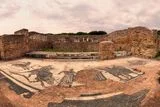
Archaeologists may now have uncovered part of the barracks where those men worked. The building emerged during work to reinforce a historic retaining wall at Villa Celimontana through Italy’s National Recovery and Resilience Plan (PNRR).
Archaeologists have fully excavated five of its eight rooms, while three remain partially preserved. The structure was built during the second century A.D. and reorganized during the third. Researchers believe it could have been used by the Fifth Cohort of the Vigiles, Rome’s night watch and fire brigade, although an aristocratic home remains another possibility.
"Rome continues to amaze us, returning testimonies capable of expanding our knowledge of the ancient city,” said Daniela Porro, special superintendent of Rome, in a translated press release.
Read More: Railway Excavations Uncover a 1,740-Year-Old Coin of Britain's Breakaway Roman Emperor
Roman Firefighter Barracks May Have Emerged at Villa Celimontana
Among the finds was a large mosaic showing a dolphin, fish, lobster, and crab circling a mixing vessel. Archaeologists also uncovered fragments of an earlier Antonine-era mosaic floor, portions of a frescoed ceiling, and panels of opus sectile, a decorative technique using carefully cut pieces of stone or marble.
That level of craftsmanship points to wealth, status, or both. The decoration resembles what a wealthy Roman family might have commissioned for a private home. Yet the marine mosaic closely resembles one previously found in a Vigiles barracks at Ostia, Rome’s ancient port, according to Reuters. Combined with the building’s location near the Fifth Cohort barracks, that similarity has raised the possibility that these rooms belonged to the firefighters instead.
The Vigiles Protected Ancient Rome After Dark
The Vigiles were not conventional soldiers, although they carried short swords and patrolled in organized units. Emperor Augustus created the permanent force in A.D. 6 after a fire, initially recruiting approximately 3,500 freedmen and dividing them into seven cohorts of about 500 men. The force later expanded, with each cohort responsible for two of Rome’s 14 districts, according to Macquarie University.
Many of the earliest Vigiles had previously been enslaved. Their equipment included buckets, sponges, brooms, pumps, hooks, and axes. They could also demolish structures to create firebreaks. Because containing a blaze depended on reaching it early, false alarms were an unavoidable part of the system.
Beyond firefighting, the Vigiles patrolled Rome at night, maintained public order, and warned residents to keep water available in upper rooms.
The Fifth Cohort Finding Could Change the Building’s Story
If the Villa Celimontana building belonged to the Fifth Cohort, the discovery could expand the known boundaries of one of imperial Rome’s major military complexes. Its decoration could also show that at least some spaces connected with the Vigiles were more elaborate than their buckets-and-brooms nickname portrays.
Researchers still need to study the structure, materials, and archaeological context before choosing between the barracks and aristocratic-home interpretations.
"The excavation has yielded a wealth of extraordinarily interesting data, but the most delicate and complex phase begins now,” said Simona Morretta, the excavation's scientific director, in the press release.
If the barracks interpretation holds, the marine mosaic becomes part of their story — a sea-filled floor beneath the feet of men, many once enslaved, who spent their nights listening for the next alarm.
Article Sources
Our writers at Discovermagazine.com use peer-reviewed studies and high-quality sources for our articles, and our editors review for scientific accuracy and editorial standards. Review the sources used below for this article:
- This article references information from Italy’s Ministry of Culture: New archaeological discoveries at Villa Celimontana
- This article references information from Macquarie University Department of Ancient History: The Firefighters of Ancient Rome
- This article references information from Reuters: Ancient Roman firefighters' barracks may have been found near Colosseum