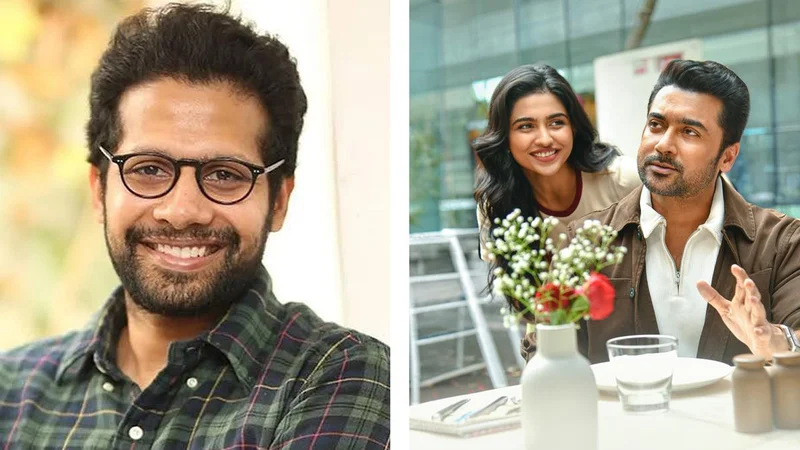
In mid-July, as director Venky Atluri was putting the finishing touches on his upcoming Tamil-Telugu film Vishwanath & Sons, another milestone arrived. The 72nd National Film Awards recognised him with the Best Screenplay (Dialogue Writer) award for his 2024 Telugu film Lucky Baskhar.
When the announcement was made, Venky admitted the news had yet to sink in. Now, as he promotes Vishwanath & Sons, starring Suriya and Mamitha Baiju, he describes the honour as “a validation of my efforts.”
“It also makes me more responsible,” he says. “People will now pay closer attention to how I write and portray my characters.”
Speaking at Sithara Entertainments’ office in Hyderabad, Venky reflects on his writing process, his approach to direction, and why he believes Vishwanath & Sons, which explores an age-gap relationship, will resonate with family audiences, especially Gen Z.
Approach to writing
Before discussing Vishwanath & Sons, which marks Suriya’s return to the romantic drama genre after more than a decade, Venky reflects on what made Lucky Baskhar resonate with audiences. The Dulquer Salmaan-starrer, set against the backdrop of banking fraud, became one of 2024’s biggest Telugu hits.
“One of the most-loved lines from the film is when Baskhar says, at a crucial moment, that if just half an hour of his life hasn’t gone according to plan, he doesn’t want to spend the rest of it trying,” says Venky. “That line was written on the spur of the moment.” Even today, both the scene and the dialogue continue to enjoy strong recall.
Venky was also struck by how movie buffs compiled their favourite dialogues from Lucky Baskhar. Unlike his earlier films — Tholi Prema, Mr Majnu, Rang De and the social drama Sir (Vaathi in Tamil) — he says he did not consciously set out to write memorable one-liners this time.
“My biggest focus was understanding the nuances of financial scams and building Baskhar’s character within that world, along with the family drama,” he says. “In my earlier films, I gave more thought to individual dialogues. In Lucky Baskhar, they emerged naturally from the screenplay.”
Early inspirations
Venky counts legendary filmmakers K Balachander, Bharathiraja, Mani Ratnam and Trivikram Srinivas among his biggest influences. “In the 1970s and ‘80s, cinematic writing was still evolving from theatre and literary adaptations,” he says. “For the first time, I realised that less is more in Mani sir’s films. The conversations were simple, with the focus firmly on human emotions. In Telugu cinema, Trivikram sir moved away from heavy, dialogue-driven writing and embraced simplicity. Nuvvu Naaku Nachav especially made me want to write and direct.”
Venky made his directorial debut with Tholi Prema in 2018. Although he followed it with two more romances before branching into other genres, audiences continued to associate him with love stories. “People kept asking me when I’d make another film like Tholi Prema,” he says. “The first draft of that film was written in 2013. It would be difficult for me to write that kind of romance today. But I had this idea of an age-gap relationship and wanted to tell a more mature love story. I just started writing, one page at a time.”
May-December romances
Vishwanath & Sons stars Suriya as a 40-year-old man and Mamitha Baiju as a 20-year-old woman. “I wondered how their equation would evolve,” says Venky. “How do I portray it without making it seem inappropriate?”
May-December romances are not new to Indian cinema. Apoorva Raagangal, Mudhal Mariyadhai, Lamhe, Nishabd, Cheeni Kum and Dil Chahta Hai have all explored the theme. Venky counts Lamhe among his favourites. “Whenever I explore a genre, I revisit films in that space, not to imitate them, but to understand how certain situations were handled and to ensure I’m bringing something fresh.”
Balancing humour, entertainment and sensitivity, he admits, was the biggest challenge. “It’s complicated to keep a story simple and simple to complicate one,” he says. “I want the drama in my films to connect with everyone, especially Gen Z. They don’t want to be lectured, but I still try to weave in life’s lessons in my own way.”
What Gen Z thinks
Venky was curious to know whether women in their early 20s viewed age gaps as a concern in relationships. “I spoke to several women in that age group and was surprised by how casually they dismissed it,” he says. “It’s a generational shift from how an ‘80s kid like me thinks. For Gen Z, compatibility matters more than age.”
Asked if he had Suriya in mind while writing the script, Venky smiles. “I never keep my hopes high while writing because I still fear rejection. I’ve admired Suriya sir since Kaakha Kaakha and Ghajini, and I’ve always felt he thinks ahead of his time. He believed in this story because it offered a pleasant change after the mass entertainer Karuppu. I’m happy I could bring him back to a breezy family drama after 13 or 14 years.”
Venky credits Suriya for creating a comfortable atmosphere on set and praises Mamitha Baiju for holding her own alongside senior actors like Suriya and Radhika. “The casting worked beautifully, and audiences will see that chemistry on screen.”
He also reunited with much of the Lucky Baskhar technical team, including cinematographer Nimish Ravi and production designer Banglan. “Neither of them had worked on a romance drama before, so this gave them something fresh to explore.”
With Vishwanath & Sons set for a bilingual release on August 14, Venky describes the film as a calculated risk at a time when action entertainers continue to dominate the post-pandemic box office.
“But we’ve also seen clutter-breakers succeed in both Telugu and Tamil cinema recently,” he says. “From a business perspective, we were clear about our budget. We spent what the story demanded and didn’t go overboard just because we had a big star.”
Published - August 08, 2026 07:30 am IST