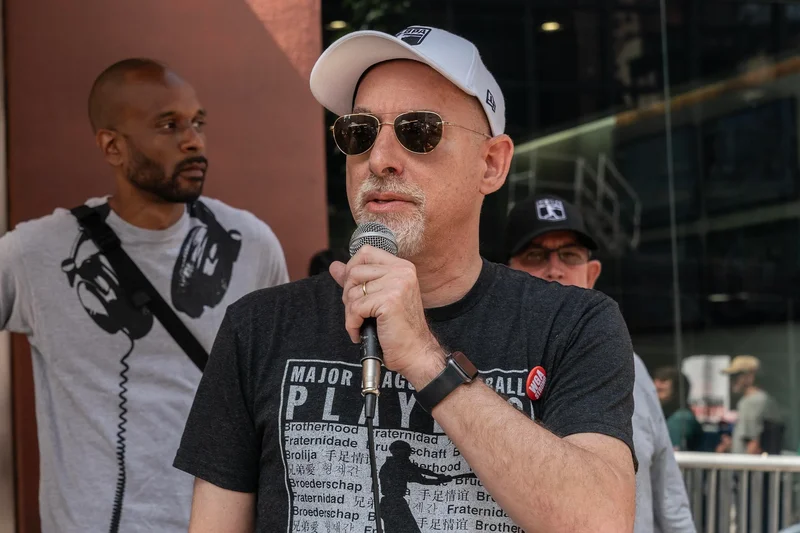
Bruce Meyer, the Interim Executive Director of the Major League Baseball Players Association is the tip of the spear in the union's negotiations with MLB owners. (Photo by Lev Radin/Pacific Press/LightRocket via Getty Images)
Pacific Press/LightRocket via Getty Images
Last week Forbes.com reported on the proposal made by MLB owners to significantly alter the game’s amateur draft, both domestically and internationally. As a reminder, the owners would like to reduce the current Rule 4 draft from 20 rounds to twelve. Just fifteen years ago, there were 50 rounds, which was reduced to 40, and then to 20. MLB also proposed that a player needs to be at least 20 years of age and at least two years out of high school to be draft eligible (said differently, players could no longer be drafted out of high school). Lastly, the owners would like to reduce the available bonus pool from roughly $360 million to $200 million.
Further, the owners brought back the idea of an international draft. As you may recall, this concept gained some traction in the previous CBA negotiation, with the players willing to accept this change if the owners did away with the qualifying offer. When the sides could not agree on the specific parameters, the status quo held.
Earlier this week the Major League Baseball Players Association (MLBPA) responded to the owners with an amateur draft proposal of their own. And they started with some incendiary language, stating that they are “rejecting MLB’s proposals that would demolish the current system by shrinking the draft, slashing benefits by hundreds of millions, and removing all players’ right to negotiate…”
The MLBPA proposed keeping the draft at 20 rounds, which, as stated above, is still a 60% reduction from as late as 2011. They would like to move the draft back to June – where it had been for many years – from its current place in July. The union, echoing the owners’ proposal, would like college players to be eligible for the draft after their sophomore year, rather than the current junior year requirement.
In addition, in order to create more competitive balance, the MLBPA has offered that teams that receive revenue-sharing (i.e., small market teams) can increase their bonus pool by $2 million for one draft over the course of the five-year CBA. And if a revenue-sharing team makes the playoffs, they would get an additional $1 million to spend as part of their draft pool the following season.
In a further attempt to get teams to spend more, the union also seeks to reduce the penalties assessed to teams that go beyond their allotted draft dollars. At present, a team that goes 5-10% over its pool loses a draft pick and pays a fine equal to 75% of the overage. And if a team goes 10-15% over, they lose both a first and second round pick and pay a 100% penalty. The union is fine with the financial aspects, but they do not want the loss of any draft pick(s). It should be noted that, per ESPN, no team has ever gone more than 5% over, but the union wants to add a level of flexibility for the teams to incentivize them to spend more, especially as they compete with colleges and ever-present NIL money.
In a nod to the owners trying to get MLB to look more like the NBA or the NFL, the MLBPA proposed the possibility of trading draft picks in the first ten rounds, something that is not currently allowed. These trades could happen at any time up to two hours before the start of the draft.
It bears mentioning that the players, in their proposal, conspicuously did not make any reference to an international draft.
At this point, the owners and the union are merely sparring, lobbing jabs back and forth without really engaging in true hand-to-hand combat. That most likely will not take place until long after the owners lock out the players in December, and when spring training and regular season games become increasingly at risk. Ultimately, however, the war will not be about the draft, it will be about the salary cap. Buckle up!