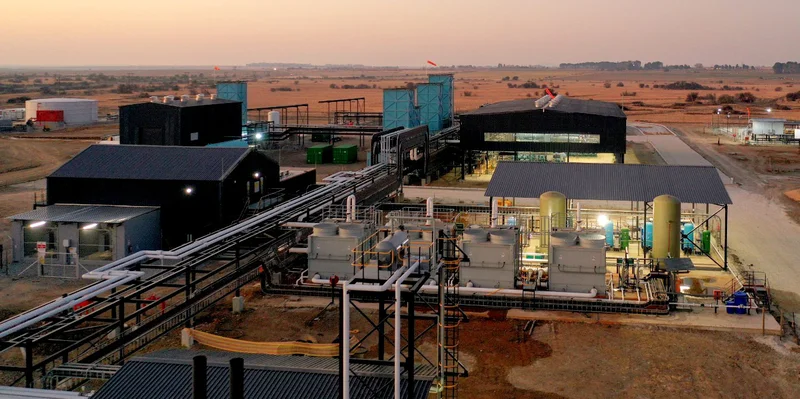
âWhat Renergen lacked, really, was access to capital, and the ability to really scale their workforce to bring this project up to speed,â said ASP Isotopesâ CEO, Paul Mann, in response to questions about the presentation they gave on the Noble Africa investor call â a presentation this writer has seen many times before, but now with updated timelines.
Wait, youâre probably wondering what Noble Africa isâ¦
On 25 June, ASP Isotopes announced that its wholly owned subsidiary, Noble Africa LLC (the intermediate holding company for Renergen Limited), will merge with a subsidiary of Endra Life Sciences. The transaction is structured to establish a pure-play, Nasdaq-listed helium and liquefied natural gas (LNG) platform trading under the ticker symbol âNOBAâ.
The move positions Renergenâs Virginia Gas Project as a dedicated, publicly traded entity â a timely transition given the growing demand for secure helium supplies in critical industries.
Blessings from above
The complex share swap completed in January served a key purpose: securing Renergenâs core asset, a 94.5% equity stake in Tetra4 â holder of South Africaâs sole onshore petroleum production right.
The project (a section of the Vredefort Dome meteor impact site) contains high-purity natural gas and is one of the richest helium concentrations in the world, averaging more than 3% helium and reaching up to 12% in recorded tests.
By comparison, typical conventional natural gas reservoirs globally contain helium in concentrations below 0.5% (currently constrained supplier Qatar averages 0.05%, Russia 0.06%, and the US 0.35%).
âSo, weâre seeing helium concentrations 10 times what we see elsewhere in the world,â Mann gloated.
âAnd that means as the helium market grows and the market needs more supply, weâre likely the lowest levelised cost and incremental production volume in the world, and that makes us a very unique asset and that we can bring new capacity on faster and cheaper than anyone else can.â
ASP Isotopes, by Mannâs account, first started checking under Renergenâs bonnet about four years ago. When the delays on the helium delivery started running into the payment deadlines on the companyâs loan agreements, ASPI came to the rescue with a refundable exclusivity fee of $10-million to Renergen under their initial exclusivity agreement to secure, erm ⦠exclusive negotiation rights back in April 2025.
A month later, when negotiating the final terms of the acquisition, the parties entered into a $30-million bridge loan agreement (referred to in the annual reporting as the Renergen Loan) to help Renergen fund its ongoing operations.
Under the bridge
In terms of the bridge loan agreement, the full $10-million exclusivity fee was applied to the principal and credited as the first advance under this new loan. The remaining $20-million was paid in subsequent tranches in June 2025, bringing the total outstanding advance to $30-million.
In August 2019, Tetra4 entered into a $40-million financing agreement with the US International Development Finance Corporation (DFC), as successor to the Overseas Private Investment Corporation.
The facility was fully drawn down in three tranches between September 2019 and September 2021, and Tetra4 must repay the loan in equal quarterly instalments of $1.1-million on payment dates ending on 15 August 2031.
Then, on 20 December 2021, Tetra4 secured a R160.7-million loan from the Industrial Development Corporation of South Africa (IDC) to fund the procurement of virtual pipeline and dispensing equipment â which is repayable in 102 equal monthly instalments, starting in July 2023. The terms included a 12-month interest capitalisation period and an 18-month capital repayment moratorium.
Daily Maverick asked what the difference is now with regard to Phase 1 delivery and Phase 2 expansion because, to get to this point, Renergen obtained a R155-million secured loan from Standard Bank on 30 August 2024 (it was amended and restated on 12 December 2025) to fund working capital and Phase 1 expansion.
A twist in the debtor tale
There is also the matter of the R50-million loan agreement with Molopo from April 2014. The loan was unsecured and interest-free for a 10-year term ending on 31 August 2024. Because it was not repaid, it now accrues interest of prime plus 2%.
Under the agreement, the loan can only be repaid using a maximum of 36% of Tetra4âs distributable profits. Since no distributable profits are projected in the short term, the loan is classified as a non-current liability.
In November 2024, Molopo launched legal proceedings against Tetra4 in the Gauteng High Court, with the summons alleging that Renergen breached the loan agreement when it sold a 5.5% equity stake in Tetra4 to Mahlako Gas Energy (MGE) in 2023. Molopo wants to cancel the loan agreement and demand immediate repayment.
Tetra4 built its defence on the grounds that the MGE deal was a share subscription that did not constitute a payment by Tetra4 to Renergen. But due to court backlogs, the earliest estimated hearing date for this lawsuit is December 2030.
The nitty-gritty
And hereâs where the Noble Africa spin-out makes sense. There are no pure-play helium companies currently close to commercial scale globally. High-margin, long-term (10- to 15-year) take-or-pay helium contracts with aerospace and semiconductor giants represent a highly stable, easily valued business model.
The spin-out allows ASPI to leverage Endraâs exceptionally clean corporate structure (no debt, minimal employees, no legacy liabilities) as an accelerated public listing vehicle.
The merger is linked to a concurrent private placement securing $50-million in gross proceeds ($20-million from ASPI as the lead investor, and $30-million from institutional investors and directors) to fund the $1.16-billion Phase 2 expansion at the Virginia Gas Project.
ASPI will retain an 89% majority ownership in the combined NOBA entity. And because the asset is expected to produce significant free cash flow when it reaches full capacity, ASPI will not distribute Noble shares directly to its stockholders; instead, they will get exposure via ASPIâs equity control.
âThe capital constraints have certainly impacted the ability to deliver,â Noble Africa and former Renergen COO Nick Mitchell explained when Mann passed the question baton to him.
âBut I think thatâs been resolved and, you know, weâre now looking forward to embarking and delivering on the commitments for shareholdersâ benefit.â
Renergenâs helium dreams are coming true, with a little LNG on the side to keep Gwede Mantashe happy. DM