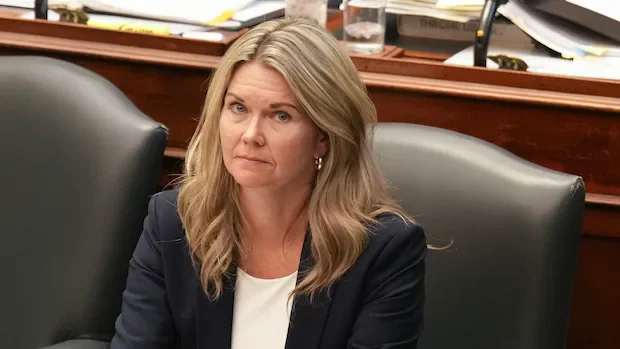
Ontario Emergency Preparedness Minister Jill Dunlop defended the province's wildfire response on CBC Radio on Tuesday, but her staff abruptly cut the interview short after she was asked to respond to criticism from community leaders.
With wildfires burning across much of northwestern Ontario, Dunlop's office is responsible for co-ordinating emergency evacuations, shelter and wraparound services for people fleeing the flames.
Several community leaders, including First Nations chiefs, have criticized the province's emergency response as slow, disorganized and unco-ordinated.
When As It Happens host Nil Köksal raised those concerns with Dunlop, the minister said her department has had "co-ordination calls every day with the communities to ensure that we're working hand-in-hand and that they have the most up-to-date information."
But immediately after Dunlop answered the question, one of the minister's staff members interrupted the call, saying it was time to "wrap it up."
LISTEN \| Interview with Emergency Preparedness Minister Jill Dunlop:
As It Happens7:26Ontario's emergency preparedness minister defends wildfire response in interview cut short
Ontario Emergency Preparedness Minister Jill Dunlop defended the province's wildfire response during an interview with As It Happens host Nil Köksal, but her staff abruptly cut the interview short after she was asked to respond to criticism from community leaders.
"We still have a few more questions," Köksal said, asking for three more minutes to complete the interview.
"Um, no," the staffer said.
"Why would the minister not want to answer the questions of her constituents?" Köksal asked.
"She has," the staffer said, before hanging up.
CBC News reached out to the minister's office to ask why the interview ended early and to give Dunlop an opportunity to respond to unanswered questions, but did not receive a response before deadline.
'Too many delays and too many gaps'
As of Wednesday, there were 146 active wildfires burning in Ontario, and 2,415 people had been evacuated from 13 communities.
The communities of Namaygoosisagagun First Nation and Whitewater Lake First Nation have been completely destroyed. First Nations chiefs in Ontario have called for a public inquiry into the wildfire response.
Chief Alvin Fiddler is grand chief of Nishnawbe Aski Nation, which represents Whitewater Lake. He spoke to As It Happens on Monday about how the fires have impacted his people.
"There's been too many delays and too many gaps in the response," Fiddler said, singling out Dunlop specifically.
Grand Chief Alvin Fiddler of Nishnawbe Aski Nation reacts as Chief Pauline Drake of Whitewater First Nation recounts her community's evacuation. (Chris Young/The Canadian Press)
Lawrence Wanakamik, chief of the recently evacuated Whitesand First Nation, told the program last week that community members have not been getting timely information from the province about the status of the fires or efforts to fight them.
"They are getting anxious, worried and some of them are getting a little bit angry," he said.
When asked how she responded to frustrations expressed by Fiddler and other community leaders, Dunlop noted there are two provincial departments responding to the fires, and she can only answer for her own.
"There's the Ministry of Natural Resources, who is dealing directly with fires, there's the Ministry of Emergency Preparedness and Response, and we're dealing with the evacuations," she said.
Emily McLaughlin, a spokesperson for Natural Resources Minister Mike Harris, says the department "meets year-round with Indigenous communities on wildfire preparedness planning."
"We are in constant contact with First Nations communities and have taken action to improve co-ordination this fire season, including requesting assistance from the federal government, to speed up evacuations and supports," she said in an emailed statement.
"We will continue to support evacuations of communities impacted by the wildland fires while deploying all available supports and resources needed, as quickly as possible."
'We were not prepared'
On Friday, the province announced it will spend $650 million on five new helicopters and six new water bombers .
But Wanakamik said that is "a little too late for that."
"The climate change has been getting worse over the years," he said. "The governments should have actually been on those things."
This year’s budget shows the province spent $271 million on emergency firefighting in 2025-26, but plans to spend $150 million in 2026-27.
However, the province has said it will access a contingency fund to cover any costs beyond what is budgeted.
"Our government will not spare a single penny to protect Ontario communities and keep people safe," McLaughlin said.
WATCH \| Opposition calls out Ford government over wildfire response:
Is the Ford government doing enough to fight wildfires? Opposition says no.
Premier Doug Ford has pledged that the province will spend whatever is necessary to combat the fires, but opposition parties argue Ontario was not adequately prepared for this year's wildfire season. CBC's Shawn Jeffords breaks down what we know.
Sharon Bak, a former field officer with Emergency Management Ontario, said the province has had decades to get its ducks in a row but has failed to do so.
She now works as a volunteer community emergency management co-ordinator for the unincorporated municipality of Pass Lake.
In an interview with As It Happens last week, she raised concerns about a lack of emergency planning for unincorporated communities, noting that work has largely been done by volunteers with no funding.
"I'm doing it off the side of my desk as a freebie to my community because I love my community. I grew up there. I want it to be safe," she said. "I'm angry. I'm upset."
Harris' office did not specifically respond to questions from CBC News about emergency response in unincorporated communities.
At a press conference on Thursday, Harris said: "We really encourage all communities, especially in the North, to have emergency management plans and work with us."
Fiddler said First Nations have been trying to do just that.
"We had a similar severe fire emergency situation back in 2021, and we had created a plan and a proposal for First Nations to have more ownership of emergency management in our territory," he said.
"I hand-delivered that package to Premier Doug Ford. He took my proposal, but there's been zero response. And that was five years ago."