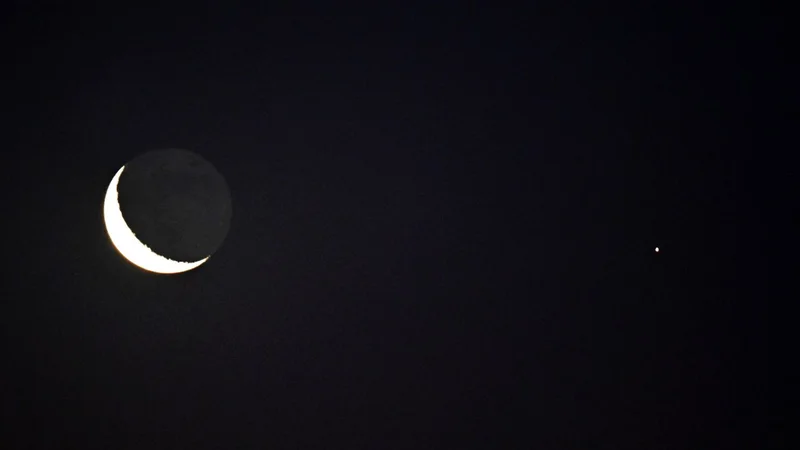
Early risers will catch a spectacular sight in the predawn hours of Aug. 9, as the slender crescent moon shines close to the red light of Mars among the stars of the constellation Taurus.
The 17%-lit crescent moon will rise around four hours before sunrise, or shortly after 2 a.m. for viewers in New York. The Red Planet will be visible as a steady crimson light less than 5 degrees to the lower right of the moon — close enough to share the field of view of a pair of 10x50 binoculars.
Both Mars and the moon will appear to race one another over the eastern horizon in the hours that follow, with the Red Planet gaining a slight lead over its competitor as dawn breaks.
The stars of the constellation Orion will glitter to the right of the pair throughout the race, while the Bull of Taurus watches on from above and Gemini watches from below, giving us a sneak peak at the starscape that will shine high overhead in the long winter nights a few months from now.
Want to get a closer look at the moon? For around $50 you can grab these beginner binoculars for better views of craters and seas on the lunar surface. 10x is enough for a closer look without worrying about excessive shakes during handheld observation.
_
Look out for the subtle glow of earthshine illuminating the night side of the moon on Aug. 9, as sunlight scattered off our planet's surface and atmosphere reflects onto the nearby lunar disk, revealing the ghostly outlines of its dark lunar seas.
It's one of the last chances we'll get to gaze at Earth's satellite ahead of its new moon phase on Aug. 12, when it will cross the face of the sun in the daytime sky to trigger a spectacular total solar eclipse, which will be visible across parts of Greenland, Iceland and Spain.
Be sure to read our explainer article to discover everything you need to know about the Aug. 12 total solar eclipse. We'll also be bringing you live reports of totality as the moon's shadow sweeps over Greenland, where skywatching editor Daisy Dobrijevic will be watching from the deck of a HX Expeditions cruise ship. Skywatching writer Anthony Wood will also be observing from central Spain, where he's embedded with a group of citizen scientists from the Dynamic Eclipse Broadcast initiative.
Editor's Note: *If you would like to share your astrophotography with Space.com's readers, then please send your photo(s), comments, and your name and location to spacephotos@space.com. *
Anthony Wood joined Space.com in April 2025 after contributing articles to outlets including IGN, New Atlas and Gizmodo. He has a passion for the night sky, science, Hideo Kojima, and human space exploration, and can’t wait for the day when astronauts once again set foot on the moon.