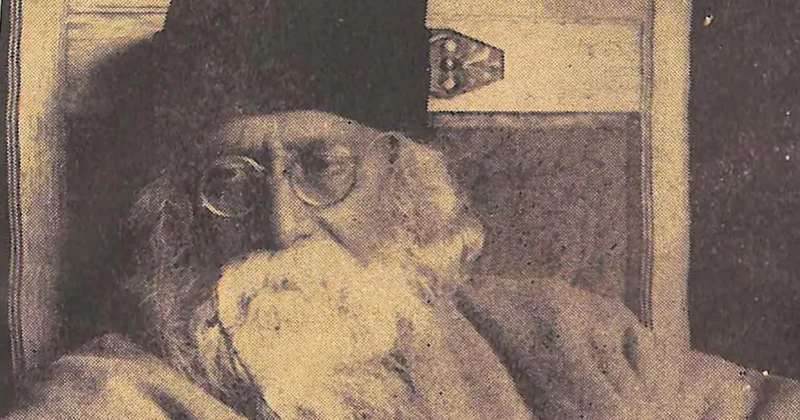
It is Baishe Srabon again, the date on the Bengali calendar when Rabindranath Tagore passed away at the age of 80. On that August day in 1941, the monsoon skies had opened up, yet thousands of people turned up to pay their last respects to Bengal’s greatest creative artist and humanist. Then, the crowd swelled into a mob, and the final procession turned into a grotesque affair. There were stories of a virtual stampede, and people – no one was sure who they were – wild with grief started pulling at the poet’s hair. The result was that Tagore’s own family and loved ones were pushed out. A Tagore worshipper on my mother’s side of the family was amongst the crowd. Determined to offer a pranam, he reached out for the great man’s feet but ended up with a tuft of his silver hair in his palm. Terrified and ashamed, he quickly got away, but most of the crowd carried on lustily.
Tagore’s last journey was, somehow, a culmination of what he had faced throughout his life, admittedly to a lesser degree. The Bard of Bengal had been composing and writing since his early youth. He had no dearth of admirers, but the mass adulation and worship from generations of Bengalis only came after his passing. In his lifetime, he was openly attacked and abused by the press, writers and notables in Bengal society. His patriotism was questioned by hyper-nationalists and his privilege ridiculed by the progressive. The West discovered him and his Geetanjali with much fanfare, thanks to artist William Rothenstein, who introduced him to literary London in 1912. The Nobel Prize followed, but, even before the excitement died down, Tagore was shabbily cast aside.
A new edition of Rabindranath Tagore: The Myriad-Minded Man by Krishna Dutta and Andrew Robinson includes many fraught episodes of the poet’s life, along with his numerous triumphs, both as an artist and a thinker. Tagore emerges from this biography more human and fragile for those who have not had the chance to read him: ultimately a sort of tragic hero, standing tall amongst his people, grief-stricken, broken and misunderstood.
Instead of drawing from his vast worldview of universality and plurality, a large section of Bengalis chose to embrace a provincial and hidebound path, while putting Tagore away on an “Olympian pedestal”. What could be more heartbreaking?
We see here an exceptionally gifted man who could have remained wrapped up in his creativity, enjoying the enormous fame and glory it brought him. Instead, he is fired by the transformational powers of meaningful, modern education. Spurred on by the idea of building a model educational institution in Santiniketan, he spends the rest of his life trying to keep his beloved Visva-Bharati University afloat.
To raise funds for his project, Tagore goes out into the world, relentlessly taking on paid lectures, wooing private donors for rich endowments, soliciting support from governments of every shade and ideology, even appearing in Indian advertisements. He goes against his grain, torn in his mind, only for his labour of love. He is, meanwhile, wounded by his Bengali brethren. He finds Gandhi’s friendship, but must differ from the Mahatma’s brand of nationalism – they proceed to have an open spat (on the symbolism of the charkha and their ideas of education), which leaves its mark on him. Amidst all this, he is visited by one personal grief after another.
Boyhood
The sections on Tagore’s growing-up years are drawn from his own writings, My Boyhood Days and My Reminiscences – the backdrop, Bengal's cultural and social context, is embellished by Nirad C Choudhuri’s prose. We see the child Rabi isolated from his parents, growing up among the domestic help in their massive Jorasanko mansion (built by his grandfather Dwarkanath, a wealthy zamindar and a British trading agent, whom Tagore avoided mentioning). The boy’s imagination and inner world expand as he spends many hours, “dawdling in the wide varandah”. The youngest of Debendranath and Sharada Debi’s 13 surviving children, Rabi craves love and attention. His strongest memory of the time is the dull company of his tutors (he was home-schooled).
His brother Jyotirindranath, an artist and musician, looks out for him, and his wife Kadambari, almost Rabi’s age, becomes his close friend and muse. She is well-read, sensitive and romantic, and as the first reader of his early poetry, the “deepest female influence on Rabindranath’s youth”. Kadambari, in fact, is the inspiration for the figure of Charulata, whom Satyajit Ray presented in his exquisite film.
As a young adolescent, Rabi travels widely, to their estates in Shelaidah and the hills of Dalhousie with his father. Then at the age of 17, he sails to England. His brother Satyendranath, India’s first ICS officer, is stationed in London with his wife Jnanadanandini Devi, a feminist icon among Bengali women. Rabi lives for several months between their home, boarding houses and as a paying guest. He is exposed to English society, turns up at dance parties, and hears fashionable Victorian songs, which inspire many of his own tunes. His exploration of literary England and its culture also begins.
Alone amidst white people, especially young women whom he shyly approached at some parties, he feels isolated and invisible. This is his first experience of racist England, and the contempt and prejudice leave him stunned. But he lives the life of a privileged brown Indian boy in Blighty. He goes to school in Brighton briefly, and does not like it. So he returns to London, where he enrols at University College. He now lives close by in Bloomsbury, where his experience of England improves somewhat. Until now he has found it cold and unfriendly, but the handsome young man finds he is appealing to women: the two attractive daughters of his host are obviously in love with him, he writes to his friend.
Back in Bombay, when he goes to stay with his brother’s friend, Rabi is immediately drawn to his daughter, the England-returned, sophisticated Anapurna “Ana” Turkhud who responds to him strongly. However, what transpires between them remains private. Debendranath possibly rejected the marriage proposal from Ana’s father, and Rabi is hastily married to the child bride Bhabatarini (“a name old-fashioned even in 1883”), a daughter of an employee of the Tagores, plain and unlettered. She is renamed Mrinalini afterwards. Rabi agrees to the proposal without meeting the girl. His “Mejo-bouthan” Kadambari, with whom he has been intimate, is heartbroken and dies by suicide soon after. This is hushed up by the powerful Tagores, but leaves Rabi shattered.
It is the beginning of Rabindranath’s lifelong encounters with grief. His parents have already passed away. And now there is a virtual march of death in the family – his wife Mrinalini and their children Renuka, Bela and Shami all die young, leaving him devastated.
Writing Tagore
The biographers bring alive the tragedy of being Rabindranath, both in his personal and public life – but they do it with wit and elegance, without a hint of sentimentality. The collaboration between a Bengali writer who lives and works in the UK (Dutta) and a Westerner (Robinson), curious about India and Indians, has given this work a quality that, in hindsight, makes it a success. Dutta’s familiarity with Tagore’s primary language and the world he inhabited complements Robinson’s approach. He meets his co-biographer more than halfway, demonstrating mastery over the craft of building a credible, unbiased and gripping story. The prose is always full of colour and character.
A seasoned biographer, with an oeuvre that includes the life of Albert Einstein, Robinson first came to India as a student. After graduating from Oxford University, he developed an interest in Satyajit Ray’s cinema and started work on him. He later segued into Tagore while researching his Ray biography The Inner Eye, which is widely acclaimed. In comparison, the first edition of this Tagore book had a quiet release. This also suggests, among other things, the waning interest in Rabindranath. At a time when Shakespeare, and more recently Homer, are alive in the imagination of writers and creators, how did we lose Tagore beyond Bengal? This brings us to the relevance of Tagore – and of the book – for a critical 21st century mind.
Nirad C Chaudhuri has written of Tagore: “Historically, the greatest product of the interaction of India in the nineteenth century between European and Hindu life and civilisation … In one sense he may be regarded as the victim of the interchange, and in another as its prophet. His own life was caught in the conflict which the interchange brought about, and his writings stand for its achievement.” Writer Anita Desai quotes Chaudhuri in her deservedly glowing foreword to this new edition (which also features a self-portrait of Tagore as the new cover). Dutta and Robinson set out to focus on the man rather than his oeuvre, and the book felicitously delivers on this promise, with Tagore emerging as both victim and prophet.
But what makes the book interesting for contemporary readers is the biographer-duo’s critical eye and balance. Some episodes and insights on Tagore are true revelations and/or reminders for even those familiar with him. Prashanta Kumar Pal, Tagore’s Bengali biographer, whose work followed the earlier biographies by Edward Thompson and Krishna Kripalani (who was married to Nandita, Tagore’s granddaughter), gifted readers the most comprehensive account of Rabindranath’s extraordinary life in nine fat volumes (the last one is forthcoming) of Rabijiboni. But this English version uses a 21st-century lens for the new reader, which makes it important and widely readable.
Dutta and Robinson hail Tagore for his monumental achievements, detailing them with their own excellent translations, yet they remain frank in their criticism. We see certain contradictions within Tagore that seem almost unbelievable. This is because many of us have grown up convinced, given his prodigious talent and output, that Tagore was above all criticism. Yet, a good biography must uncover the whole truth about its protagonist, which this one does. And so we see Tagore here as an “inextricable mixture of humility and vanity”…with the authors’ insightful conclusion that “those who did not know him personally…tended either to worship or debunk”.
Of course the man had his share of blind spots, delusions, poor judgment, and an almost chronic sensitivity towards criticism. This is not only normal, but at times inevitable for people who become larger than life. There is one example, though, for which there is no excuse: the child marriages of his daughters Bela and Renuka. This was at a time when wealthy Brahmo families felt no social obligation to marry off their underage wards. Tagore’s beloved niece Indira, who documented her own experiences with him, was married at 26. Moreover, the poet-thinker was vocal in his criticism of early marriage and the joint family system, among many other 19th-century social customs. Yet not only did he let his own daughters down, he also made himself believe that his girls were “contented” in their marital homes. The biographers call this “a monumental piece of self-delusion” at best and “rank hypocrisy” at worst.
The racist West
Tagore’s encounters in the West, and his one-time fame beyond India, come alive vividly and comprehensively, thanks to the book’s impeccable research. It goes well beyond Tagore’s own versions, tapping well-documented sources: newspaper reports, Edward Thompson’s writing, diary entries and letters from an entire cast of characters Tagore got to know and formed friendships with in Europe and America. This list includes WB Yeats, Ezra Pound, Romain Rolland, Bertrand Russell, Nicholas Roerich, and many others.
The stunning racism of Westerners, mercilessly documented, is hardly surprising. The most celebrated instance features Yeats, who, ironically, was initially ecstatic in his praise of Geetanjali, was hands-on refining its translation and decided to champion Tagore. But he was soon put off by the quality of Tagore’s English and his attempts to labour too much in that language.
Yeats not only wrote to Macmillan asking them to disregard Tagore’s works beyond what they had already published, he was also damning and sharply racist in his vocabulary. In his letter to Rothenstein, he wrote, “Damn Tagore. We got out three good books…and then, because he thought it more important to see and know English than to be a great poet, he brought out sentimental rubbish and wrecked his reputation. Tagore does not know English, no Indian knows English. Nobody can write with music and style in a language not learned in childhood and ever since the language of his thought.”
Yet Tagore was treated as a European (after the Nobel Prize there was a time when letters reached him in England even if the envelope only bore his name) even as he was also considered a representative of mystic India, the authors write. In the midst of all the fuss over him, George Bernard Shaw “Europeanized” him, joking to Rothenstein’s wife in 1913: “Old Bluebeard, how many wives has he got, I wonder!” The flowing beard and robes immediately stereotyped him as “some sort of precursor of Bhagwan Shree Rajneesh.” In 1956, years after Tagore’s passing, the poet Philip Larkin wrote to a friend: “…an Indian has written to ask what I think of Rabindrum Tagore: feel like sending him a telegram ‘FUCK ALL LARKIN’.”
Tagore sensed this antagonism and profiling, but he persisted. The accounts of his breathless lecturing and non-stop travels for funds leave you exhausted. Tagore himself returned home exhausted and disappointed, craving time in Santiniketan (and rarely Calcutta), but then he went back again and again, only for Visva Bharati’s future. He also willingly engaged with ultra-nationalist dictators, whose beliefs he loathed. The government, in each instance (Peru and Italy), tried to use Tagore “as a pawn in its own scheme”.
Mussolini agreed to support Tagore, and, blindly encouraged by this, Tagore blundered by meeting him and showering high praise on him in the fascist media. This naturally came under massive fire from the press and liberal Indians. He was later anguished and embarrassed by his visit to Italy.
Tagore also travelled to China, Japan and the Far East, which led to many confluences in arts and culture between India and those people. In Japan, he met the ultra-right Samurai Toyama Mitsuru.
Tagore’s name
However, these stories do not define Tagore as the global thinker and prophet that he was. There are often moving passages where he finds real friendship and kindness. Victoria Ocampo, the aristocratic Argentine woman, was a dear friend who went out of her way to help the poet. Tagore also formed a relationship of mutual trust and respect with Helen Keller. Young Westerners CF Andrews, Leonard Elmhirst, and Giuseppe Tucci were inspired to travel to Santiniketan and help Tagore with building Visva-Bharati.
There are three memorable stories about Tagore’s “one-time-fame” in the West that I am compelled to share. The first is a letter Tagore received from a lady in 1920 about her young poet son, who had gone off to the war earlier. In his last letter from the trenches, the youngster had scribbled Tagore’s line: “When I go from hence, let this be my parting word”. The poet was Wilfred Owen, who died in the First World War.
The second was that of a gravely wounded Indian soldier from the British regiment in the First World War, taken prisoner by German soldiers. Only an amputation of his leg could save his life, but he was so traumatised and frenzied about brutal enemy treatment that he would not give his consent. This is when the surgeon whispered, in his ears, Tagore’s name. The surgeon’s friend shared this story during Tagore’s centenary in 1961: “After he had said it three times the Indian seemed to understand. His face relaxed, a shy little smile came into his eyes, then he closed them, his fear was gone, and he nodded weakly his consent and confidence to the enemy doctors.”
The last one is from the Second World War, which unfolded in the Warsaw Ghetto, in an orphanage headed by the writer and educator Janusz Korczak. Korczak refused to abandon “his” children, even though his friends made several pleas for him to get away. “On 15 July 1942 he produced his last play with them, ignoring SS orders forbidding Jews to perform works by Aryan authors. It was The Post Office, Tagore’s famous play. The central character from Dakghar (the original), Amal, is dying, and is confined by his doctor to postpone the inevitable. He is made to believe that a king will visit him and grant his dearest wish. After the performance, Korczak was asked why he chose The Post Office. “…eventually one had to learn to accept serenely the angel of death,” he answered. In August 1942, Korczak and the children were taken to a gas chamber in Treblinka and murdered.
Tagore’s thinking on education, nationalism and the environment is extremely relevant in India’s context. His essays, containing these and other important ideas, are written in his magnificent, moving prose. These are explored in the later chapters. Reading Tagore’s life only makes you want to return to the originals throughout the process. There is rarely an area of human experience, ideas or emotion that he does not touch upon in his poems, short stories, novels, essays and art. Currently, there are excellent English translations of Tagore’s text available both by Westerners and Indians that could be of interest to readers.
When Tagore was given a DLitt by Oxford University, just a year before his passing in Santiniketan, the citation described him as “myriad-minded”. Given the vast expanses touched by Tagore in his writing, the deep philosophical terrains of his mind, and the magnitude of his ideas, the title of this book is spot on. Tagore’s long and eventful life is captured in excellent prose within its 494 pages, with extensive notes, a strong bibliography and an index. This book is an achievement.
Rabindranath Tagore: The Myriad-Minded Man, Krishna Dutta and Andrew Robinson, Rupa Publications
We welcome your comments at letters@scroll.in.