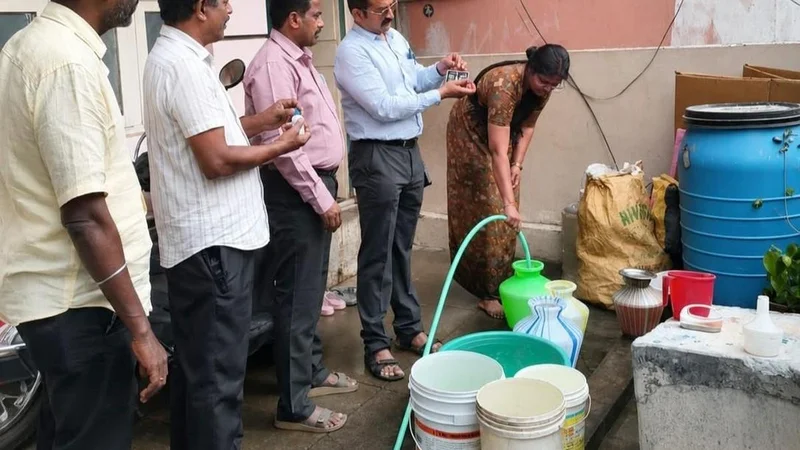
Coimbatore Corporation officials inspected drinking water sources and supply points across the city on Saturday (August 8) to verify residual chlorine levels as part of a State-wide chlorination campaign aimed at ensuring safe drinking water and preventing water-borne diseases.
The campaign was conducted on the directions of the Directorate of Public Health and Preventive Medicine, in coordination with local bodies. Health officials and local body personnel were instructed to ensure chlorination of all public drinking water sources and verify residual chlorine levels after treatment.
The State Health Department has instructed officials to ensure residual chlorine levels of 0.2 to 0.5 parts per million (ppm) in water samples after chlorination. Wherever the required level is not achieved, the local body concerned has been directed to take immediate corrective measures and conduct a re-test.
Corporation officials inspected various overhead water tanks and points where drinking water was supplied to households.
The officials said water supplied from the Siruvani and Pilloor water treatment plants was chlorinated at the source. The Corporation monitored residual chlorine levels at overhead tanks and in the distribution network, maintaining 2–3 ppm at the overhead tanks and at least 0.1 ppm at the tail-end points
The Corporation currently receives 362.67 million litres a day (MLD) of drinking water from six sources — Siruvani, Pilloor-I, Pilloor-II, Pilloor-III, Aliyar and Bhavani — against the city’s assessed requirement of 308.89 MLD. The average supply is 158.51 litres per capita per day.
Siruvani supplies 63.87 MLD, Pilloor-I 4.28 MLD, Pilloor-II 110.50 MLD and Pilloor-III 157.91 MLD. The Bhavani source supplies 20.56 MLD to areas including Kavundampalayam and Vadavalli, while 5.55 MLD is sourced from Aliyar.
The Corporation has 215 overhead water tanks and 3,638 km of distribution pipelines serving 3,27,397 drinking water connections.
The State Health Department has also directed Health Inspectors to maintain records of the water sources covered, the date and time of chlorination, quantity of chlorine used and residual chlorine levels recorded. District Health Officers have been asked to ensure 100% coverage of identified drinking water sources and submit district-wise reports on the campaign.
Published - August 08, 2026 07:50 pm IST