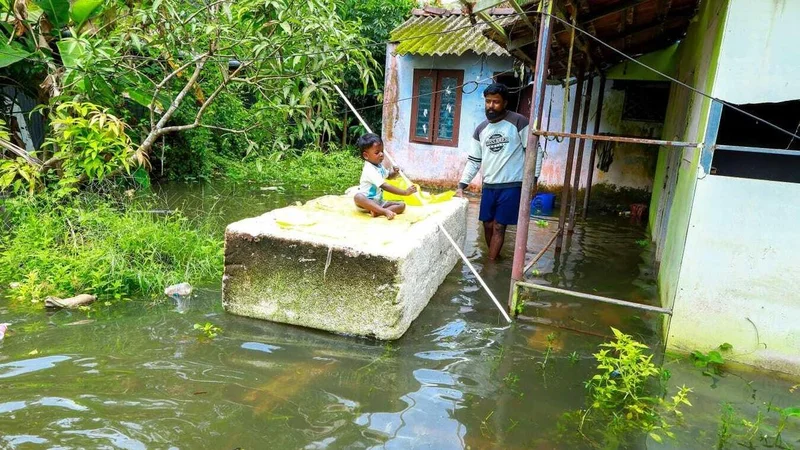
As Kuttanad continues to reel under floodwaters, a political controversy has erupted over the preparedness of the low lying region to handle the massive runoff through its rivers, with the Thottappally spillway emerging as a major flashpoint.
The controversy came to a head on Saturday when a ministerial team comprising Excise Minister M. Liju and Agriculture Minister T. Siddique visited the flood ravaged region along with Alappuzha MP K.C. Venugopal. Protests were staged over the alleged delay in clearing waste accumulated near the spillway.
Though 39 of the 40 shutters remain open, the Communist Party of India (Marxist) [CPI(M)] and other critics allege that the delay in removing the sandbar and debris is hampering the discharge of floodwaters into the sea. Democratic Youth Federation of India (DYFI) activists staged a protest on the National Highway, accusing the United Democratic Front (UDF) government of delaying the removal of the accumulated waste. Police forcibly removed the protesters from the road.
Responding to the criticism, Mr. Liju said records with the Harbour Engineering department showed that dredging of the leading channel and the spillway had been carried out for eight years.
“The records show that these works have been going on since 2018. But what impact they have actually made needs to be investigated,” he said.
MLA dismisses criticism
Alappuzha MLA G. Sudhakaran, however, dismissed the criticism as an attempt by vested interests to create the impression that Thottappally was facing a crisis. He said water was flowing rapidly into the sea, with the mouth of the estuary widening to more than 100 metres.
“Waste and other debris carried down the Pampa are being cleared from the eastern side and moved towards the western side before being flushed into the sea. To avoid disrupting traffic, this work is carried out every night. The District Collector and Irrigation department officials have been working round the clock,” he said in a social media post.
Mr. Sudhakaran, however, pointed to another possible bottleneck, saying more than 16 structures along the National Highway 66 on the western side of the spillway were impeding the smooth flow of water into the sea.
The political sparring comes against the backdrop of substantial flood damage across the district. Preliminary government assessments put the loss over the past week at ₹55.64 crore. The Local Self-Government department accounts for ₹30.34 crore while the Agriculture department has estimated crop losses at ₹20.4 crore, with 1,515.15 hectares of cultivated land affected.
The human cost too has continued to unfold even after the rain eased. Families have been moving into relief camps as floodwaters remain in paddy fields in Champakulam, Nedumudi and Kainakary panchayats. Those living on field bunds and small elevated settlements have been forced to evacuate, while others have left because they can no longer cook at home.
Several families from other States living in rented houses and rooms across Kuttanad have also been affected.
AC road issue
The Thottappally controversy has been accompanied by another debate over flood preparedness, this time centred on the recently rebuilt Alappuzha Changanassery (AC) road.
The 24 km-road, reconstructed at a cost of more than ₹750 crore after the devastating 2018 floods, became unserviceable at the beginning of the flood season. It has remained submerged for days after floodwaters overflowed from the AC Canal, disrupting a crucial central Kerala corridor used by thousands travelling between Alappuzha and Kottayam, Pathanamthitta, Kollam and Kochi.
The road was rebuilt as a semi elevated corridor after the 2018 floods disrupted traffic for more than a month and severed connectivity between the central districts and Alappuzha and Kochi. The project, awarded to the Uralungal Labour Contract Cooperative Society and supervised by the Kerala State Transport Project, included five flyovers, four major bridges, 14 minor bridges and three causeways.
Its latest flooding has revived allegations that the reconstruction did not adequately account for Kuttanad’s vulnerability to flooding. Waterlogging at Poovam, Kidangara and Manaykkachira, where there are no flyovers, has intensified those questions.
Officials, however, attribute the flooding primarily to a blockage in the AC Canal.
Published - August 08, 2026 08:01 pm IST