Your support helps us to tell the story
From reproductive rights to climate change to Big Tech, The Independent is on the ground when the story is developing. Whether it's investigating the financials of Elon Musk's pro-Trump PAC or producing our latest documentary, 'The A Word', which shines a light on the American women fighting for reproductive rights, we know how important it is to parse out the facts from the messaging.
At such a critical moment in US history, we need reporters on the ground. Your donation allows us to keep sending journalists to speak to both sides of the story.
The Independent is trusted by Americans across the entire political spectrum. And unlike many other quality news outlets, we choose not to lock Americans out of our reporting and analysis with paywalls. We believe quality journalism should be available to everyone, paid for by those who can afford it.
Your support makes all the difference.
Read more
Recently, as hundreds of fires burned across Northern Ontario and smoke pushed Toronto’s air quality to among the worst on the planet, Canada’s minister of emergency management defended Ottawa’s response and said, in effect, that nothing went wrong.
In the same news cycle, Ontario’s minister of emergency preparedness sent a letter asking the federal government to guarantee that aircraft and crews could be deployed on less than 24 hours’ notice. However, a request for pre-agreed 24-hour readiness is, by definition, evidence that such readiness does not currently exist. You don’t ask for something you already have.
In early June, I wrote in The Conversation Canada that Canada’s decision to lease a fleet of 10 firefighting aircraft for the 2026 wildfire season was a useful beginning but not yet a strategy. The aircraft were real; the doctrine to deploy them was not. The season has now run that experiment for us, and the results are in.
As of July 22, there are just over 900 active wildfires across Canada, with around 90 of them out of control, according to the Canadian Wildland Fire Information System. More than three million hectares have already burned — the product of a season with more fires than at the same point last year, and now above the long-term average, even though total area burned still trails the extreme 2025 and 2023 seasons.
On July 9, the national total stood at 1.4 million hectares; roughly 1.5 million more have burned in the days since. Federal forecasts still describe the season as near the five-year average, but that average now carries the weight of 2023 and 2025, two of the worst fire years on record, so “near average” is no longer the reassurance it once was.
As of July 22, there are just over 900 active wildfires across Canada, with around 90 of them out of control (AFP via Getty Images)
The federally funded surge fleet is not pre-positioned in any operational sense — it must be requested by provinces. Provincial agencies apply for the aircraft through the Canadian Interagency Forest Fire Centre’s resource-request process, and they file that request when they’re already losing ground to wildfires.
A timing failure
Aerial suppression is most effective in the first hours of a fire, when a small ignition can still be stopped before it becomes a massive wildfire. A request-based model means the system is reacting slowly precisely when it needs to be fast.
The consequences weren’t abstract this month. When Ontario’s fires outran the province’s capacity, the help it sought from Ottawa was not more water on the fires — it was airlifts to move people out, including possible Canadian Armed Forces support.
Even that stalled: a full day after Ontario’s request, the federal defence minister said no formal request had reached the Armed Forces and that personnel and equipment were “on standby” awaiting a “more formalized ask.” Communities were burning while the request moved between departments.
The starkest evidence is what happened to those who could not wait. Homes and other buildings in Namaygoosisagagun First Nation were destroyed. Residents had to flee across a lake by boat as the fire arrived.
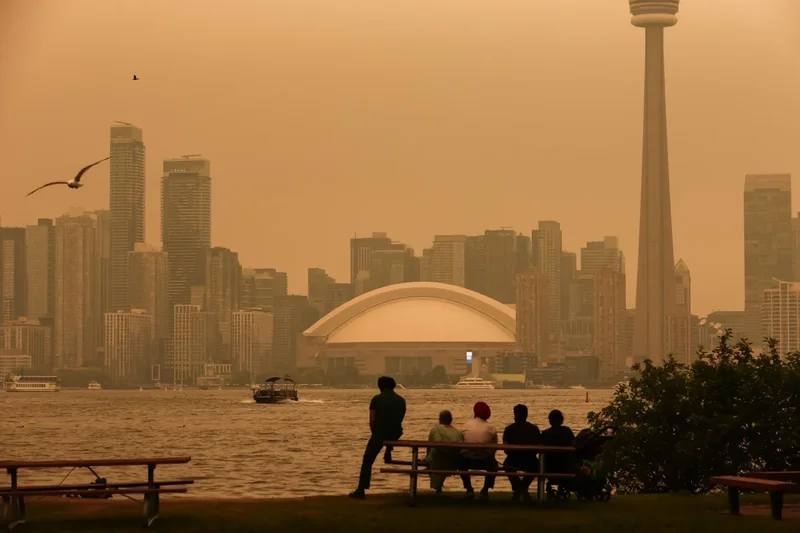
Smoke from wildfires in the provinces of Quebec and Nova Scotia is seen on June 28, 2023 in Toronto, Canada (Getty Images)
Anishinabek Nation Grand Council Chief Linda Debassige said plainly that if one community had waited for the official response, they would now be recovering bodies. This is the signature of a timing failure, not an inventory failure. The aircraft existed. The system to move them moved much slower than the fire did.
Danger outlasts the fleet
August is expected to be as demanding as July. Ottawa’s own modelling forecasts fire danger through August to remain elevated across the North, Québec and the southern interior of British Columbia. The joint North American outlook also forecasts increased fire activity in August and September.
However, the leased fleet’s 150-day contracts expire on Sept. 27, when forecasters are still expecting significant fire hazards.
None of this means the surge fleet was a mistake. Leasing rather than buying got aircraft flying this year instead of waiting years for delivery. My argument is narrower, and it survives that caveat: simply having more aircraft does not strengthen national capability if no one is authorized to move them early.
Ontario’s own response unintentionally made that point. On July 17, with the north ablaze and Toronto under a smoke warning, Premier Doug Ford announced $650 million for 11 new aircraft — six water bombers and five helicopters, the largest such purchase in the province’s history. It is a serious commitment. It is also, by the premier’s own account, a four-year one: he has said repeatedly that new water bombers take up to four years to build.
John Gradek is a Faculty Lecturer and Academic Program Co-ordinator, Supply Network and Aviation Management, McGill University. This article was first published by The Conversation and is republished under a Creative Commons licence. Read the original article .
Ontario cut its emergency forest-firefighting budget to $150 million for 2026-27, down from the $271 million it spent in 2025-26.
These aircraft will not help tackle the fires currently ablaze. In addition, Ford acknowledged the province cannot crew all the water bombers it already owns, with some of them grounded for lack of trained pilots.
This is what reaching for the only available lever — buying more aircraft — looks like when the binding constraints are crews and the authority to move aircraft early, neither of which a purchase announcement can fix.
Pre-agreed triggers
We already know a faster fix works. While the federal government waited for a formalized ask, Alberta sent 94 firefighters and 13 aircraft into Ontario under the inter-provincial resource-sharing agreements that let provinces move people and equipment across borders without renegotiating terms each time. Those compacts have pre-agreed triggers. That is the whole difference.
The answer is not mainly a new fleet or a bigger budget line. It is having a plan in place ahead of time: standing rules for how federally funded aircraft are pre-positioned in advance, who can move them across provincial lines, how they are prioritized when several provinces face fires at once and what a 24-hour readiness standard actually requires of Ottawa.
Ontario has now asked for that standard in writing. The Senate’s Canada on Fire report, to which Ottawa owes a formal response later this year, points the same way.
The uncomfortable truth becoming evident is that mass evacuations have become Canada’s de facto aerial wildfire strategy. It was the response in 2021, in 2023 and now again 2026. We move people out because we cannot provide enough water early enough to keep the fire away from them. That is a strategy — just not one anyone would choose on purpose, and not one we should keep backing into by default.
Forest fires are changing faster than the system built to fight them. The aircraft are finally here. What is still missing is a clearly thought-out strategy on how to use them effectively.