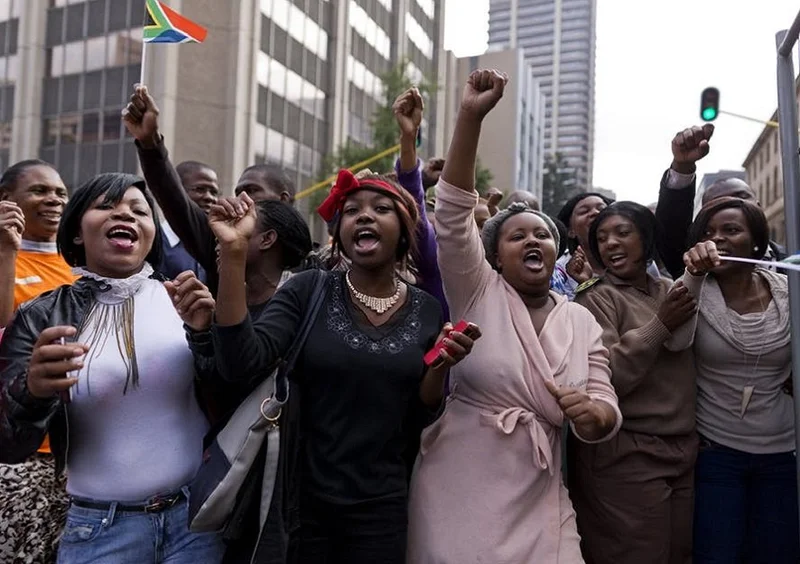
Women make up 51.1% of the countryâs population, numbering about 30.75 million. Although they have made gains in leadership positions, parliamentary representation and property ownership, they continue to face problems such as higher unemployment and poverty rates, and gender-based violence.
Government
Before 1994, only white women were permitted to vote and stand for office, rights they only gained in 1930. By the dawn of democracy, just 2.7% of MPs were women. As of 2026, women make up 44% of MPs in the National Assembly and 37% in the National Council of Provinces. Similarly, in 1996 just two ministers (7.1%) were women compared with 13 (40.6%) this year.
Today, an increasing number of political parties, particularly the ANC and EFF, have aimed for gender parity in their national party lists. In 2025, women made up 53.5% of the ANCâs national list, 50% of the EFFâs, 37% of the DAâs and 34% of the MK partyâs.
Households
The number of women-headed households increased from 37.8% in 1996 to 42.4% in 2024. Women have also made gains in property ownership. Recent estimates show that single women have overtaken mixed-sex couples and single men in property ownership. In 2025, 39% of properties were purchased by single women compared with 31% by single men and 30% by couples.
Business
Historical figures on womenâs business ownership are difficult to find owing to the systemic barriers and legal restrictions women have faced in operating businesses. In 2023, 13.5% of women were entrepreneurs, compared with 19.9% of men.
Women have made gains in top management. In 2024, they held 36% of board positions at JSE-listed companies. In 2025, they made up 35.9% of top management in the public sector and 27.6% of top management in the private sector.
Women have made gains, overtaking men in higher education. The percentage of women with no schooling sharply declined from 20.2% in 1996 to 7.6% in 2022. Women with at least matric increased from 15.2% in 1996 to 36.9% in 2026. Women with tertiary education also increased from 5.5% in 1996 to 12.8% in 2022, outpacing male graduates (11.6%).
Labour force participation rate
The labour force participation rate for women increased from 38% in 1996 to 53.8% in 2026. The unemployment rate for women remains higher than men at 36.4% versus 29.6%. DM
This story first appeared in our weekly DM168 newspaper, available countrywide for R35.