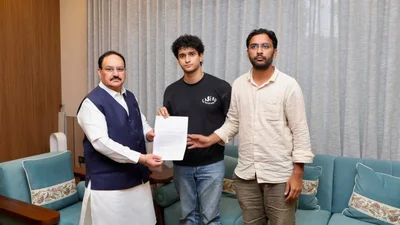
The Cockroach Janata Party (CJP) on Monday accused Union Health Minister JP Nadda of lying about the Centre's talks with NEET-UG paper leak protesters, rejecting his claim that the discussions were cordial and productive.
CJP spokesperson Ashutosh Ranka, who attended the meeting with Nadda, described the dialogue, held amid the 'Chalo Sansad' march, as "useless", alleging that the delegation wasted four hours in the process. Meanwhile, fellow spokesperson Saurav Das said they had waited nearly two hours for what ultimately turned out to be a 10-minute meeting.
His response came after Nadda posted on X on Monday: "This morning, for the first time, the protesters proposed holding talks with the government, and discussions have been underway since 11:50 am."
"The meeting took place in a cordial atmosphere. An initial detailed verbal discussion was held with their delegation, and they submitted a written memorandum to me around 4 pm. I have requested all the protesters to end their sit-in and assist the administration in restoring normalcy," Nadda said.
In response, Ranka wrote: "Just seeing this -- Nadda ji, don’t lie. Your government got desperate when they realised the strength of this movement. Then ended up wasting our 4 hours for this useless meeting."
On Monday, the Centre did not offer any assurance on the three demands raised by the Cockroach Janta Party during two rounds of talks with Health Minister JP Nadda, according to government sources. Instead, Nadda asked the protesters to call off their sit-in and assist in restoring normalcy.
The discussions took place as thousands gathered in central Delhi under the CJP's 'Sansad Chalo' march to Parliament call, seeking accountability for alleged irregularities in competitive examinations and demanding the resignation of Education Minister Dharmendra Pradhan. Government sources said the situation was monitored throughout the day, with Home Minister Amit Shah in touch with senior officials and reviewing developments.
As per the memorandum submitted to Nadda, the CJP's three main demands were the unconditional release of activist Sonam Wangchuk, the removal of Pradhan, and compensation of Rs 1 crore for the families of NEET aspirants who allegedly died by suicide after the NEET paper leak. CJP chief spokesperson Saurav Das and national spokesperson Ashutosh Ranka were part of the delegation that met the minister.
Government sources said the first meeting was held at about 11.50 am, when the CJP representatives presented their concerns to Nadda. During that meeting, the minister asked them to submit their demands formally in writing. The representatives returned later in the day and handed over a written memorandum to him at around 4 pm.
Sources said Nadda did not give any commitment on the demands in either of the two meetings. They added that he appealed to the protesters to withdraw their agitation and cooperate with the administration so that normalcy could be restored.
According to government sources, police and paramilitary personnel deployed during the protest were told not to use force and to show maximum restraint wherever intervention became necessary.
The CJP protest began at Jantar Mantar on June 6 and has widened over the past few weeks. It gathered pace after Sonam Wangchuk joined the sit-in on June 20 and then began a hunger strike. Wangchuk, who has been on fast for 23 days, was taken by the police to Safdarjung Hospital on Sunday after his health worsened.
The government also sought to push back against the protesters' claims by referring to the scale of the entrance examinations held this year. Sources said more than five million students appeared for the three major tests, NEET, JEE and CUET. Of them, about one million are believed to have taken more than one examination, while more than four million candidates sat various entrance tests across the country.
Government sources further argued that most genuine candidates were currently occupied with counselling and admission procedures, which have already started in many institutions, and therefore it was unlikely that large numbers of successful students would join the protests. They also said the results did not point to widespread irregularities, claiming that many top rank holders were appearing for the first time and that many came from poor and lower-middle-class families.
Defending the handling of the NEET issue, sources said the authorities moved quickly after reports of the paper leak emerged. They said a re-examination was held within a month and that action had been started against those responsible. The CJP, however, has continued to demand accountability in the examination process, saying systemic failures in the conduct of competitive exams require action against senior officials and policymakers.
- Ends
Published By:
Sayan Ganguly
Published On:
Jul 21, 2026 10:12 IST