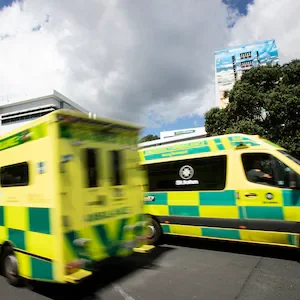
St John Ambulance will hold a press conference this afternoon after it saw the highest volume of 111 calls on record over the past week.
The media stand-up will be held at 3pm and will be livestreamed from the top of this article.
Hato Hone St John director of ambulance operations Doug Gallagher will speak about the “sustained heavy demand” on the emergency ambulance service and the impact on patients and the public.
Demand is expected to remain high tomorrow, traditionally the busiest day for ambulance workload.
St John has forecast that, during exceptional demand, some people with less urgent conditions may wait longer than usual. If someone’s condition becomes more serious after calling 111, St John has advised they should call again to update.
A person calling 111 may also receive advice from a clinician or support to access another healthcare service rather than an ambulance response.
Ambulance personnel may also assess and treat suitable patients at home, refer them to another provider or help them access care somewhere other than an emergency department.
On Saturday 8 August, 2,562 calls came into ambulance through 111 – the highest number received in a single day. This placed significant pressure on emergency call-handling staff and frontline crews. A normal day would see around 1,900 calls.
Gallagher says it is the third time the daily record has been broken this week, with 2,404 calls received on Monday and 2,454 calls on Thursday.
“All three days were busier than any recorded during the COVID-19 pandemic or on traditionally high-volume dates such as New Year’s Eve. At the peak, emergency call handlers were answering a call every 20 seconds,” Mr Gallagher says.
The ambulance service received 15,268 calls this week as at 2pm on Sunday 9 August. It is on track to exceed the previous weekly record of 15,289 calls, set last week between 27 July and 2 August. That week broke the previous record of 14,984 calls, set between 25 and 31 August 2025.
“Saturday is not normally our busiest day, so this level of demand is highly unusual,” Gallagher said.
“Our emergency ambulance staff are continuing to respond effectively, but the workload is not showing the signs of easing that we would normally expect over a weekend.
“With demand remaining high and Mondays typically bringing the greatest workload, we are preparing for further pressure.
St John has declared a major incident and activated its Emergency Operations Centre to ensure all reasonable steps are being taken to maintain a safe response.
This is an early and precautionary decision to help us continue providing safe and effective care during an unprecedented period of demand,” Mr Gallagher says.
“We want to reassure people that emergency ambulance help remains available, and we are continuing to respond to those who need us.”
The response supports closer coordination with Health New Zealand and hospital partners.
“Our first priority is patient safety. Ambulance staff continue to prioritise people with life-threatening and time-critical conditions,” Gallagher said.
“People should call 111 immediately when someone is seriously ill or injured or there is an immediate threat to life.”
St John is encouraging people with non-emergency health concerns to seek advice early and check which services are available locally.
Options may include a GP, Health New Zealand’s online GP care service, a pharmacist, an urgent-care provider or Healthline on 0800 611 116.
Budget 2026 ambulance funding
In the 2026 Budget, the Government announced a funding boost for two new Auckland ambulance hubs, more staff, upgraded technology and stronger frontline support.
The Government said it would provide $35 million over four years , to strengthen road ambulance services and deliver immediate improvements for patients and frontline staff.
“When New Zealanders call an ambulance, they need confidence that they will get the help they need quickly and that frontline crews have the support and resources they need to respond,” Health Minister Simeon Brown said.
“Demand for ambulance services continues to grow across the country, which is why we are focused on strengthening the workforce, infrastructure, and technology needed to support modern, reliable emergency care.”
The funding will go towards:
- The establishment of two ambulance hubs in Auckland, with one confirmed for South Auckland (these are large, central bases where crews begin and end shifts and vehicles are fully prepared for service)
- The deployment of an electronic Patient Clinical Record system (this is a digital platform that enables real-time sharing of patient information between ambulance services and health providers, improving co-ordination)
- Additional training support for ambulance communications centre staff
- Additional clinical welfare checks for patients