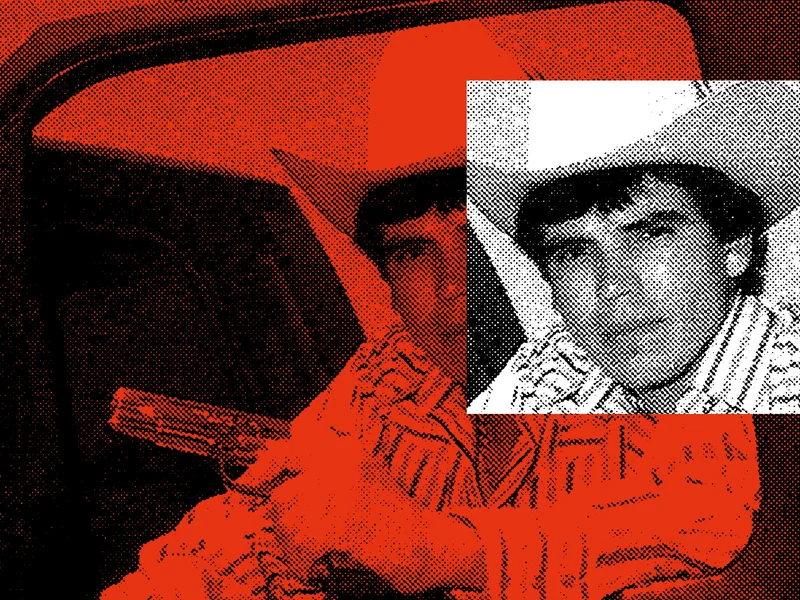
At the end of a song, someone in the crowd handed him a piece of paper folded in half. It was common at his shows. He liked people to climb onto the stage while he was performing, take photos, and request songs. Chalino Sánchez was the anti-star of corridos, just another ranchero raising hell with his buddies. As the first notes of the accordion play, Chalino unfolds the note and reads what’s written on the paper without letting go of the microphone. It lasts only a few seconds. When he lifts his head again, he grimaces nervously. He wipes the sweat from under his wide-brimmed beige sombrero with his hand. He looks lost, as if deciphering the message he had just received in a kind of limbo. He folds the paper again, gives a slight nod to someone on his left and begins to sing. The next morning he was found dumped in a stream. His eyes were covered, his hands tied behind his back, and he had two bullet holes in the base of his skull.
On that night of May 15, 1992 there were more than 2,000 of his countrymen at the Buganvillas Hall in Culiacán, the capital of Sinaloa, the city he had fled almost two decades earlier for California. He was 31, and in less than four years of his musical career he had become a hero to millions of Mexicans on both sides of the border. With a shrill, off-key voice, no musical training and only a few years of school, he renewed a popular genre rooted in 19th-century northern Mexico, where the barrel of a gun was the law. Corridos told the tales of revolutionaries and bandits as epic deeds.
Chalino updated that imagery for the modern, urban world. His heroes were migrants like him who faced abuses by the Los Angeles police, or peasants who started by trafficking some marijuana and ended up as drug lords. A Sinaloan, like most major traffickers, he was one of the forerunners of the narcocorrido, which today is experiencing a global boom. “El Compa” Chalino was the king of corridos and, like the protagonists in his songs, he left many enemies in his wake.
When he was 11, some residents of the small town where he lived with his family raped his only sister. Everyone knew who had done it, but Chalino waited patiently to take revenge. When he turned 15 he went to a party where he knew the men who had humiliated his sister would be, and shot at them. They chased him and he crossed the border as an undocumented migrant until he reached an aunt’s house in Los Angeles. He worked in the fields and as a farmhand while helping his older brother, who was a coyote smuggling migrants across the border from Tijuana. One night, his brother was shot dead while sleeping in a motel. He spent some time in prison, and that is where he started out with music. He turned the stories of the thieves and traffickers with whom he shared a cell into songs, and a cousin who was also imprisoned accompanied him on guitar.
After leaving prison, he kept writing songs, many on commission. Sometimes he was paid with a watch or a gun. Even then, he usually carried a loaded revolver on his hip. Chalino was a man of few words: tough, proud, and fiercely independent. He was the epitome of the Mexican rancher, who, in his most stereotypical form — as portrayed precisely by popular culture — is so impetuous that he even defies death. His songs were a reflection of his life: the migrant, the outcast, the nobody. In some of them, Chalino would recount a murder and take the victim’s side, hurling insults and threats at the culprit. Banned from the radio and with no record label behind him, he recorded his songs on cassettes and sold them at barbershops, gas stations, and street markets.
His reputation as a brawler was sometimes tested during concerts. In January 1992, just months before his death, he was performing in the Coachella desert. Midway through the concert, a man climbed onto the stage and opened fire with a .25 caliber pistol. Chalino leapt into the crowd and returned fire with his own gun. The toll was one dead and 10 wounded, including Chalino himself, who was hit in a lung. The incident made headlines in newspapers and on television. His notoriety swelled and the cassettes sold out in stores.
But after that, he made two uncharacteristic moves: he gave his prized gun collection away to friends and sold all the rights to his catalog to a small record label for about $100,000. With that money he bought a house in a middle-class suburb for his wife and son. Many began to think Chalino already knew he would die soon.
It was at that time that the offer came to perform at the Buganvillas Hall in Culiacán. Friends and family tried to dissuade him. He had received threats and Sinaloa, to where he had not returned since fleeing, was a dangerous place. It was no longer his home. But his countrymen wanted to see him and had paid about $20,000. Chalino had already received half up front. A man of his word, he felt he had to go through with it.
The show was a success and, afterward, he drove off with two of his brothers and a cousin to grab something to eat. Before they reached the restaurant, two vans cut them off. Several armed men got out, identified themselves as state police, and told Chalino: “My commander needs your help.” Accustomed to bribes, he offered them money, but they refused and instead pulled one of his brothers from the car and put him in their van. Chalino negotiated and, instead of his brother, they took him.
The investigation, as has so often been the case in Mexico, was a black hole about which almost nothing is known to this day. But in the months following his murder, more than 100 corridos were produced about his death — more than were written about Pancho Villa. Just as with Elvis or Michael Jackson, legends say he’s still alive, that he faked his death to escape his enemies. In his town’s cemetery, there’s a giant mural depicting him: wearing a hat, an open shirt, and cowboy boots. In one hand, a microphone. In the other, a pistol and the caption: “I was never afraid.”