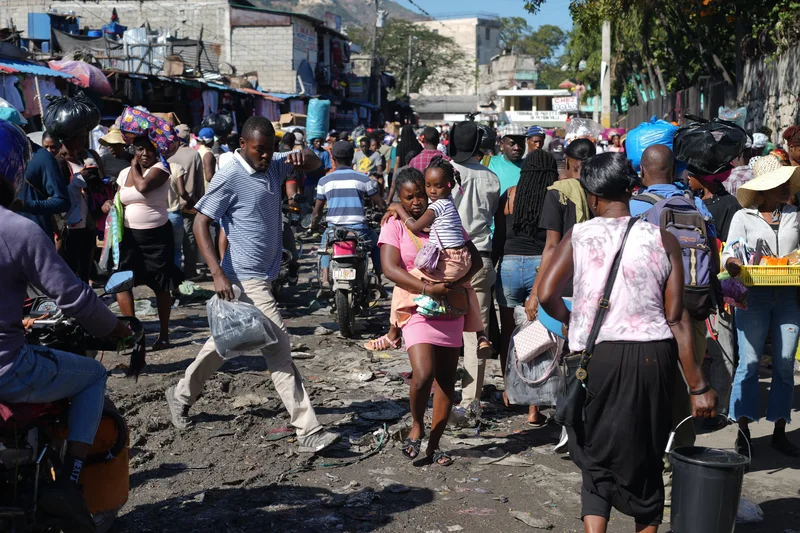
Not even United Nations envoys, with their escorts and armored vehicles, can land in Port-au-Prince and move safely around Haiti, a country dominated by gangs since the assassination of President Jovenel Moïse in 2021. When he travels to the island, the UN High Commissioner for Human Rights’ designated expert on Haiti, William O’Neill, lands in Cap-Haïtien and then travels by helicopter. “I cannot go to most of the capital,” he says.
Gangs control almost all of Port-au-Prince and much of the country. The violence from their clashes has displaced more than 1.5 million people, deepening the humanitarian crisis that Haiti was already facing. Families survive on remittances sent by relatives abroad: billions of dollars that pay rent, healthcare, schools, funerals, taxes for a weakened state and the fees demanded by the gangs.
And now the United States, the Dominican Republic and other countries that host most of the diaspora have set out to deport them to an island that is not able to receive them.
“Nobody should be deported or forced to return to Haiti,” O’Neill tells EL PAÍS in an interview from New York. “The human rights situation is catastrophic and there is no way any forced repatriation at this moment could be safe, dignified and durable. Therefore, they should not do it. It violates international law and, morally, it is terrible to send people back into this situation,” adds the lawyer and human rights expert who is documenting the escalation of the humanitarian and security crisis in the country.
The past few months have been particularly violent, O’Neill says. Some of the groups that make up the Viv Ansanm gang alliance, which dominates Port-au-Prince, are fighting over key checkpoints on the roads. And north of the capital, Grand Grif and Kokorat San Ras have been expanding their territory toward the center of the country.
Haitians in the diaspora have nowhere to return to. “They arrive in Cap-Haïtien and the Haitian government gives them the equivalent of about $60 or $70, in gourdes, and says, ‘Good luck.’ Where are they supposed to go? If they come from gang-controlled areas, there is no way to return safely. And if they get past that, they go back to a neighborhood that has been burned and where everything is destroyed. There are no jobs, no opportunities, very little schooling, no medical care. Many Haitian families in Haiti were surviving on money sent back by Haitians working legally under TPS. And that money is already starting to dry up,” O’Neill describes.
Temporary Protected Status (TPS) protected roughly 350,000 Haitian immigrants in the United States from deportation. The first designation was approved after the devastating January 2010 earthquake and subsequent administrations renewed it until Donald Trump entered the White House and moved to end it.
TPS for Haitian nationals expired at midnight on July 27, and on August 5 a court took the legal step that confirmed its termination. With the status gone, beneficiaries also lost their work permits and many began to be laid off before the deadline dates arrived. Employers are already feeling the absence of this workforce in cities such as Miami, New York and Philadelphia, especially in healthcare, hospitality and agriculture.
The worst place to be a child
Organizations that support Haitian communities in the United States estimate that more than 50,000 U.S. children with dual nationality have at least one parent or guardian who is a beneficiary of such programs and therefore at risk of deportation. The removal of protections forces families to face impossible choices: separate the family, risk detention and deportation, or return to the island together.
On every occasion in recent months when he has addressed the situation of children, the UN expert has said that Haiti is one of the worst places in the world to be a child.
“In eight years there has not been a single full school year for any Haitian child, not even in areas where gangs are not as powerful or do not have control, due to disruptions in the economy, prices, fees, displacement and stress on society. Teachers are not paid, they are at risk and some have been killed,” the lawyer says.
Although the exact number of gang members in Haiti is unknown, UNICEF and the United Nations estimate that roughly half are children under 17. Many of them do not even know their exact age and lack birth certificates.
“In gang-controlled areas children have very limited access to school, and they are also exposed to incredible levels of violence. They see it, they hear it and sometimes they are victims of it, or their relatives or close friends are,” O’Neill says. And both in those territories and in areas without armed clashes, girls, adolescents and women are exposed to sexual exploitation and abuse.
The displacement camps do not offer safety either: they are makeshift shelters set up in public parks and vacant lots, tents and cardboard-and-wood shacks where hundreds of people live without food, water or basic services. “Haitians barely have enough to live on or to eat. How can they be expected to take on more mouths to feed in places that are already so overcrowded?”