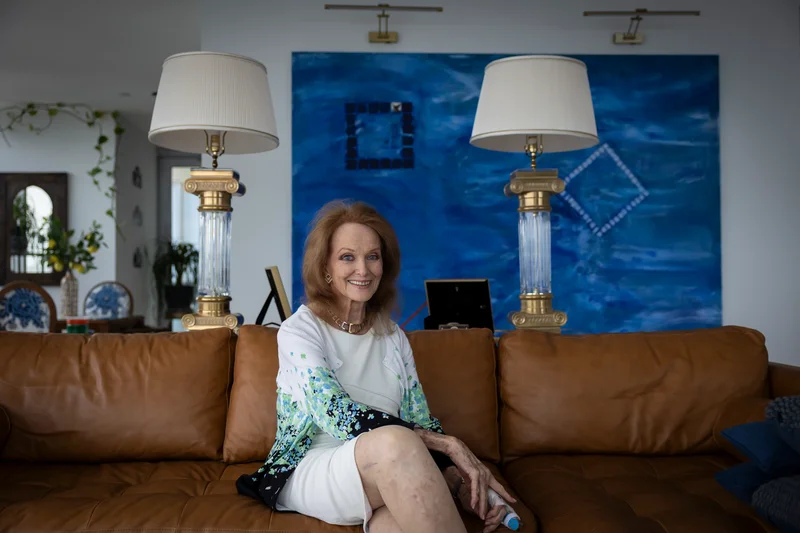
For Christiane Magnani de Alemán, the first French woman to be crowned Miss Universe in 1953, the impossible does not exist. At 90 years old, the former beauty queen has published a self-titled autobiography in which she travels a life marked by war, fame, cinema, family and Mexican politics.
Sitting in the living room of her apartment in Brickell, Miami, with the Bay of Biscayne behind her, Magnani wears a white dress with a patterned cardigan and matte gold neck scarf. She speaks with both studied solemnity and contagious emotion, and laughs at herself easily.
“I write because it is my story. It was a life of so many moments that I have a lot more to tell,” she says in an interview with EL PAÍS.
She began to dream up the book in 1998 during a stay in San Miguel de Allende, but for years doubted that she would be capable of writing it because she had no literary experience, and left school at an early age.
Magnani identifies as a member of the “lost generation”, though she was three years old when the Second World War began, and still remembers hugging her parents and sister before a small window as they watched bombs being dropped. Once, German soldiers occupied their home and the family had to sleep in the granary.
Her father spent around nine months in a concentration camp. Before he was detained, thinking that he might not return, he put his businesses in the name of his brother-in-law, who declined to return them when he eventually did come back. “I had to work ever since I was little. They couldn’t pay me, but they gave me milk, they gave me butter. I was happy to have something to bring home,” Magnani remembers.
Her book traverses the many eras of her life, accompanied by anecdotes and photos of places and people. The family escaped the darkness of war when they moved to Agressais, the town that now represents the warmth of home and security to Magnani. In Loudun and Poitiers, she spent years working, having had to leave school behind. In Châtellerault, when she was 16 years old, she returned to school, and happily crossed the city on bicycle each day.
It was in Châtellerault that, almost by accident, she signed up for the local beauty contest that would change her life. She was in attendance to merely watch the show. But one of the judges saw her in the crowd, asked her to participate — and she won. Then she won regional competitions. Preparing for Miss France, she realized she couldn’t compete under the name Christiane Magnani, because she had already competed under it for the “most beautiful Italian in France” event. She caught sight of a bottle of Martell cognac, and decided then and there that she’d enter as Christiane Martel.
“I told my father, ‘I need a very short name that is easy to remember.’ Then I asked, ‘Hey, what do you think about Christiane Martel? It’s really easy, everyone drinks cognac, they won’t forget it,” she says laughing. “And I think it worked, because to this day, people remember me.”
At 17 years old, she traveled to the United States to compete in the Miss Universe pageant in Long Beach, California. She didn’t speak any English, and had never boarded an airplane before. She remembers that the competition, then in its second year, was based solely on its entrants’ natural beauty and personality.
She won the crown, and signed a contract at Universal, opening the door to a film career. She had to take singing and acting classes, and went to shoots in Hollywood and Mexico, where she met businessman Miguel Alemán Velasco, whom she would wed and have four children with. She has now spent most of her life with him.
“I said, ‘If one day we get married, I want our children to have their father. I don’t want you to have to go off to do politics every once in a while. If I get married, I will leave behind everything artistic, movies, everything — I’ll let it go completely. But what I would ask of you is if you want to get into politics, that it be when our kids are no longer young, when they reach a certain age, like 10, 12 years old, when they can better understand,” she says.
Decades later, Magnani accompanied her partner in his return to politics as governor of Veracruz between 1998 and 2004. A large part of the book is dedicated to her work as a president of the state system for integral family development (DIF, in its Mexican acronym), and how she carried out projects in rural communities, including the building of five student centers with dormitories, dining halls and medical facilities.
“The centers were equipped with internet, communications, they had a doctor, dormitories, food, everything. When gave them a name in Nahuatl, Telpochcalli, which means “our children,” she remembers. “We loved being able to do so many things.”
She also sold a photo book to raise funds for a hospital’s pediatric wing, learned short speeches in Nahuatl and promoted reproductive education.
Her goal was to offer “a dignified life, what any community deserves,” she says.
These days, she spends a large part of her life with her grandchildren and great-grandchildren, who will soon number 17. She gets confused when she tries to count them all, she says as she shares a photo of the youngest on her phone.
Through the ups and downs, she’s tried to stay balanced, and has never felt special for having lived surrounded by presidents and actors, nor for having to work to bring milk home to her family.
“I don’t differentiate — only if there are good people, or not good people. I think that has really helped me, because I have always been at the same level. I don’t think I’m better because I have a lot of things, or that I’m lesser-than. I feel good where I am. When there was war and I had to work, well, I worked. There were many very different moments in life, up, down, but we always knew how to balance ourselves out, never be too much this or too much that,” she says with a smile.
She now lives in Miami because she was having respiration issues in Mexico City, and to be closer to her family in Florida. She says that she is unsettled by the news of the advance of AI and robots that would have seemed like science fiction until very recently.
She still gets fan mail from Russia, the Phillippines, Germany and other countries, and she responds to it all, she says. “They remember me, they want photos, and they tell me about their lives. It gives me a lot of pleasure,” she says.