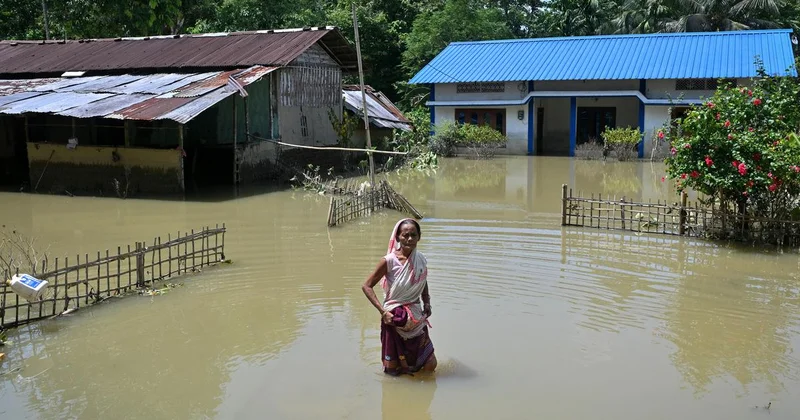
Floods hit Assam every year. But the current cycle has been especially devastating, killing 97 people and displacing more than 12 lakh persons. The waters have wreaked havoc in Upper Assam, particularly in Sivasagar and Charaideo, districts that have rarely seen such intense floods in the past.
Scroll spoke to Mirza Zulfiqur Rahman, a researcher on the Brahmaputra river basin and climate issues in northeastern India, to understand the reasons behind this year’s flooding and what could have been done to prevent it.
Edited excerpts:
Floods happen every year in Assam. But why are the floods in Upper Assam being called unprecedented?
Unprecedented is a convenient term to describe every subsequent flood event, glossing over the core lessons from the past floods in the Assam floodplains. The intensity of the Kaziranga floods in 2020 was similar, but it affected mostly animals and a few human habitations. This time, the floods took place in a highly populated area of Sibsagar, Chairaideo, Jorhat and Golaghat districts, and a lot of people have suffered losses.
The usual refrain is that this is unprecedented, but with the kind of interventions on the river system and the past pattern of floods in Assam, these should no longer be termed as surprising. We need to be better prepared.
Was it a cloudburst that led to this extreme event? If not, what were the reasons?
Whether it was a cloudburst or not is not so important as is what are the conditions that amplified this flood within Assam. Just blaming it on a cloudburst in Nagaland is convenient and broadbrushing the issue.
The main reasons why the flooding was so intense are wetland degradation, weak river embankments inside Assam, indiscriminate mining in riverbed and wetland areas downstream, and high obstructions to the natural drainage patterns of rivers. For example, we saw this devastation because of certain obstructions in the natural drainage pattern of the Dikhow river. [Dozens of roads in the path of the river were washed away or breached in many areas of Sivasagar, Jorhat and Chairadeo districts.]
There are several other tributaries of the Brahmaputra, which have similar conditions, and future devastation can also happen there.
Over the decades, we have created a barrier to the natural drainage of the rivers and that’s why the flooding is becoming more and more intense.
Disaster management authorities in Assam were not capable of handling this, because they have limited capacity, as structural interventions like dams and raising embankments have been their favoured responses.
How should the government respond to this challenge?
The government will promise that they will do everything to restore normalcy, but the ground conditions existing before the floods are why we see such flooding in the first place. They are saying they will build the embankments back and restore the landscape as it was.
But the point is not to build back the hazards in the landscape again. Bringing it back to square one is basically not learning anything from this disaster. The task is to learn and scientifically map out the larger floodplain and build back better and in alternate ways.
What do you mean? Can you explain?
We need to give more space to the river to flow in a way that will not create more damage and water can pass without much obstruction. We are not thinking of that. We are thinking that the road will be fixed, we will raise the road and the embankment even higher, and you people will be more protected.
But the embankments and highways were all built without proper scientific planning or understanding how the natural drainage of the region is being obstructed.
We do not want a mass of concrete back into that landscape again. We want to actually scientifically map out the floodplain and then say, “Okay, see, this is going to recur. So where do we then relocate the people? How do we ensure that the future generations will not have to go through the same kind of flood?”
Floods are inevitable in the Assam floodplains. This control mindset has to give way to a mitigation and management mindset through rigorous cutting edge research. We must allocate resources to build the capacity of institutions and of the community in general to face such floods in the future.
Why do you think the local administration failed to respond to this disaster? Was it because of a lack of warning?
Communities can only use an early warning effectively if they are aware of where to seek safety. These are simply non-existent in the public discourse across districts in Assam. Are there specific drills done to prepare people to use any sort of early warning. If it is not existing, then what is the use of early warning?
Has increased construction in the region contributed to the floods?
The height of the highway in Upper Assam has been increased over the years as a response to floods. The logic is to make it safer for road traffic, for economic connectivity to keep on happening between Lower Assam and Upper Assam. But the homes on both sides are at a lower level, and at increased risk of high flooding. This kind of infrastructure accentuates and amplifies the disaster manifold.
In the mountains too, they have started building more roads. Because of that, more debris is coming down, raising the riverbed even higher. The embankments are not enough now to carry that sediment load and ultimately give way.
Earlier, if we did riverbed mining, it was a small scale. We didn’t have the audacity to take a JCB right into the riverbed and extract materials, which is illegal under environmental guidelines. But they are doing it across several tributaries of the Brahmaputra. The activities that have led to environmental destruction on both sides of the border of Nagaland and Assam is also unfortunately connected to livelihood in these areas. We have to change the narrative and understand what environmental damage in the larger transboundary landscape in the non-flood seasons can affect us severely in the flood season.
Can the Assam government shrug off its accountability and responsibility by blaming the high intensity rainfall upstream in Nagaland, Arunachal Pradesh and Meghalaya?
We need to have a public discourse on seeking accountability, which is simply not there anymore. Disasters are being normalised in doling out compensation, and the future holds no accountability, save for the fact that there will be timely compensation.
We collectively need to learn from this disaster not in narrow fragmented contexts, but in a larger bioregional and biocultural context. These artificial administrative constructs and boundaries limit our thinking on floods and disasters, and prevent us from finding solutions. We need a bioregional governance model which looks at the problem from an overall watershed point of view, and not these district, state and regional boundaries.
A shorter version of this interview was published in the newsletter sent out to Scroll’s members on Saturday afternoon.
Here is a summary of last week’s top stories.
Crimes against women. Journalist Tarun Tejpal was sentenced to 10 years of imprisonment for raping and sexually harassing a junior colleague in 2013. The Goa bench of the Bombay High Court directed him to surrender within two weeks. It set aside a 2021 verdict of a sessions court that had acquitted Tejpal.
He was held guilty of rape by a person holding trust or authority, rape by a person who is in a position of control or dominance over a woman, sexual harassment and criminal force against a woman with an intent to disrobe her.
Tamil Nadu politics. Dravida Munnetra Kazhagam leader Udhayanidhi Stalin was briefly arrested on Tuesday for purportedly derogatory remarks about Chief Minister Vijay and actor Trisha Krishnan. He was released on the directions of the Madras High Court.
The leader of the Opposition in the Tamil Nadu Assembly had made the alleged remarks at a protest rally in Thanjavur on Monday. The first information report against him was filed by a worker of actor-politician Vijay’s Tamilaga Vettri Kazhagam party. The complaint alleged that Stalin’s remarks were an indecent double entendre.
BJP leader acquitted in sexual harassment case. A Delhi court acquitted former Wrestling Federation of India chief Brij Bhushan Sharan Singh in a sexual harassment case filed against him by six women wrestlers. Vinesh Phogat, one of the wrestlers who had taken part in protests demanding Singh’s resignation, said that the complainants were disappointed with the court’s decision and would appeal against the order.
In January 2023, several Indian wrestlers, including medallists Phogat, Sakshi Malik and Bajrang Punia launched a protest against the former Bharatiya Janata Party MP, accusing him of intimidation and sexual harassment.
Seven complainants, including a minor, accused the BJP leader of demanding sexual favours for professional help on at least two occasions, and also reported 15 incidents of alleged molestation and other forms of sexual harassment. He was later cleared with respect to allegations made by one of the women.
Surprising outcomes. Jan Suraaj party chief Prashant Kishor won Bihar’s Bankipur bye-election on his electoral debut. The polls became necessary after the MLA, BJP National President Nitin Nabin, resigned after becoming a Rajya Sabha MP.
The constituency near Patna is considered a stronghold of the Hindutva party. Nabin had held it since 2010, after representing the Patna West seat before its boundaries were redrawn.
In Madhya Pradesh’s Datia, Congress candidate Ghanshyam Singh won the bye-election defeating the BJP’s Ashutosh Tiwari. Despite the setback in the two states, in Gujarat the Hindutva party retained the Manjalpur seat.
Anant Gupta explores whether the youth protests drove Prashant Kishor’s bye-poll win.
Also on Scroll last week
Scrolllast week
- The dark side of the booming Indian market for weight-loss drugs
- In Kashmir, most pellet gun victims wait for compensation even a decade later
- ‘What future do children have if teachers can’t take classes?’: An SIR crisis has hit Mumbai schools
- Modi government boasted about the NEET re-exam. But students say it was full of glitches
- How the BJP stole the month of Sawan
- Delhi unrest: Police conduct can never be equated with that of a protesting crowd
- Undone by a meme: Mockery may have dealt a shock to the Modi-led regime – history shows why
- Two years after the July Uprising, Bangladesh’s only political consensus may be distrust of India
- ‘Ohh My Dog’ review: A smart kid and a fabulous canine deliver a parable about goodness and justice
- ‘Vadhandhi Season Two’ review: A juicy fleshing-out of the secrets hidden in skeletons
Follow the Scroll channel on WhatsApp for a curated selection of the news that matters throughout the day, and a round-up of major developments in India and around the world every evening. What you won’t get: spam.
We welcome your comments at letters@scroll.in.