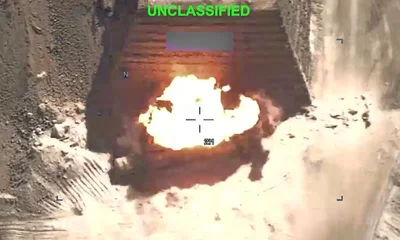
Iran targeted US radar and air defence installations in the Gulf on Tuesday, warning Washington of “more decisive and powerful” attacks to come as the US military completed a fresh round of strikes on the country. Iran’s Revolutionary Guards said they had attacked and stopped two “non-compliant oil tankers” attempting to transit the Strait of Hormuz, part of an effort to tighten its grip on the vital waterway while the war reignited. Following the deaths of at least three US soldiers in the past several days, the United States launched a new round of attacks against Iran late on Monday which it said were “designed to further degrade Iranian military capabilities used to attack commercial shipping” in the strait. It later said that it had completed the strikes during which US forces “struck Iranian military command centres, maritime capabilities, missile and drone launch sites, and air defence systems to degrade Iran’s ability to continue attacking commercial vessels flowing through the Strait of Hormuz”. “Commercial vessel transits through the vital international maritime corridor continue,” it said. “American forces remain postured and prepared to hold Iran accountable for unwarranted aggression toward civilian mariners seeking to freely and openly transit the strait,” it added. Hours after the first statement, the Iranian army said it had targeted US assets in Kuwait and Bahrain, including air defence systems, radar installations and administrative buildings. “With this radar sweep, the enemy should prepare for even more decisive and powerful waves of drone and missile attacks,” the Guards said in a statement carried by state news agency IRNA. US President Donald Trump warned Monday that Iran would pay “many times over” for every American soldier killed, while Iranian President Masoud Pezeshkian said the conflict had become “a full-scale war”. Nearly 100 US servicemembers have been wounded since July 7, the Pentagon said on Monday, most with minor concussions. Diplomatic exchanges In the Strait of Hormuz, meanwhile, the Revolutionary Guards said on Tuesday two tankers attempting to transit the strait “were hit by explosions, resulting in massive fires that brought them to a standstill”. The UK Maritime Trade Operations agency (UKMTO) earlier reported that an “unknown projectile” struck a tanker off the coast of Oman. On Tuesday, UKMTO reported another tanker off the coast of Oman had been struck by a projectile. Despite the latest fighting, Iranian foreign ministry spokesman Esmaeil Baqaei said diplomatic exchanges with Washington via mediators were ongoing. Iran’s Interior Minister Eskandar Momeni is in Islamabad for a two-day visit during which he will meet with Prime Minister Shehbaz Sharif and Chief of Defence Forces and Chief of Army Staff Field Marshal Asim Munir, according to the interior ministry. Lebanese President Joseph Aoun is set to meet with Trump in Washington on Tuesday as pressure builds for Beirut to disarm Hezbollah, Israel’s key condition before withdrawing from south Lebanon. Red Sea threat Yemen’s Houthi rebels entered the fray on Monday, announcing an immediate maritime embargo on Saudi Arabia, opening a new front in the conflict. Houthi military spokesman Yahya Saree declared the embargo effective immediately, framing it as retaliation on an “eye-for-an-eye” basis against Saudi Arabia. The naval blockade, if enforced, could further strain Saudi Arabia’s economy by cutting off access to its Red Sea ports, which have been vital for oil exports as renewed fighting limits passage through the Strait of Hormuz. The blockade is also expected to hurt global markets that rely on Saudi Arabia — the world’s leading crude exporter, producing over 10 million barrels per day — for their energy imports. The announcement follows an exchange of fire between the Houthis and Saudi forces last week, the first direct clash between the two sides in years. The Houthis have previously tried to cut off shipping through the Red Sea, leveraging the Bab al-Mandab Strait, a chokepoint at its southern tip which vessels must navigate when travelling to or from the Suez Canal and the Mediterranean. They previously launched drone and missile attacks on ships transiting the strategic waterway beginning in November 2023 during the Gaza war, forcing vessels to take lengthy detours around Africa instead of travelling directly from Europe. Yemen shares a border and coastline with Saudi Arabia, whose Red Sea port of Yanbu has been crucial for exporting oil, bypassing Iran’s effective closure of the Strait of Hormuz during its war with the US. Saudi’s foreign ministry condemned the Houthi maritime blockade and a reasserted Riyadh’s backing for Yemen’s Aden-based government.
Iran targets American military assets in Gulf, warns of more attacks as US strikes Iran for 10th consecutive day