Trump's latest push to reshape U.S. history? Signs at the Smithsonian
U.S. president orders signs outside museum warning of 'inaccurate' information
On any given day at the Smithsonian's National Museum of American History in Washington, D.C., Americans and visitors from all over the world file in to see the red slippers Dorothy wore in the Wizard of Oz, the inaugural gowns of U.S. first ladies and the garrison flag that inspired the Star-Spangled Banner.
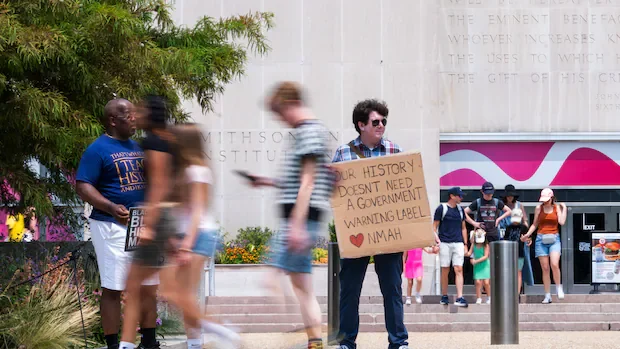
These days, though, it's not uncommon to also find several protesters outside the entrance, holding up signs that read "Truth Matters" or "History does not belong to rich old white men!"
The museum is currently at the centre of an effort by the Trump administration that observers say is part of a broader attempt to reshape the stories of the United States as told by the country's cultural institutions.
"I think this set of actions fall sort of at the confluence of two trends," said Suse Anderson, an associate professor and head of museum studies at George Washington University in Washington, D.C.
"The first is the longer-term, right-wing project aimed at gaining more control over cultural institutions really since the 1980s to ensure that exhibits and educational programs are more aligned with conservative values. And the second is an attempt to reduce the influence of independent experts in areas where the administration would like more control."
In late July, U.S. President Donald Trump ordered that signs be put up outside the museum warning visitors about "inaccurate information" presented inside.
The signs aren't up yet, but they are supposed to point visitors to a 162-page report the White House released on America's 250th anniversary. The report largely focused on the National Museum of American History and accused the Smithsonian's leadership of "extreme political activism" and prioritizing a narrative of shame and division over more celebratory and patriotic narratives.
Last year, in a Truth Social post, Trump said: "The Smithsonian is OUT OF CONTROL, where everything discussed is how horrible our Country is, how bad Slavery was and how unaccomplished the downtrodden have been — Nothing about Success, nothing about Brightness, nothing about the Future."
The recent developments are all part of an overall initiative by the Trump administration to "review" the Smithsonian's exhibits and programs.
- PodcastTrump signs executive order to push for the rewrite of U.S. history
- Trump threatens Smithsonian museums in escalating attacks on social media
The Smithsonian itself is the world's largest museum system. It includes 21 museums, 14 research centres and the National Zoo. It holds more than 150 million items, including historical objects and works of art.
The July 4 report — titled Saving America's Story: How Ideological Capture at the Smithsonian Institution's National Museum of American History Erases Our Heritage— echoes Trump's complaint that the Smithsonian focuses too heavily on the legacy of slavery in the U.S.
It also alleges, for example, that there is an overemphasis on the plight of Indigenous people during the country's founding and "identity politics," including materials that "present gender as fluid."
**The Smithsonian response **
The Smithsonian has spent the summer fighting to maintain its independence.
Anthea Hartig, director of the National Museum of American History, faced heavy questioning by Republicans over two days in late July at a House oversight committee, where she was asked questions like "Do you love America?"
"Unconditionally," she said.
WATCH | Questioning a museum director:In a memo to staff after the White House report's release, Lonnie Bunch, the Smithsonian's secretary, said it was "not a fair characterization" of the work the National Museum of American History does.
"At the Smithsonian, our work is driven by scholarship, accuracy and an uncompromising commitment to tell the fullness of America's story."
James Millward, a history professor at Georgetown University and co-founder of Citizen Historians for the Smithsonian, a group created over fears of political censorship of the museums, said he's been impressed by the Smithsonian's unwavering defence of the work it is doing, given how other institutions, such as some universities or big law firms, "caved almost immediately" to similar White House pressures.
- Trump is demanding universities change policies or face defunding. Would Poilievre do the same?
- Trump administration reverses course within a day, vows to continue court battles against 4 law firms
"I think history will recognize its backbone in the face of political pressure," he said in an interview.
Millward also said he is concerned this recent flurry of activity — the report, the committee hearings, the executive order for the signs — is setting the stage for attempts by the administration to "stack the board" of the Smithsonian in the coming months with members more sympathetic to its cause.
Millward is also concerned that Trump's attack on the Smithsonian could be seen as "weird things having to do with Trump's own narcissistic goals," similar to his pre-occupation with turning the Reflecting Pool on the National Mall "American flag blue" or the East Wing renovations.
"It really does tie into something that transcends Trump," he said of the fixation on museums, adding that it is part of a long-term effort by various groups to define the U.S. as a country of European settlers by playing down slavery and colonialism and opposing immigration that is ongoing, as well as trying to reassert traditional gender roles and the traditional family.
Millward also cites comments made by U.S. Vice-President JD Vance last year, where he said Americans who have ancestors who fought in the Civil War have "a hell of a lot more claim over America" than those who question their belonging to the country or the work of Project 2025, a conservative vision and policy plan to reshape American culture through the expanded powers of the executive.
Mike Gonzalez, a contributor to Project 2025, testified at the same committee hearing as Hartig did.
"Teaching lessons about American wickedness is now the mission of the Smithsonian," he told the hearing.
A trusted institution
The Smithsonian has been around for nearly 180 years.
Susie Wilkening, founder of Wilkening Consulting, has been conducting industry research for the American Alliance of Museums. She said that year after year Americans are increasingly supportive of "inclusive content," including people of colour, women and religious minorities.
At a time when Americans are losing faith in many institutions, museums still rank high in polls, right under family and friends and public libraries and above non-governmental organizations, the media, social media and the government.
"What we're seeing is that most people do want the Smithsonian to have what we refer to as curatorial independence," said Wilkening, adding it cuts across the political spectrum.
Wilkening said polling she did in January from a representative sample of 2,045 U.S. adults shows 63 per cent of conservatives disagree with political pressures to remove content from museums.
Among liberals, she said, that number is higher, at 83 per cent, although there is a segment of the conservative base that supports it — 17 per cent — as well as some liberals — eight per cent.
Early this week, on her way out of the National Museum of American History, Amy Carlson Miesel reflected on her first visit. The West Virginia native found it "disappointing" and "a little tinged with leftist ideology."
She said she found the museum pointed out many times that "in American history, Christians had mistreated the Native Americans."
For Carlson Miesel and her husband, Richard Carlson Miesel, neither of whom are fans of Trump, it was a question of emphasis.
"It seemed to me that what you saw was all true stuff," he said. "But it just kind of felt like a hodgepodge of differences while there was not a 'Well, this is all where we came from. Now, what is it that unites us?'"
Tan Tran, a student at George Washington University who is studying museum education, had just come from meeting a friend by the the museum's Jerome and Dorothy Lemelson Hall of Invention, which celebrates American ingenuity.
"Any self-directed educational experience, you get out what you put into it," Tran said, listing several examples of exhibits that celebrate accomplishments of individual Americans.
"But it's all history," said his friend, Rebecca Hill. "Good, bad, ugly, it's all the American history."