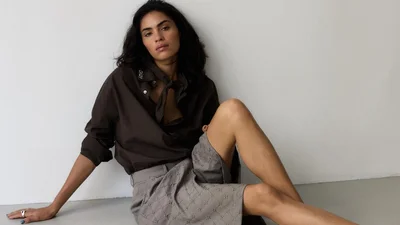
I was sitting at a French bar with a photographer, a culture and fashion zine founder, and a stylist, when a question was floated over crisp Chablis: which designers excite you right now? The fact that this conversation was happening in Paris, where, earlier in the day, we had visited the Rescha showcase at Musée Guimet by the much talked about Indo-French designer Charlotte Chowdhury, was what made the penny drop for me. The designers that excite me right now are not the creative directors shifting around maisons like Balenciaga, Dior, Gucci, or Chanel. It’s the fringe designers, cropping up around and sometimes on a very full Paris Fashion Week calendar.
The Rescha showcase at Musée Guimet by Indo-French designer Charlotte Chowdhury
\| Photo Credit:
Special arrangement
There is context to this, of course. For decades, India has lived inside Paris fashion as labour, as technique — from couture embroidery ateliers to high jewellery houses. But something is afoot, now. Instead of Paris simply borrowing from the country, Indian and Indian-heritage designers are now writing their own stories in the city.
At Haute Couture Week, the established names have made that change visible: Rahul Mishra, Gaurav Gupta, Vaishali S. and, this earlier this month, Manish Malhotra. Around them are contemporary labels such as Kartik Research and Dhruv Kapoor, and diaspora voices like Ashish Gupta and Priya Ahluwalia, who have long shown that Indianness in fashion can be fragmented, bilingual, diasporic: Paris tailoring, Japanese dyeing, American sportswear details, Punjabi memory, Kenyan-Gujarati ritual, Kerala domesticity — all working towards something layered and culturally rich.
A creation by Manish Malhotra as part of his Haute Couture Fall/Winter 2026-2027 collection show in Paris
\| Photo Credit:
Reuters
Pascal Morand, executive president of the Fédération de la Haute Couture et de la Mode, says: “French designers have been attracted to Indian craftsmanship for a long time, and vice-versa.” He points out that emerging brands now represent “a third of the Official Calendars”, and that the Fédération supports young labels through calendar services and grants. So perhaps the question is not only what Indian fashion means in Paris these days, but how Paris itself is changing to make room for these new readings.
Pascal Morand, executive president of the Fédération de la Haute Couture et de la Mode at Paris Fashion Week
\| Photo Credit:
Getty Images
I’ll tell you why these emerging designers matter: they see the world in ways we can’t, or don’t.
Evidence of interconnectedness
I came across Kenyan-Gujarati designer Anil Padia of Yoshita 1967 — a 2026 LVMH Prize for Young Designers finalist — during this edition of the State of Fashion Biennale in Arnhem, Netherlands. His crochet pieces that travelled over the head and down to the ankles were somewhere between armour, veil, heirloom and apparition.
Only a few days after winning the Circular Design Challenge award earlier this month, Padia and I met at a Parisian cafe a short walk from his studio. Here’s what I discovered: the new-era designers are still asking the “why?” of fashion with dangerous sincerity.
Kenyan-Gujarati designer Anil Padia of Yoshita 1967 is a 2026 LVMH Prize for Young Designers finalist
\| Photo Credit:
Special arrangement
Padia particularly likes to dig deeper into rituals we’ve inherited without much questioning. For instance, why does a man wear the sehra at an Indian wedding? What happens if you put it on a woman? Which, interestingly, he did, in the brand’s first show in South Africa. What does crochet become when it is no longer the domestic background noise of women’s labour?
“Métiers d’art”, or artisanal craft, is how Padia describes his brand’s visual language. He also describes the brand as “a collaborative craft economy”, which sounds complex until you understand its logistics: the clothes are made by women in Kenya, some of whom were formerly in domestic work and have now been trained to become full-time crochet artisans; the youngest is in her 20s, the oldest is in her 70s; and Catherine, the first artisan Padia worked with, now runs a team of 50 women.
Métiers d’art, or artisanal craft, is how Padia describes his brand Yoshita 1967’s visual language
\| Photo Credit:
Special arrangement
Bells, or ghungroos, are omnipresent in the designer’s work. Padia flips open a brand document to explain the origin story to me. There’s a photo of a pair of bangles, with bells attached, that belonged to his mother. They look like ghungroos to an Indian eye, but their stories travel further, he explains.
He found the small silver bell ornaments in Diamond Plaza, Nairobi’s South Asian centre, too, and they became a symbol of the brand: dance, movement, mysticism. Later, while digging into ritual objects, he realised the silver bell exists across India, Gujarat, Pakistan, Yemen, Sudan, Ethiopia, all the way down to Zanzibar. It is, he says, evidence of “interconnectedness”.
A global muse
I noticed this boundary-less fil rouge (common thread) in Natasha Sumant of Gundi Studios’ new store in Paris’ 13th arrondissement. It’s a space that brings her Kerala roots to the city. The store is designed in collaboration with her French architect husband, making the space itself a kind of Indo-French marriage: mud-coloured floors, urlis dotting the interiors of what was once a boulangerie, and clothes that carry a New York attitude but are softened by a Parisian effortlessness. “The French, much like Indians, really appreciate craft — there’s a huge reverence in that. That’s been the biggest difference moving my brand from America to Paris,” she explains.
A corner at Natasha Sumant’s new Gundi Studios store in Paris with elements inspired by Kerala architecture, such as red floors, dark wood and metal
\| Photo Credit:
Courtesy instagram/@gundistudios and Kate Devine
Later that week, over wine and cheese with Tamanna Mullen of Arth Atelier, a one-and-a-half-year-old U.S.-based brand that chose Paris for its first showcase, Mullen told me she wanted her clothes to be read not only as products, but as objects with provenance. Her approach is quieter, more restrained: traceable textiles, Indian handwork, genderless tailoring, and the relationship between land and cloth — a lens she developed growing up in Punjab. A chikankari boyfriend shirt, for instance, placed embroidery from India against banana fabric from Myanmar, making the garment feel less like a “craft piece” and more like a map of material, labour and memory.
Designs from Arth Atelier
\| Photo Credit:
Special arrangement
Arth Atelier in Paris
\| Photo Credit:
Special arrangement
Meanwhile, Chowdhury of Rescha, a designer I’ve been following from their early days, also navigates her Indo-French cultures through the clothes she presents. Her global muse this season: Krishna Roy Riboud, the late Indian-French scientist, researcher and textile historian who dedicated much of her life to preserving Indian textile arts. Riboud collected textiles, Chinese antiquities, Baluchari saris from Bengal and so much more, but she also embodies the very world Chowdhury seems interested in dressing: a woman moving between India and Europe, scholarship and society, archive and wardrobe. Rescha’s collection reimagined how these influences might have played out in Riboud’s clothes.
Rescha showcase at Musée Guimet
\| Photo Credit:
Special arrangement
As I met with these emerging names coalescing around a cultural calendar in Paris, I was once again reminded what they are bringing to the table: new ways of seeing and working. Sumant and Padia both work with women craft clusters, while Mullen asks us to look closer at the relationship between agriculture and textile. All of them are interested in global connection.
Last week, when I posted my review of the Rahul Mishra couture show on Instagram, I received a DM from an emerging Indian designer, whose collections had already been playing with the Indian temple references now doing the rounds among couturiers. His was a looser, more modern take: beadwork and grey stone washes worked into louche athleisure. It felt like the perfect reminder that the Indian aesthetic never arrives in one form. And now, with India Couture Week coming up — and several shows planned outside the usual Delhi-Mumbai axis, from Anamika Khanna at Falaknuma Palace to Tarun Tahiliani at Bikaner House — I wonder how many more temple traditions we’ll see circling mood boards this season. My own favourite among them all still? The one by London-based emerging designer Dhruv Bandil.
The column is dedicated to dissecting India’s growing presence around the world, against some of the most talked about cultural backdrops.
The writer is an independent journalist based in London, writing on fashion, luxury and lifestyle.