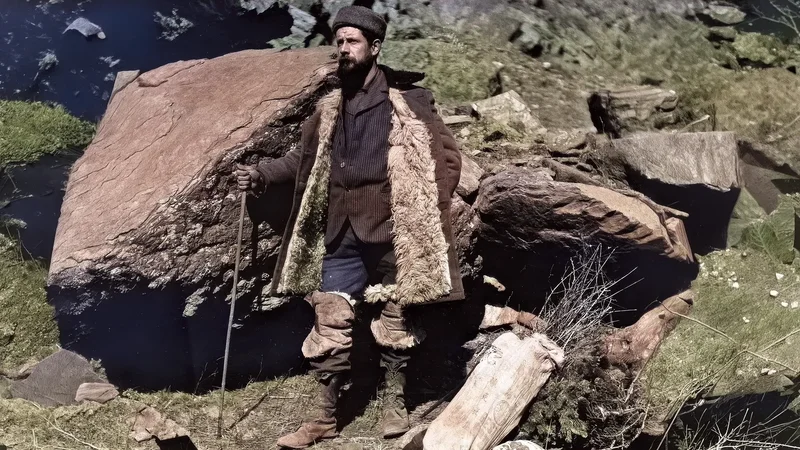
Adapted from Undesirable: Invasive Species, Humans and Where We All Belong, by Amy Crawford (Oxford University Press).
In 1922, Popular Science ran an exclusive interview with Henry C. Wallace, then the U.S. Secretary of Agriculture, about a small division of his department that had an outsize influence on Americans’ dinner tables—and imaginations.
“[A] little band of globe-trotting plant hunters from the United States Department of Agriculture has succeeded in the past 25 years in locating in foreign countries, and introducing into this country, more than 51,000 lots of grains, fruits, forage crops, vegetables, and plants,” wrote reporter E. L. Jones.
“These Columbuses of the plant world know the remote places of the sphere as few real explorers can. They travel through tropical jungles where boa constrictors, tigers, lions and leopards lie in wait for human prey,” he wrote. “Their only goal, through all this suffering and privation, is a mere plant which, if introduced into the agricultural life of America may add, it is hoped, to the farm wealth and food resources of the country.”
The USDA’s Office of Seed and Plant Introduction dispatched these explorers beginning in 1897, under the supervision of a 29-year-old botanist named David Fairchild. Ultimately, “Uncle Sam’s Plant Hunters” would be responsible for the introduction of some 400,000 cultivars, including quinoa and soybeans, mangoes, and Meyer lemons. They also wound up importing some of our most notorious invasive species, among them the aggressive vine kudzu, fast-growing melaleuca, and the now-widespread Chinese tallow tree.
The plant hunting craze of the late 1800s and early 1900s
Plant hunting was not only an American endeavor. This was a time of ruthless colonial conquest, and European countries also sent their own explorers across Asia, Africa, and South America, with or without the consent of the people who lived there. Scottish botanist George Forrest collected some 31,000 specimens from southern China between 1904 and 1932, at least once disguising himself in local garb to avoid being murdered by Tibetan guerillas.
“Few realize the great hardships and dangers which have to be faced in order to secure new plants for cultivation,” he wrote, in a 1910 account for The Gardeners’ Chronicle. “In the warmer regions, there is danger from miasma [unhealthy odor], fever, animals, and snakes. Not infrequently too, the collector has to seek his specimens among savage or semi-civilized peoples, who, in most instances, strongly resent his intrusion into their midst.”
The United States, however, directed more resources to plant-hunting than anywhere else. In the 1890s, with the frontier officially closed, agriculture stretched from coast to coast and American farmers were clamoring for new, hardy crops able to adapt to different environments, from high plains to semi-tropical, in which they found themselves.
A tropical garden of strange plants in Miami
Fairchild, who had recently returned from circumnavigating the globe, was eager to take on this challenge. He had a particular interest in tropical fruit, and among his first orders of business was to establish an experimental garden in Miami, where he might grow delicacies like the “alligator pear”—better known today as an avocado.
The first USDA Plant Introduction Garden sat on a small plot of land in what is now downtown Miami. There, Fairchild and his colleagues set about cultivating all manner of plants, trees, and vines.
“To us young fellows, this six acres seemed quite marvelous,” he wrote in his 1938 memoir, The World Was My Garden. “It was the first land available to us where we could plant anything we wanted.”
The risk of foreign plants
In addition to new varieties of citrus, kale, and hardy durum wheat, they also planted some crops that proved to be regrettable mistakes. In 1903, the USDA acquired the Chinese tallow tree, notable for its waxy seed coatings. Hoping to spark the development of a new fuel oil industry, the department had tallow seedlings planted in Texas. By the end of the 20th century, the versatile hardwood had spread through the Gulf states, transforming native prairies and marshland into tallow tree monocultures.
It was not the only USDA-introduced species to get out of hand. In 1914, researchers imported seeds of Australian melaleuca, a fast-growing tree with papery bark; a couple decades later, the U.S. Army Corps of Engineers was planting groves of melaleuca, which can shoot up six feet in a year, to stabilize levees in the Everglades. At least one pilot broadcast seeds from the air as part of an effort to dry out what was generally seen as a “useless” swamp. One hundred years after the USDA imported it, melaleuca had taken over half a million acres in South Florida.
Kudzu, a vine from Japan, was another of Fairchild’s imports—one that he lived to regret after he planted it at his Maryland estate. “I grew a lot of seedlings and scattered them about rather recklessly,” the botanist wrote in his memoir. “The seedlings all took root with a vengeance, grew over bushes, and climbed the pines, smothering them with masses of vegetation which bent them to the ground and became an awful, tangled nuisance.”
Meanwhile, the Miami Plant Introduction Garden kept growing, too. By 1914, the original site had become too crowded, so the Department leased another 25 acres in the subdivision of Buena Vista. But both sites were soon hemmed in by the growing city.
In 1923, the garden operation moved to Chapman Field, an abandoned World War I airbase south of town, where new species continued to arrive through the 1960s at the rate of 500 species of fruits, vegetables, flowers, shrubs and trees each year. All along, the busy facility—which eventually expanded to 125 acres—was separated from the Everglades by little more than a chain-link fence.
Shifting attitudes towards non-native plants
Running between one of the country’s most sensitive ecosystems and the wild-eyed experimentation of America’s globe-trotting plant hunters, that permeable barrier now belongs thoroughly to another era. Indeed, in the decades following Fairchild’s tenure, the USDA’s posture toward non-native plants and animals began to shift, and ultimately to reverse.
Today, the idea of deliberately shipping thousands of species around the world has become anathema to conservation goals, as well as to the mission of the USDA, which now budgets nearly $2 billion a year toward preventing, detecting, and managing species that originate in foreign countries.
But while the USDA’s plant hunters do shoulder the blame for many invasive species, it’s a complex tradeoff—after all, we also have them to thank for some of today’s most nutritious (and delicious) foods, including Meyer lemons, pistachios, kale, mangoes, quinoa and that funny-looking fruit they called “alligator pear.”
Were Fairchild alive today, he might be dismayed to see the havoc wrought by some of his imports. On the other hand, he would likely smile at the popularity of avocado toast.
In That Time When, Popular Science tells the weirdest, surprising, and little-known stories that shaped science, engineering, and innovation.