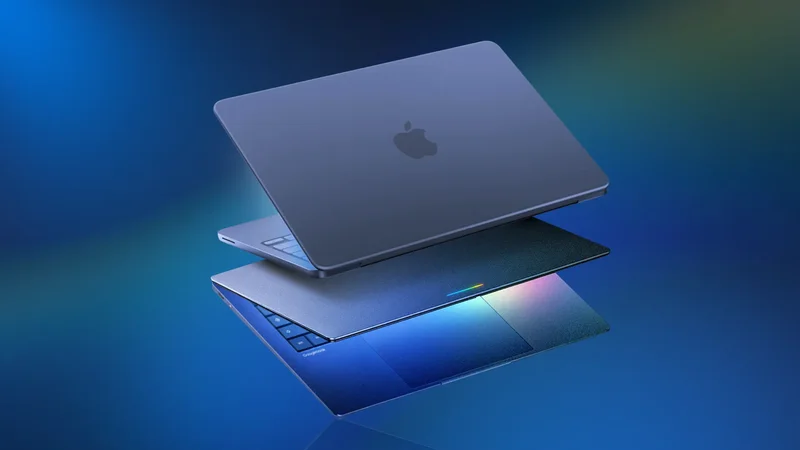
My trusty Chromebook died last week. I'm still unsure exactly what knocked it out of commission, but I knew it was time to let it go. The $300 laptop had served me well for over five years, and it was time for a replacement.
While I was surprised it had lasted me this long, I was hoping it would last me a few more months.
The is right around the corner, and it seemed like the ideal replacement. However, now that I've picked up its competitor, I'm glad I didn't wait.
The more leaks I hear about the Googlebook, the less confident I get
What started as an exciting MacBook competitor has turned into another Gemini product
In March 2026, when rumors around Aluminium OS were heating up, alongside the , I became very excited. Finally, a true Android laptop that would bring the iOS/macOS experience to Android devices.
Sure, Android devices sync marvelously with Chromebooks, but no Chromebook can compete with a powerful Windows or macOS laptop. Hence, my excitement for a true competitor to Apple laptops.
However, as the months passed, my excitement waned. Rather than the productivity and media powerhouse I was hoping for, the Googlebook was shaping up to be another way to encourage us to use Gemini.
My opinion didn't improve when I went hands-on with the Magic Cursor demo. Pitched as a flagship feature of the Googlebook, I found it to be clunky, unresponsive, and broken.
August 12 should reveal the Googlebook in full, but it's too late for me.
A week of using the MacBook Neo showed me why the Googlebook will disappoint
Its respectful approach to AI blew me away
I'm a practical man at heart, so I buy the best tools for the job. I needed an affordable laptop that helped me stay productive. Enter the MacBook Neo.
There's a lot I could say about this laptop, but most of it can be summed up by pointing at the price tag. It functions like a laptop twice the price, and has all the bells and whistles one would expect from a MacBook (minus a backlit keyboard, which is annoying).
However, there's one feature that convinced me I had made the right choice.
While setting up my MacBook Neo, I was asked if I wanted to use Apple Intelligence. I cheerfully clicked "No" and continued on my way.
A week later, I noticed something. Or rather, the lack of something. Not once had I seen a pop-up, suggestion, or reminder to use Apple Intelligence.
I know I won't get this level of respect from a Googlebook
Google won't let you ignore its flagship feature
It might seem silly to point out that after confirming that I didn't want to use Apple Intelligence, I didn't see the feature again.
However, my experience with Gemini over the years is that Google doesn't take "no" for an answer.
Yes, I can disable the Gemini app and uninstall the AI Core app, but Gemini is everywhere. It's baked into Chrome, Google Search, and apps like Gmail and Drive. I can't use the Google ecosystem without seeing Gemini.
By contrast, after disabling Apple Intelligence, I never saw it again. I've hunted through all the preinstalled apps on my MacBook Neo, including Siri, and I haven't come across hide nor hair of it.
Apple Intelligence is still in beta, so there's still a chance Apple can follow the Google route. But using this laptop is a breath of fresh air and the distinct sense that I've dodged a bullet.
Baking AI into hardware is a consumer-unfriendly decision
Google is banking on people wanting a dedicated Gemini machine
I have no particular desire to use Apple Intelligence, but if I change my mind, it's only a settings toggle away.
That's what the AI experience should be. I use a few AI tools infrequently, and I'm grateful for them. But like any tool, I like to put them away when done.
I use a screwdriver about once a month, but if Google provided it, it would check in every day to see if I needed it. I know when I need to use a screwdriver. I know when I need an AI tool; I don't need to be reminded about it.
The problem is that Google has bet so big on AI that it has to push it on everything to avoid disaster. Apple, on the other hand, seems content to develop AI as just another tool.
The result is an experience where I'm in control of AI. On a Googlebook, I won't get that level of respect.
Google is going to struggle to make the Googlebook succeed
Even if the Googlebook wasn't a Gemini-first product, I would still be apprehensive about its future.
It's going to be hard to ditch the legacy of Chromebooks, and people will be reluctant to give up the Windows and macOS laptops they've grown used to for years.
Chromebook users are the best target, but is shoving Gemini in their faces the best way to encourage an upgrade? I don't think so.
If Google really wants to mimic Apple's success, it needs to take the same .