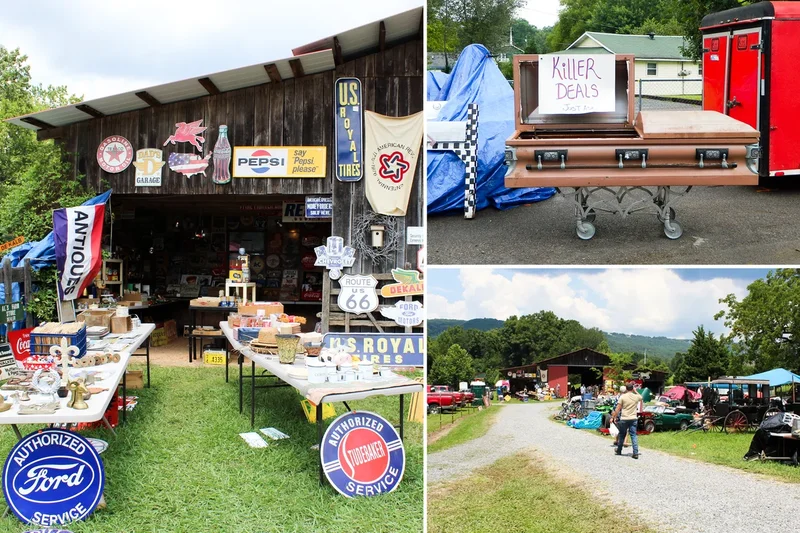
To understand the 127 Yard Sale, it helps to start on a back road in rural Ohio, where a 12-foot rooster statue towers before a red barn. Alternatively, route to a two-lane stretch in Tennessee, where a vendor’s sign propped inside an open casket promises a “killer deal.”
For nearly 700 miles — stretching along Highway 127 in southern Michigan down to Lookout Mountain Parkway, Alabama — the nation’s longest yard sale winds through open farmland, mountain bluffs and small towns.
Along the four-day route, tables hold a mix of everyday attic clear-outs and true oddities.
Shoppers sift through classic roadside fare like vintage tools, mid-century furniture, milk glass and car parts, mixed with items you would be hard pressed to find anywhere else. Over the years, vendors have set up everything from Victorian wheelchairs and antique farm machinery to full-sized replica dinosaurs and even a vintage embalming table.
“Every year, people ask me, ‘What is it like?’” Josh Randall, the director of media relations for the 127 Yard Sale, told The Independent. “It’s one of those things where, until you experience it yourself, it’s very hard to put into words because it’s on such a massive scale. People think yard sale, they think the Saturday morning kind of thing. But because it’s so big, it’s like you’re going to an event. You're not just going to a yard sale.”
The event’s origins trace back to 1987, when Mike Walker, then county executive of Fentress County in Jamestown, Tennessee, hatched a plan to lure vacationers off major interstates. The goal was to redirect tourist traffic onto two-lane back roads, giving small rural communities along Highway 127 a chance to show off their local businesses, parks and regional culture.
The local experiment quickly caught on. Neighboring communities across Kentucky, Ohio and surrounding states wanted to be part of it, eventually expanding the route into the six-state corridor it is today.
“Over the following years, Ohio was added to it, Georgia down into Alabama, and eventually the last portion that was added was into the southern portion of Michigan,” Randall said. Next year, he added, marks the sale’s 40th anniversary.
Spanning nearly 700 miles, the event is so vast that even those who run it struggle to capture its magnitude. With no single entry point or gate count to rely on, organizers estimate that participation climbs into the hundreds of thousands, driven by more than 10,000 vendors spread across all six states.
Navigating the sale requires patience and a willingness to abandon strict schedules. Because traffic slows to a crawl through the heavy vendor clusters, driving Highway 127 means surrendering to the pace of the road.
“You might show up somewhere and think you're going to be there for ten minutes,” Randall said, "and the next thing you know, you're talking to a vendor and you're there for two hours.”
For Randall, that unhurried pace is precisely what gives the sale its staying power. Having traveled the entire 700-mile corridor multiple times, he sees the event as a rare reprieve from an increasingly digital world.
“Today, so much of our lives is digital — we’re on social media, we’re doing email,” he said. “Actually being in person and talking to other human beings face-to-face is becoming more of a unique thing. People spend a lot of time talking, and there’s a real community aspect to it.”
That desire to talk to actual people mirrors a broader trend in the explosion of second-hand shopping and secondhand culture. In recent years, thrifting and vintage hunting have transformed what used to be a weekend hobby into a massive secondary economy, fueled in large part by social media creators, digital resellers and content creators looking for unique pieces.
The 127 Yard Sale Facebook community alone has grown to more than 199,000 members, serving as a year-round online home base where shoppers post wish lists, vendors share photos of incoming merchandise and property owners rent out booth spaces for about $25 per day.
Yet while platforms like TikTok, Instagram and online marketplaces have introduced a younger generation to the thrill of second-hand treasure hunting, Randall notes that digital hype can only take you so far.
The online space helps build anticipation, but it ultimately serves to feed the real-world experience.
Influencers and content creators now travel the route to document their journeys in real time, drawing viewers into a culture centered on tactile discovery — sifting through physical crates, bargaining over old tools or vintage fashion and connecting directly with the seller.
Beyond individual sellers clearing out attics, the event provides an essential economic lift to small towns along the route. One indoor antique mall in Chattanooga, Tennessee, recorded four-day sales totals during the event that eclipsed its entire previous month’s revenue.
Revenue aside, most people come for the simple joy of the drive.
“You get to experience something you wouldn't normally,” Randall said.