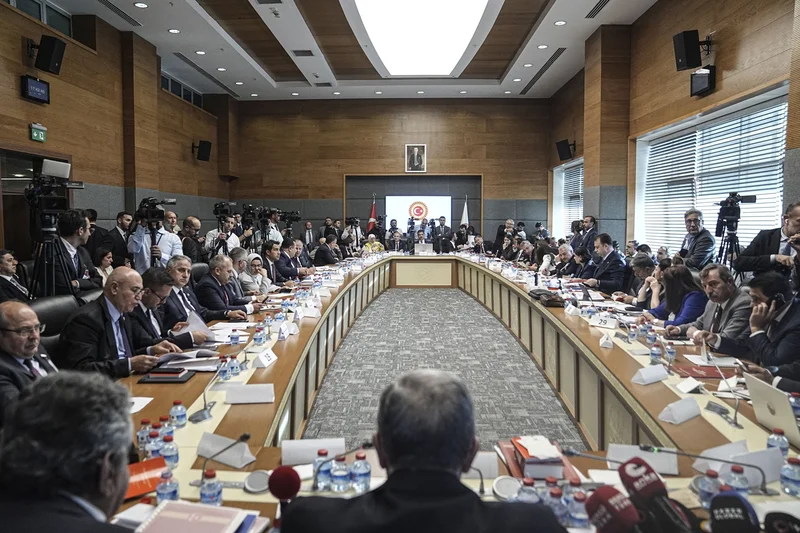
On a scorching day with temperatures floating around 31 degrees Celsius (88 degrees Fahrenheit), lawmakers in Parliament will convene one last time before a summer recess that will end in October. On their agenda is a topic as hot as the Ankara weather: a terror-free Türkiye. Deputies are expected to give overwhelming support to a draft bill that involves the disarmament of the PKK terrorist group and reduced sentencing for nonviolent members of the group.
The passing of the law is a highly critical stage in the "terror-free Türkiye" initiative, which has so far advanced through apparently unilateral moves by the PKK after it announced its dissolution last year.
The Law on Strengthening National Solidarity and Social Integrity was approved on Saturday by Parliament’s Justice Committee after a quarrel in which lawmakers supporting and opposing the bill engaged in harsh verbal arguments.
On Monday, Parliament’s General Assembly will convene to discuss the draft law, roughly five days before the anniversary of the PKK’s first attack in Türkiye in 1984. Since then, the terrorist group has been involved in the killing of tens of thousands of people across the country, as well as troops conducting counterterrorism operations abroad. Türkiye changed its policy toward the PKK over the following decades, though it firmly opposed its existence due to the group’s separatist ambitions.
As the terrorist group started diminishing in power and influence, Devlet Bahçeli, leader of the government-allied Nationalist Movement Party (MHP), informally launched the "terror-free Türkiye" initiative on Oct. 1, 2024, the day Parliament opened its new term. This unexpected foray by a nationalist politician primarily known for advocating the execution of the PKK’s jailed ringleader Abdullah Öcalan evolved into a state initiative over time. Bahçeli’s call for Öcalan to urge his group to lay down arms met a response in the PKK’s 2025 announcement to that effect. The MHP leader, who has limited his attendance at public events due to frail health, is expected to attend the General Assembly to see what his call has culminated in.
The draft bill will come into force once authorities verify that the PKK and all of its regional affiliates have fully dissolved and handed over all weapons and munitions to security forces, and this verification is published in the Official Gazette. The bill covers crimes including founding and running the PKK, aiding and abetting the group, producing propaganda for it, and funding its operations. Suspects who were prosecuted or investigated for those crimes will have their sentences deferred for five to 10 years. The deferral period will be longer for those prosecuted for crimes carrying prison terms of over 15 years.
PKK members involved in killings, as well as those prosecuted and sentenced for crimes bearing sentences like life imprisonment before June 1, 2005, will be exempt from deferrals. This includes most senior cadres of the PKK currently in hiding in northern Iraq, as well as Abdullah Öcalan, who was earlier sentenced to life imprisonment and is currently held in an island prison near Istanbul.
Those benefiting from deferrals will have certain political and civil rights suspended for two to three years. PKK members seeking to benefit from deferrals will be allowed to apply at Turkish diplomatic missions in their current countries of residence.
Türkiye will also set up two boards to monitor the process: a monitoring board chaired by the vice president and a parliamentary board comprised of 17 members. Authorities will log every weapon, piece of ammunition, explosive and piece of equipment declared by PKK members into a registry to monitor the dissolution process.
During Saturday’s session, the Justice Committee approved the bill, which bore the signatures of 367 lawmakers, with votes in favor cast by the AK Party, the MHP, the PKK-aligned Peoples’ Equality and Democracy Party (DEM Party) and the Republican People’s Party (CHP). Lawmakers from the New Party (YP) were divided over the bill, with one lawmaker voting "yes" while two other party members on the committee abstained. However, YP lawmaker Sezgin Tanrıkulu, who observed the committee’s session, announced that they would vote in favor once the bill reached the General Assembly.
The Good Party (IP) did not participate in the vote, although its members clashed with proponents of the bill during Saturday’s session. Addressing the committee, Mehmet Ökmen, director general of legislation at the Ministry of Justice, said the monitoring board would not issue any judicial decisions and would only be tasked with making suggestions regarding the process. Stating that under the Turkish legal system there is no deprivation of rights during the investigation and prosecution phases, Ökmen noted that exceptions exist under certain special laws, citing the Legal Profession Law as an example. Explaining that under this law, deprivation of rights exists while prosecution, meaning the court process, is ongoing, Ökmen noted that there are also deprivations of rights under other statutes in Turkish law.
Following the approval of the bill, Cüneyt Yüksel, chair of the Justice Committee, said they had completed work of historical significance.
“Together, we have crossed a crucial threshold toward leaving behind a heavy burden that our nation has carried for more than 40 years. I believe the determination displayed here will hold an exceptional place in Türkiye's political and social history," he said.
Abdülhamit Gül, deputy parliamentary group chair for the AK Party, echoed his remarks. "Today, we have carried out the first stage of an important key, an important lock opening Türkiye's doors. We are talking about a legislative proposal submitted with 367 signatures. According to our Constitution, the signatures of 200 members of Parliament are sufficient even to submit a constitutional amendment proposal. Today, a legislative proposal has come before our Parliament with a strength greater than that of a constitutional proposal," he said.