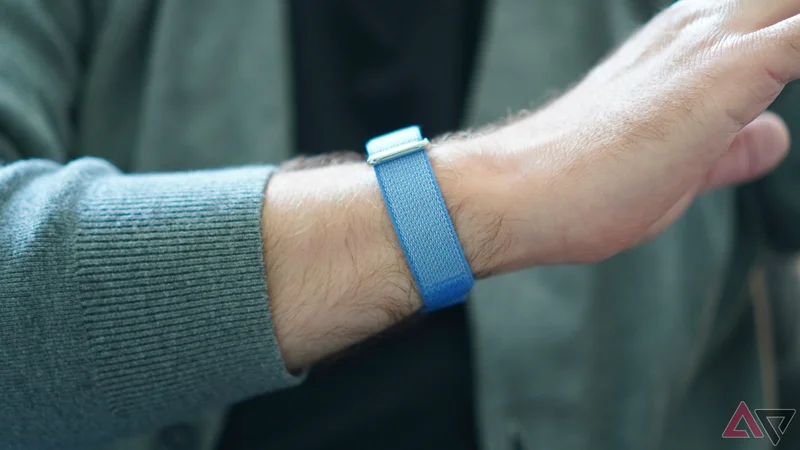
I bought the Fitbit Air expecting a simple, reliable way to keep an eye on my daily activity.
For the first few days, everything looked perfectly normal, and I had no reason to question the numbers appearing in Google Health.
But during one incident, I paid closer attention and compared the data with my actual routine, and something felt seriously off.
The entire saga left me questioning whether I could trust the Fitbit Air at all.
I expected a quiet activity day
Due to a long trip by road
I had been wearing the Fitbit Air for nearly a month, and until then, it had been good enough for what I needed.
I was not expecting laboratory-level precision from it, but the daily step count, activity summaries, sleep data, and generating fitness insights seemed useful.
Nothing stood out as obviously wrong, so I had little reason to question the data it showed me.
That changed last Sunday when I drove from Ahmedabad to Surat. The journey was roughly 300 km (186 miles), and I spent most of the morning sitting behind the wheel.
Apart from walking around briefly before leaving, stopping along the way, and moving around after reaching Surat, it was supposed to be a very quiet day.
I expected my final step count to reflect that. Instead, Fitbit Air recorded something so unrealistic that it changed how I looked at the device.
The final number made no sense
The bumpy road fooled the tracker
The problem became obvious when I checked my Fitbit Air after the journey. Instead of staying unchanged while I sat behind the wheel, the step count kept climbing throughout the drive.
It added between 800 and 1,000 steps every hour, even though I had barely left the driver’s seat.
By the time I completed the five-hour journey, the Fitbit Air had recorded nearly 5,000 steps. The number made no sense.
There was no realistic way I had covered thousands of steps while driving from Ahmedabad to Surat.
At first, I wondered whether I had missed something, but the hourly data made it clear that most of those steps had been added while the car was moving.
The road conditions offered the most likely explanation. Many parts of the journey were rough and uneven, so the car was constantly vibrating and bouncing.
Since I was driving, both my hands were frequently moving with the steering wheel as I adjusted to the road.
It appears that the Fitbit Air interpreted those repeated wrist movements and vibrations as walking.
Every bump, steering correction, and movement of my hand seemingly contributed to the step count.
This was not a harmless mistake
Other metrics may have been affected
It would have been easy to ignore the issue if Fitbit Air had only a few hundred extra steps during the drive.
Wrist-based trackers are never perfectly accurate, and small errors are expected.
But nearly 5,000 steps over a five-hour journey is not a minor error. It pushed me much closer to my daily goal without any real physical activity.
The inflated step count also made me question the rest of the data. Steps feed into estimates like distance, calories burned, and overall activity levels.
As a result, the Fitbit Air showed a more productive day than I had. Even if some metrics rely on heart rate and personal data, thousands of false steps can still skew the results.
Now, I can’t tell which numbers are reliable and which are not.
False progress is worse than no progress
Accuracy matters more than extra features
A low step count would have at least given me an honest picture of my day. Instead, the Fitbit Air made it look as though I had been active when I had spent most of the time driving.
That kind of false progress is more harmful because it can influence my decisions.
I might skip a walk, feel satisfied with an activity goal, or assume I had moved enough when none of it was true.
The Fitbit Air may offer plenty of health insights, activity summaries, and smart features, but none of them matter if I can’t trust the underlying data.
I would rather use a simpler wearable that consistently gets the basics right than a feature-packed tracker that delivers questionable numbers.
The problem was impossible to miss
Step tracking is one of the most basic things a fitness wearable should get right, which is why this experience has been so disappointing.
A few extra steps would have been understandable, but recording thousands of steps while I was sitting behind the wheel is difficult to overlook.
More importantly, this has made me question the rest of the data as well. I am no longer fully confident in its calorie estimates, activity minutes, or other health metrics.
At this point, I am planning to replace it with the Samsung Galaxy Watch 9 or the upcoming Google Pixel Watch 5.