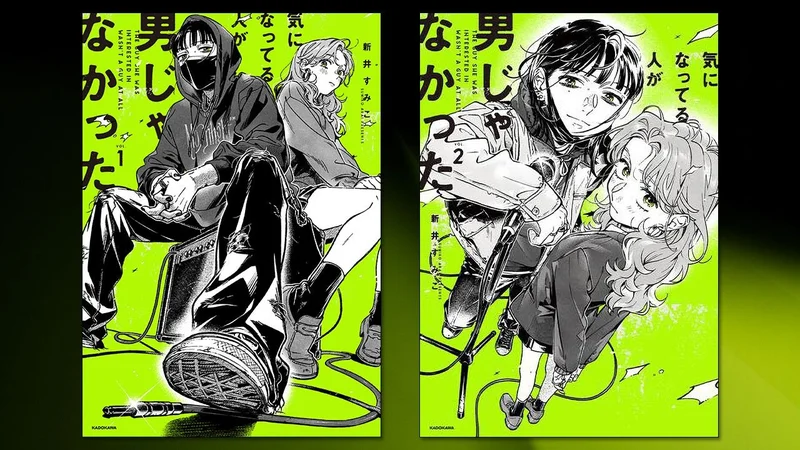
Manga works dealing with youth, young passions, and love are far from rare. The Guy She Was Interested In Wasn’t a Guy at All by Arai Sumiko dives into the deep end by going beyond the themes of music and youth to explore friendship, love, and gender, and the ways these can all blend in complex ways.
The Record Store Guy is a Girl
Our story begins with high-school girl Aya “totally fangirling” over a guy working at a local CD shop. The guy, though turns out not to be a guy at all—it is, in fact, Mitsuki: the plain girl who sits next to Aya in class. At first, Mitsuki hesitates to reveal the truth to Aya, who has a reputation for flashiness. Mitsuki fears that revealing the two sides of her character might disappoint Aya.
But as they grow closer through their love of music, the truth is revealed.
When the facts come to light, Aya is angrier about Mitsuki hiding the truth than she is about the idea of her “guy” actually being a girl. Once they get past that snag, though, the two grow to be something more than friends, if not quite lovers. What makes this story unusual is how it never becomes all about “romance between women.” It is striking how everyone accepts them so naturally. The story can simply show the naturally growing relationship of two young people.
The obstacles between them have nothing to do with gender, in fact. They are more related in terms of their standing at school and the difference between Aya’s outgoing flashiness and Mitsuki’s reserved gloominess and the way she struggles to get along with others.
The way in which the bonds and love between these two girls is depicted so naturally, without any intense drama or conflict, could well be called particularly modern. In that sense, it is a monumental work reflecting today’s increasing acceptance of same-sex couples.
Volume four of The Guy She Was Interested In Wasn’t a Guy at All, by Arai Sumiko. The relationship between light-haired Aya (left) and dark-haired Mitsuki accelerates as the story goes on. (© Kadokawa/Kitora)
An Unbreakable, Special Bond
Topics like the budding of adolescent sexuality or coming to terms with what it means to “have feelings” for someone have long been bedrock elements of manga and stories written for girls. The idea of some “supreme bond” that ignores all boundaries, including gender, is another universal that this work also shares.
Stories dealing with intimacy or romance between girls are generally known as yuri. Whether this series is considered part of the genre will depend on how broadly you define that realm. However, fiction dealing with romance between women has long existed in Japan, reflecting changes in society through the years. Here, I’d like to take a quick look over those changes in looking at the particular appeal of this manga.
Early signs of this theme show in up prewar girls’ entertainment. Stories by the novelist Yoshiya Nobuko (1896–1973), like her 1932 Wasurenagusa (Forget-Me-Not), became a sensation among younger girl readers for their depiction of the “Class S”—the S standing for sister—subculture of special relationships between students at girls’ schools. The majority of women in those days were fated to marry partners chosen by their parents and become homemakers. Their sealed world of girls’ schools gave them some room to experiment, thus leading to the Class S culture of short-term pseudoromances. After World War II, that culture died out and freedom to choose romantic partners became the norm, but girls’ manga preserved the idea of those fleeting moments of happiness.
Even with the spread of democratic ideals after World War II, same-sex romance was the target of social opprobrium, and romance between women became the stuff of tragic stories. The 1971 story Shiroi heya no futari (The Couple in the White Room), by Yamagishi Ryōko, features two lonely girls in the same dormitory growing close, but in the end the tale of their shared-gender relationship ends in sadness.
After that, girls’ manga began to focus on shōnen-ai, or boys’ love. Stories about romance between women were overshadowed by the numbers of those about male couples, but they never vanished completely.
Reflecting Japanese Society
Amid the lavish Japanese bubble economy, which reached its peak from the late 1980s into the early 1990s, the stories in these manga grew from focusing on tragic downfalls into less shadowed ones. For example, the 1993 shōjo manga Anata to sukyandaru (Scandal With You) serialized in the magazine Ribbon, the girl protagonist falls in love at first glance with a guy who, in fact, turns out to be a girl. The events resemble what happens in Arai’s The Guy She Was Interested In. No one around the protagonist judges her as abnormal or unusual; she simply focuses on following her feelings and grows close with her crush. However, in the end, she ends up with someone else—a boy—in what was considered a “happy ending.”
In the 2000s, men also began reading stories about romance between women under the influence of works like Konno Oyuki’s light novel Maria-sama ga Miteru (The Virgin Mary is Watching), and specialized magazines also appeared on the scene. Such works also began to be called yuri, and so a specific genre was born.
Manga dealing with LGBTQ characters and issues have increased over time, and Japanese attitudes in general have also changed. Same-sex marriage is not recognized at the national level in Japan, but as of May 2025 over 530 local governments had adopted same-sex partnership systems, covering 92.5% of the population. The Guy She Was Interested In itself reflects how the world is changing around us.
Of course, it is still a stretch to say that Japanese society is truly tolerant of queerness and diversity of sexual orientation. The unaffected way the manga depicts the girls’ relationship is not at all the norm. That is exactly why this story can also be seen as an ideal which we hope society will someday become.
Highlighting Preconceptions
The author first started posting the story of The Guy She Was Interested In on X (formerly Twitter) in 2022, and as of February 2026, the author’s account has over a million followers. I imagine that the reason it resonates with so many people is that it has helped us notice the unconscious gender stereotypes that many of the Japanese people still harbor.
As the title hints, the protagonist falls for someone that she thinks is a guy because “he” is cool and handsome, traits that are associated with masculinity. It holds up a mirror to the readers, many of whom certainly hold the preconception that “if a girl has a crush, that crush will be on a guy.” But when the story and its characters treat the fact that this is a same-sex relationship as utterly unexceptional, and readers see how these two girls develop deep, special bonds, the readers naturally come to accept the relationship.
Rather than anything surprising or provocative, the girls’ relationship is presented simply, and the readers can take it as just something that happens. I imagine that, on reflection, many will find that they feel differently after reading the story than they did before.
This manga could well be called groundbreaking for the way it evokes feelings of universal human drama, rather than confining itself to genre labels like yuri, or “girls’ love.”
To celebrate the publication of the fourth volume in February 2025, Kinokuniya stores throughout the Asia-Pacific region put up special displays. (© Kadokawa/PRtimes)
Within Japan, the series has been recognized many times, coming in first in the Web Manga division of the Next Manga Awards 2023, second in the Women’s section of the Kono Manga ga Sugoi! 2024 ranking from Takarajimasha publishing, and second in Da Vinci magazine’s Book of the Year 2023 comic ranking. It has also been chosen for anime adaptation.
On the international front, the English translation was named Best New Manga at the 2025 American Manga Awards. In Europe, the French version won the Best Romance Award at the Japan Expo Daruma, while the Spanish translation was named the Best Yuri at Manga Barcelona, both in 2025. It was also selected for the 2026 Texas Maverick Graphic Novel Reading List, which is compiled for young adult readers by public and school librarians.
Music Manga Breaking Boundaries
One of the main characteristics of this manga is how the story moves with music.
Aya and Mitsuki love Western rock music. This is a stark difference from the common image of high school girls in Japan following pop idols or social media influencers. Rather than doing what everyone’s doing and like what everyone likes, fixing the affirmation “I want to like what I like and be who I am” to music makes for a more stylish story of youth. The visuals also incorporate yellow-green shading to accent the black and white drawings, drawing out the chicness.
The girls’ conversations about rock are filled with references to real bands and recommended songs. When they attend the Fuji Rock Festival together, the visuals are sure to get the heart racing for readers who’ve been themselves. There is a strong contingent of readers in their late thirties or early forties who were rock fans in their own youth. Now, though, fans among Aya and Mitsuki’s generation are few and far between, and it serves to show how they stand apart.
Volume three of The Guy She Was Interested In Wasn’t a Guy at All (Arai Sumiko). The guitar motif hints at the music theme. At the very end of volume two, the author comments: “One of the things I like about listening to music is when there’s someone there who really gets it. This manga is the same way.” (© Kadokawa/Kitora)
Music connects people across barriers and sweeps away those societal identifiers: age, gender, personalities that are outgoing versus introverted. And one of the great charms of the manga is how it uses that element of music.
The author has created a playlist built from the perspective of the two girls, using songs mentioned in the manga, and made it public on streaming apps like Spotify or Amazon Music. Try listening while you read, or even after you’re done!
(Originally published in Japanese. Banner photo: The Guy She Was Interested In Wasn’t a Guy at All volumes one and two, by Arai Sumiko. © Kadokawa/Kitora.)