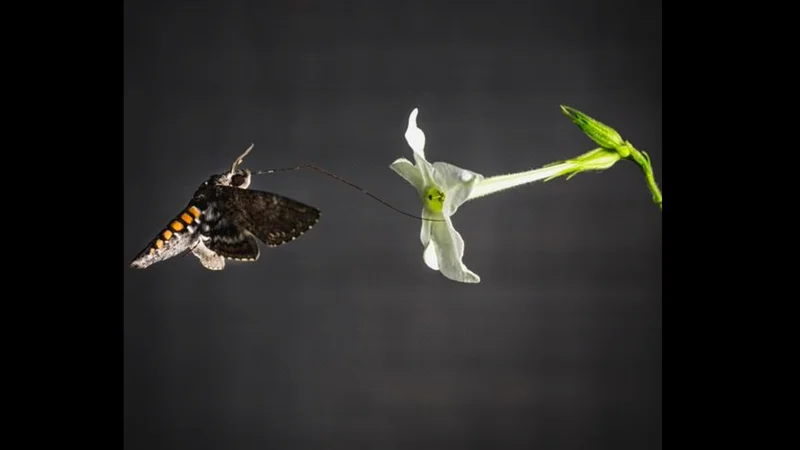
A moth’s wings do much more than help these pollinating insects fly. Their powdery look comes from tiny scales made of sensitive hairs that help moths stay stable in the air, thermoregulate, and taste sweet and bitter molecules. Now, a study recently published in the Journal of Experimental Biology found that in tobacco hawkmoths (Manduca sexta), they can even help the insects smell.
A team of scientists in Germany initially suspected that moth wings may be able to detect certain aromas based on earlier research.
“The tobacco hawkmoth was recently found to have receptor proteins in its wings that could detect different smells and tastes,” study co-author Sonja Bisch-Knaden, a scientist at the Max Planck Institute for Chemical Ecology, explained in a statement.
To begin their study, the team gently clipped the edges of the moth’s wings and sprayed them with a gold mist. Then, they took a closer look at the tiny hairs on the wings, using a scanning electron microscope and found that some of them were porous—a hallmark sign of scent sensors. Then, they spent months conducting an analysis that revealed the wings have the genes for odor receptors.
To confirm that the moths could actually sensor odors with their wings, the researchers used a technique called electrowingography. They placed cut out wings between two electrodes and recorded how they responded to different odor molecules. The wings only picked up two odors—pyrrolidine and piperidine, a pair of stinky organic compounds called amines that are found in the leaves of nightshade plants.
What’s more, the wings could still pick up the scents with their edges trimmed off. “This suggests that the moth has special sensory hairs across its wings, not just along the edges, that can smell those odors,” said Bisch-Knaden.
As a final test, the researchers used artificial intelligence to predict the structures of ten candidate odor receptors and see whether pyrrolidine and piperidine fit into their binding pocket. Both of the malodorous molecules fit neatly into two of the candidates, confirming that the wings have a sense of smell.
There’s still a lot the scientists don’t know about these sniffing wings, including how they impact moth behavior. Tobacco hawkmoths like to lay their eggs on nightshade, so it’s possible that they use their wings to guide them towards the plants.