- See more Daily Mail on Google - save us as a Preferred Source
Here is a question. Do you want Nigel Farage to win the by-election in Clacton on Thursday?
If you are a supporter of Reform UK, you obviously do. If you back Labour, the Lib Dems or the Greens, you don’t. I’m not sure about those who favour Restore Britain, the extreme breakaway party to the Right of Reform.
What if you are a Tory voter? You may be uncertain or divided, although your leader, Kemi Badenoch, is in no doubt. She has sent a letter to the electors of Clacton asserting that they ‘deserve better’ than Farage. That sounds like a big ‘No’ to me.
Actually, it seems highly likely that Reform’s leader will win the by-election, which he precipitated because he resented an inquiry by the parliamentary commissioner into whether he had broken rules by not declaring a £5million gift before the 2024 general election.
He is facing 33 other candidates, among them the slightly tiresome ‘Count Binface’, who together constitute a motley crew of oddballs. The main parties, including the Tories, have refused to fight what they regard as an artificial contest.
Nigel is relying on the verdict of the good people of Clacton. If they vote for him, he’ll claim he has been exonerated. This would be untrue. All he could honestly say is that voters in his constituency don’t think the allegations against him render him unfit to serve them.
Anyway, let’s not go too far down that foxhole. I return to my question. What should Tories – or perhaps I should say people of the reasonable non-Reform Right – think about Nigel Farage, not just in Clacton this week but in the months ahead?
There’s a general view among such folk, fostered by Kemi, that Nigel shouldn’t be trusted with power. Some of them (I can’t say whether they include Kemi) believe the Tories can regain their position as the main party of the Right before the next election, and even win.
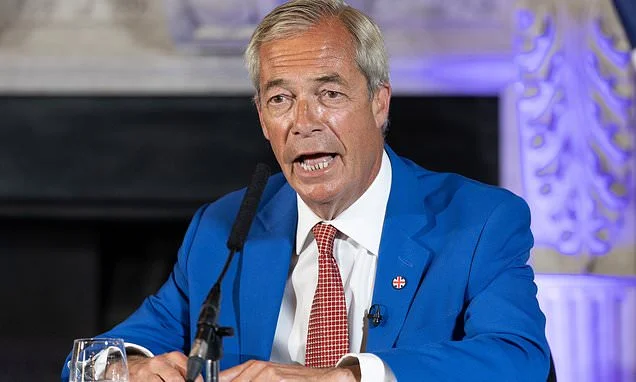
It seems highly likely that Reform leader Nigel Farage will win the by-election in Clacton on Thursday
Needless to say, such people are only too happy to see Farage tottering under the weight of various financial scandals. Indeed, it was Kemi who referred Reform’s leader to the parliamentary commissioner over the £5million gift.
So there we have it. A Tory belief that the natural order of things will be re-established so that they will reprise their traditional role of the party that governs Britain for most of the time. And a Tory conviction, or at any rate an ardent hope, that Farage will be brought down by sleaze.
Let me say that in my opinion any belief in an imminent Conservative recovery borders on the lunatic, while the assumption that Reform’s leader will disappear under a mountain of financial allegations is probably far-fetched.
How could the Tories conceivably be reinstated? Look what has happened in the polls since Andy Burnham arrived in No 10. There has been the predictable ‘Burnham bounce’, though in truth it’s more like a souffle already showing signs of sagging.
The latest Ipsos poll shows Labour with 28 per cent, having overtaken Reform, who have slipped to 25 per cent, with the Tories stuck on 18 per cent. Research agency More In Common has Labour and Reform at similar levels as Ipsos, and the Tories faring marginally better.
Labour’s slightly improved showing in these and other polls probably reflects its shiny new leader, as well as the negative stories that have been dogging Farage. There’s little to suggest that the Tories are cashing in.
It was Conservative leader Kemi Badenoch who referred Nigel Farage to the parliamentary commissioner over the undeclared £5million gift
Imagine, for a moment, that Reform were to collapse significantly. Who would be the main beneficiaries? Almost certainly Labour more than the Tories.
Some former Conservative voters would be tempted back, especially as the Tory Party’s policies on many issues are now so close to those of Reform. But it’s going to be well-nigh impossible to attract ex-Labour supporters of Reform into the Tory fold. They would more likely return home.
Meanwhile, if Reform unravelled, its most diehard supporters would probably defect to Restore Britain. That party’s unreliable leader, Rupert Lowe, last week produced a list of conditions (including having no ex-Tory ministers in a future Reform cabinet) that Farage surely couldn’t accept.
Reform MP Lee Anderson has suggested that a deal with Restore might be possible but only if Lowe first pledged public support for Nigel Farage. That seems unlikely.
To return to the Tories: it’s very hard to see how a contraction of Reform would suddenly propel them to the top of the polls. Memories of their sense of entitlement, and their failures in government, still run deep.
But in any case I question the Tory assumption (and the hope of the progressive parties) that Farage and Reform are going to be dragged down by scandals. Two things happened last week that suggest otherwise.
Farage and his deputy, Richard Tice, are suing the National Crime Agency (NCA), often described as Britain’s FBI. The two men allege that the agency has leaked confidential information about bank transactions to newspapers.
As a journalist I defend the right of the Press to publish stories in the national interest that rely on confidential sources. However, the NCA, being an organ of the State and duty-bound to respect private information, can make no such defence.
One can imagine the uproar if links were established between the firebombing of Farage’s home and the death of Ann Widdecombe. Joshua Kerry, 28, was charged with her murder on July 20
If it could be shown that the National Crime Agency had passed on confidential details liable to damage Reform, such a revelation would soon develop into a scandal, with Farage and Tice portraying themselves as victims of overweening State power.
A second development last week may be even more significant. Counter-terrorism police investigating the recent murder of Reform luminary Ann Widdecombe have reopened an inquiry into a firebombing at Nigel Farage’s London home in April 2025, which was previously described as a burglary.
The police have referred their handling of their initial investigation to the Independent Office for Police Conduct, which raises the possibility that mistakes were made or evidence overlooked.
One can imagine the uproar if links were established between the firebombing of Farage’s home and the death of Ms Widdecombe. Joshua Kerry, 28, was charged with her murder on July 20.
Should any links be proven, Nigel Farage would argue, with apparent justice, that his party had been the victim of a slapdash police investigation. He would claim that the State hadn’t shown even-handedness towards Reform.
Remember that in the immediate aftermath of Ann Widdecombe’s murder, Devon police repeatedly insisted that there was no political motive – a contention that was seemingly contradicted by the subsequent involvement of counter-terrorism police.
The NCA might of course emerge spotless, and maybe no link will be established between the firebombing and Ms Widdecombe’s murder. But I suspect Reform will succeed in deflecting scrutiny from its own alleged financial improprieties to arguably more serious lapses by the State.
Don’t write off Nigel Farage and Reform UK: that is my message to the Tories. It really is time to put the country first, and to stop thinking in narrow tribal terms.
Sooner or later, Reform UK and the Conservative Party will have to do a deal if we are going to escape a Leftist coalition government led by Burnham’s Labour Party far into the future.