- See more Daily Mail on Google - save us as a Preferred Source
The proportion of late trains on the first line to be re-nationalised by Labour soared to nearly half in its first year under public ownership, figures show.
In a blow for Andy Burnham's plans for more state control, services arriving late on South Western Railway (SWR) surged from 34 per cent to 46 per cent.
The decline took hold in the six months after the operator became the first of Britain's 19 privatised train firms to be taken under full public ownership in May last year.
And while its record has since improved, data obtained by the Daily Mail shows more trains were still arriving late a year after re-nationalisation than before.
Cancellations also rose in the same period – an increase of 1,000 on the year before nationalisation, according to figures obtained under Freedom of Information laws.
Richard Holden, the Conservative Party's transport spokesman, said: ‘Labour promised their state control of rail policy would bear down on ticket prices, end disruption and strikes and lead to better on-board services.
‘All it has done is hard-wire failure into the network. South Western Railways continue to cancel thousands of services.
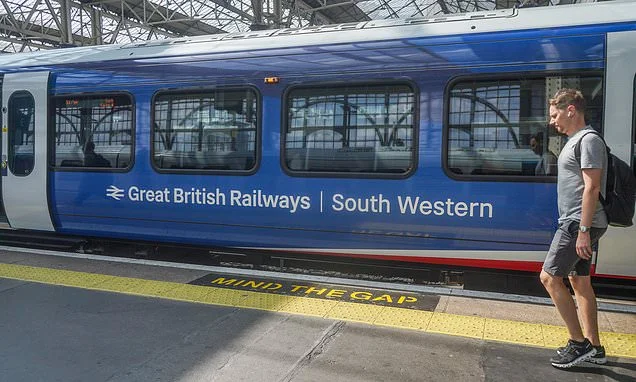
GBR-liveried trains are now starting to run around the rail network, including on the SWR network
'And Labour's answer is to just shovel millions out in compensation and consultancy fees.
'This is a railway being managed badly, at public expense, with no one now left to blame but this incompetent Labour Government.'
Sir Grant Shapps, a former transport secretary, added: ‘Labour's obsession with nationalisation has always been driven by dogma, not what works for passengers.
‘Replacing private investment with taxpayer funding doesn't make trains run on time, it simply shifts more of the cost onto the public.
‘If passengers are now paying more and getting worse service, they'll be entitled to ask what exactly nationalisation was supposed to achieve.’
In June, Transport Secretary Heidi Alexander admitted during a Commons debate that SWR's performance 'has not been up to scratch' and that she could not guarantee tickets would get cheaper amid growing complaints about poor service.
A Department for Transport spokesman said of SWR's decline during the first six months of nationalisation: 'This analysis is misleading - it compares a four-week period in late spring, where performance is typically better, with a four-week period in the height of autumn, when seasonal conditions affect punctuality across the entire network.'
The spokesman added: 'We've invested almost £360 million into SWR's infrastructure over the past year, and increased the number of new, more reliable trains eight-fold.'