Zionism has warped the lexicon, so words are now convenient weapons
It is early on a Sunday morning, and you are awoken by armed police officers banging on your door. They hand you a letter: the state will freeze your assets for a further six months, denying you access to your own bank accounts because they disagree with the anti-genocide stance you have publicly expressed.
The letter cites a tweet you posted several months ago, in which you criticised the Israeli and US bombardment of Iran. It cites the fact that you have shared an interview with a pro-Palestine activist and an article written by an academic historian on social media. These actions are proof, the letter explains, that you have failed to renounce your "pro-jihadist" convictions.
It sounds like something out of the pages of a dystopian sci-fi novel, but for Elias d'Imzalene, a French pro-Palestine activist and founding member of the campaign group Urgence Palestine, it has become real life.
The crime of which d'Imzalene is accused - and for which his movements have been restricted and his assets frozen for more than a year - is not so much a thoughtcrime, to use George Orwell's term, but a wordcrime.
In September 2024, at an anti-genocide demonstration in Paris, he used the Arabic word intifada to refer to the global non-violent uprising against Israel's occupation of Palestine that is still taking place in cities all around the world.
The clip of his speech circulated widely on social media, and by the time d'Imzalene arrived in the courtroom to defend himself - he was sentenced to five months in prison in December 2024, and his appeal was heard in January 2026 - the meaning of the word intifada had been changed entirely.
According to the Zionist organisations that brought the case against him, the word did not refer to an uprising against oppressors. They had transformed the word intifada into a word that denoted antisemitic violence.
Erasure and control
The word intifada is not the only word to have its meaning transformed in this way by Zionist political organisations.
In February 2026, the pro-Israel lobbying group UK Lawyers for Israel wrote to the British Museum asking it to remove the term "Palestine" from gallery labels.
This terminology, they explained, constituted an "erasure" of Jewish history and "could amount to harassment" for Jewish or Israeli visitors. The museum complied.
Zionism's ability to control what words mean has been crucial to Israel's genocide of the Palestinians
Their letter was part of a longstanding campaign - since exposed by Middle East Eye - to rewrite the past, imposing a version of history that lends legitimacy to Israel's occupation of Palestine.
The campaign, which was directed not only at the British Museum but also at universities, including the one where I work, sought to transform the meaning of words.
Terms like "Ancient Palestine", historically attested from at least the 12th century BCE and widely used by professional historians today, were now transformed by this Zionist campaign into "antisemitic" erasures of Israel's preferred version of history.
These examples echo other attempts to transform and control what words mean in order to restrict opposition to Israel's genocide.
The phrase "from the river to the sea" has been banned in multiple places, including Germany and the Australian state of Queensland, because of arguments that it is antisemitic - even though it appears in the 1977 founding charter of Benjamin Netanyahu's Likud party in support of the idea of a Jewish ethnostate.
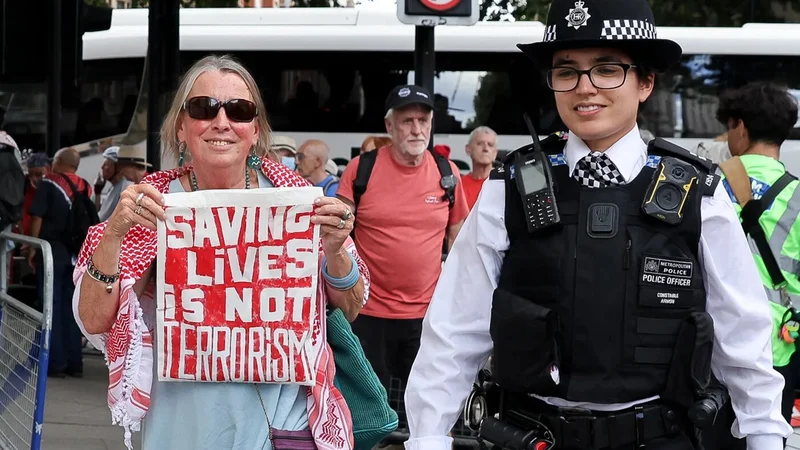
And nearly 3,000 people have been arrested in Britain for displaying the phrase "I refuse genocide, I support Palestine Action", following the proscription of the direct-action group.
The ban, now being challenged in the Supreme Court, transformed Palestine Action into a terrorist organisation and changed the meaning of the phrase into support for terrorism.
In each of these examples, we see one of the most potent weapons of Zionism at work: its attempt to control what words mean.
The word intifada is used widely in Arabic and other languages to refer to resistance against oppressors - from the strike of dock workers in the port at Basra in 1952, to Irish anticolonial protest against the British, the two Palestinian intifadas, and the intifada of the Jewish resistance against the Nazis in the Warsaw Ghetto Uprising of 1943.
To argue that the term intifada refers to antisemitic violence is to hollow out the layers of meaning the word has built up over decades of circulation and usage, and impose a new meaning onto it.
Like the other examples of words whose meaning is altered in defence of Israel's genocide, the word intifada is distorted and reframed as a signifier of antisemitism, transforming those who utter it into antisemites themselves.
Colonisation as 'liberation'
Zionism's ability to control what words mean is not new. In fact, perhaps its most successful act of transformation is the word "Zionism" itself.
In his 1896 book The Jewish State, Theodor Herzl explained that Zionism was a project of European supremacy. In deliberating over whether Argentina or Palestine ought to be colonised to establish a Jewish ethnostate, Herzl argued that Palestine was preferable because a Jewish state there could form "a rampart of Europe against Asia, an outpost of civilization as opposed to barbarism".
He outlined a "Jewish Company" on the model of other European colonial companies, such as the Dutch East India Company and the Imperial British East Africa Company.
Other Zionists concurred. Chaim Weizmann recalled in his autobiography telling the 1919 Paris Peace Conference that "what the French could do in Tunisia... the Jews would be able to do in Palestine", and Vladimir Jabotinsky wrote that "Zionism is a colonizing adventure".
But the meaning of the word "Zionism" was soon transformed from European colonialism to national liberation.
In a letter to Max Nordau, Herzl wrote: "The Jewish Colonial Bank must actually become the Jewish National Bank." This shift also took place in many other colonial organisations. The Jewish Colonisation Association, which facilitated the migration of settler-colonisers from eastern Europe to occupied land in Palestine, was renamed the Jewish Charitable Association.
The fact that the word "Zionism" had meant colonisation was erased, and the word was given a new meaning. It now meant the charitable establishment of a place of refuge, and a national liberation movement for self-determination.
To say that Zionism's weapons are also linguistic is not a way of minimising their destructive potential. What words mean is not simply a matter for academics or philologists to mull over in ivory towers, leafing through lexicons and etymological dictionaries.
We are living in a moment where words can kill.
Zionism's ability to control what words mean has been crucial to Israel's genocide of the Palestinians.
It has rewritten histories, incarcerated activists and imposed restrictions on freedoms of all kinds on those who refuse to submit to Zionism's attempts to control language itself.
It is high time we all learn to recognise that the control of words is a weapon. And it is high time we arm ourselves with the language to fight back.
The views expressed in this article belong to the author and do not necessarily reflect the editorial policy of Middle East Eye.