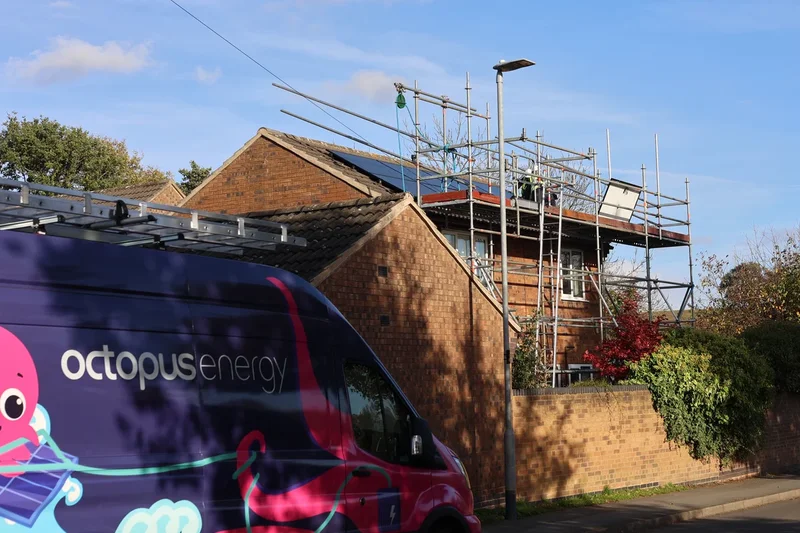
Octopus Energy may be best known as one of the UK’s biggest energy suppliers, but it now wants to manage far more of your home’s energy setup. Alongside electricity tariffs, heat pumps and EV charging, it installs rooftop solar panels and batteries, giving homeowners the option to generate, store, use and sell electricity through the same company.
That one-stop-shop approach is one of Octopus’s biggest selling points. Its solar systems can be paired with home battery storage and smart import and export tariffs designed to help you make better use of the electricity you generate. Octopus also handles the process from system design through to installation, which may appeal if you’d rather avoid dealing with several different companies.
Convenience isn’t everything, though. Solar panels remain a sizeable investment, and Octopus won’t necessarily be the cheapest installer for every home. In this review, we look at its panels, batteries, prices, warranties and installation service to help you decide whether Octopus solar is worth considering.
Get a quote for solar panels for your home
Use our comparison tool to get free quotes from leading solar panel installers.
Octopus grew rapidly during the energy crisis, a period when many smaller suppliers collapsed. Since then, it has pushed further into home energy services, adding solar panels and battery installations to its existing renewable tariffs, EV charging products and heat pump offering.
That breadth is Octopus’s main advantage as a solar installer. For homeowners who want one company to handle more of their energy setup, Octopus can install panels, supply electricity and gas, provide smart tariffs, buy back excess solar power, support EV charging and fit low-carbon heating systems.
This joined-up approach will appeal to households that want to simplify their move towards cleaner energy rather than dealing with several separate companies. However, export rates are still important. Octopus’s flat Outgoing tariff currently pays 12p per kWh for exported solar power, while some rival tariffs may offer higher headline rates with conditions attached. The lower your export rate, the longer it can take to recoup the upfront cost of your solar installation, so it is worth comparing tariffs as carefully as the panels themselves.
Why choose Octopus solar panels?
- Solar installation cost: From £6,663 for two panels without a battery
- Solar plus battery cost: From £8,623 for eight panels with a 5kWh Essential battery
- Guarantee length: 25-year solar panel product warranty, 30-year linear power-output warranty and five-year installation warranty; battery and inverter cover varies by product
- Area covered: England and Wales
- Typical time from inquiry to installation: 2-3 months
- Founded: 2022
Batteries are often a good choice for families who use their electricity mainly in the evening. That way, your panels charge your battery during the day, ready for you to use as the sun goes down.
Octopus also has a cheap overnight tariff, which can be used to top up your battery for use during the day. This could be particularly useful in winter if you have a smaller array, when solar power might not offer enough for your needs.
What’s more, Octopus offers microinverters with some of its solar packages. Rather than relying on one central inverter, these sit beneath individual panels and can improve energy capture in low-light or partially shaded conditions, while also allowing you to monitor the performance of individual panels. They come with a 25-year warranty.
Microinverters aren’t used with every Octopus system, though. Packages using batteries such as the Tesla Powerwall 3 and Fox EVO can instead use the inverter built into the battery, so the equipment installed will depend on the solar and storage package you choose.
Octopus’s solar panels come with a 25-year product warranty and a 30-year linear power-output warranty. Its installation work is covered by a five-year warranty, while warranties for batteries and inverters vary depending on the equipment you choose.
How much do Octopus solar panels cost?
Octopus solar installations currently start from £6,663 for a two-panel system without a battery, based on June 2026 prices. However, that entry-level package is much smaller than the system many households will need, so it’s more useful to look at the cost of a larger setup when comparing Octopus with other installers.
Octopus currently installs all-black solar panels rated at around 450W to 455W, depending on the package. The panels measure roughly 1.7m by 1.1m, and Octopus will recommend the number and system size that best suit your roof and electricity use.
Octopus offers several battery and inverter combinations depending on your budget, roof and energy needs. Its more affordable systems use Fox batteries, while its Optimised systems pair Enphase batteries with microinverters, which can be particularly useful on larger or partially shaded roofs because each panel can be monitored and optimised individually. For households looking for greater storage capacity and backup power, Octopus also offers the 13.5kWh Tesla Powerwall 3, which has a built-in inverter and can keep the home powered during a blackout when the appropriate backup equipment is installed.
Battery warranties vary by product, with Fox systems offering up to 12 years of cover, Enphase batteries 15 years and the Tesla Powerwall 3 10 years. Compatible systems can also work with Intelligent Octopus Flux, which automatically manages charging and exporting according to electricity prices.
An eight-panel installation with a 5kWh battery currently costs £8,623 with Octopus’s Essential battery, or £9,018 with its Smart battery. The final price will depend on the number of panels your home needs, the battery capacity you choose and the complexity of the installation.
Octopus says its standard quotes include the solar panels, battery where selected, microinverters where required, other electrical components, labour, delivery and scaffolding. Bird proofing costs extra. You’ll receive a final price once Octopus has designed a system for your property.
Customers can either pay in full following installation or use a fixed-term loan. Octopus currently requires a £500 non-refundable deposit when you sign the installation agreement.
As with any solar installation, it’s worth comparing several quotes rather than judging Octopus by its headline starting price alone. The cheapest package may not reflect the size of system your home actually needs, while battery choice can make a noticeable difference to the overall cost.
Pros:
- One supplier for energy, panels and other supplies
- Which? Recommended energy supplier 9 years in a row
- Fixed price quotes
- Big name brand, albeit a fairly new one
Cons:
- There are cheaper fitters
- Limited solar panel choice, although many models can be very similar
Can I get a grant for Octopus solar panels?
Yes, you might be eligible, but it depends on your household and property. Here’s what to know:
Grant availability
Octopus Energy’s solar panel offering points to the Energy Company Obligation (ECO) scheme (England & Wales) as the main route for subsidised solar installs. According to Octopus, under ECO, some eligible homes can install solar panels (and sometimes heat pumps) at zero cost.
For other homeowners, wider funding options may include the Warm Homes: Local Grant in England, which is delivered through local authorities and can support eligible low-income households with measures such as insulation, solar panels and air source heat pumps. Availability depends on your household, property, postcode and council participation.
Eligibility conditions
- To qualify under ECO (via Octopus) you typically need:
- A home with an EPC rating of E, F or G.
- Private rent or social housing, or being in receipt of means-tested benefits.
- Roof and home gear suitable for solar + heat pump (if required).
Octopus emphasises that not all applicants are guaranteed installation; suitability and survey outcomes matter.
If you do not meet grant criteria, you may still proceed via a paid installation, and you’ll still benefit from VAT relief, export tariffs and savings on electricity. For more on these and other funding and savings options, see our guide to solar panel grants and funding.
What to do next
- Fill in Octopus’ eligibility checker or request a quote.
- Have a professional roof/home survey done to check solar suitability.
- Check your EPC rating, benefits status, and whether pairing with a heat pump is required (for some funding).
- If you don’t qualify for grants, consider the pay-back analysis and savings section below.
Bottom line: Grants for Octopus solar panels are available, but they are limited to certain households under ECO/HUG-type schemes. Most homeowners will instead depend on cost savings and export payments.
How much can I save on energy bills with Octopus?
Here’s a realistic look at savings you might achieve with Octopus solar, and what to bear in mind.
What Octopus claims
Octopus says the amount you can save with solar depends on the size of your system, whether you have a battery, the tariff you use and when you consume electricity. Its current solar guidance cites government estimates suggesting households could save around £500 a year, although actual savings will vary considerably from home to home.
Adding battery storage can increase the amount of solar electricity you use yourself and allow you to take advantage of time-of-use tariffs. Octopus currently offers both Octopus Flux, which lets customers schedule battery charging and exporting around cheaper and more expensive periods, and Intelligent Octopus Flux, which automates this process for compatible batteries.
What you should check
- Your energy usage pattern: how much you use, when you use it, and how much you consume during the day (when solar is generating).
- Your system size and battery: larger homes and households with evening usage benefit more when paired with a battery.
- Your tariff and export deal: Membership of an export-friendly smart tariff and good export rates improve ROI.
- Location, roof orientation and size: installations in north-facing roofs, heavy shading or smaller systems will reduce savings.
- Up-front cost and pay-back period: despite savings, most systems take 9–13 years (or more) to pay back in the UK context.
Remember, these figures from Octopus are all estimates. Your actual savings will vary widely based on usage, system size, roof, battery and export rate.