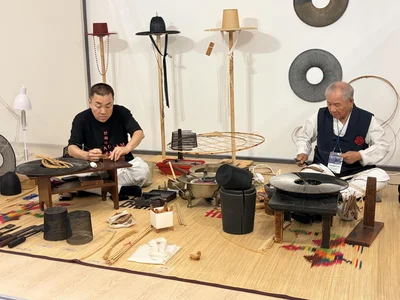
Master horsehair hat maker Park Chang-yeong, right, and his son Park Hyung-park, demonstrate traditional horsehair hat making at the K-Heritage House exhibition in BEXCO, Busan, Tuesday. Korea Times photo by Park Jin-hai
BUSAN — As Korea hosts the UNESCO World Heritage Committee meeting for the first time since joining the organization in 1988, a major cultural showcase in Busan is drawing massive crowds eager to experience the nation's traditional heritage powered by cutting-edge technology.
Since its opening on Monday at BEXCO, the K-Heritage House is drawing attention from locals and committee meeting participants. The special exhibition introduces Korea’s UNESCO-listed assets and heritage administration policies across four themed zones: an archive tracing the past, present and future of heritage; a living intangible heritage zone; a technology-driven heritage section; and interactive activity spaces.
Living heritage: Master craftsmen in action
The highlight for many visitors is a joint public demonstration featuring master artisans holding National Intangible Cultural Heritage titles. Craftsmen demonstrate intricate traditional techniques, including making a traditional "gat" (horsehair hat), embroidery, needlework, mother-of-pearl inlay, fine woodworking, horsehair cap-weaving, woodcarving and engraving. Hands-on workshops also allow guests to craft mini gat, Hanbok keychains, and mother-of-pearl tumbler cups.
A major draw is the live demonstration of traditional gat-making. The Korean headwear recently gained global attention after appearing in the animated feature "KPop Demon Hunters."
Park Hyung-park, a sixth-generation master horsehair hat maker continuing the family tradition alongside his father, expressed pride in sharing his craft with a global audience.
"First of all, it was wonderful to show that our traditional crafts — our intangible heritage — are being continuously passed down without interruption."
A visitor makes paper hydrangeas at the K-Heritage House exhibition in BEXCO, Busan, Tuesday. Korea Times photo by Park Jin-hai
Demonstrating how to make miniature gat, Park explained that authentic Korean headwear features subtle curves and hair-thin bamboo strands.
"Gat evolved from practical sunshades into formal attire worn gently atop the head as a sign of respect," Park said. "Foreign visitors are often amazed by how delicately we split and weave the bamboo."
Nearby, Seoul’s historic Jingwan Temple led a workshop on jihwa — traditional paper flowers made from "hanji" (mulberry paper). Historically burned after royal and religious rituals to embody the "aesthetics of emptiness," these flowers were believed to comfort souls and welcome deities.
"While many cultures make artificial flowers from fabric, Korea is unique in using hanji," explained a guiding monk, demonstrating how to fold paper hydrangeas.
A visitor touches the wall that is part of immersive digital installation at the K-Heritage House exhibition in BEXCO, Busan, Monday. Yonhap
The exhibit also highlights the Hoeam Temple Site in Yangju, Gyeonggi Province — one of Korea’s most significant Buddhist monastery ruins, preserving the foundations of a vast 14th-century Seon (Zen) temple currently on Korea’s World Heritage Tentative List.
At the Hoeam Temple booth, visitors can pose for extended reality (XR) photos set against a 3D digital restoration of the historic temple complex, or engage in real-time AI conversations with King Taejo (Yi Seong-gye), the founder of the Joseon Dynasty (1392-1910).
Norfaryanti Binti Kamaruddin, a visitor from Malaysia, praised the seamless blend of history and technology.
"Even though I cannot understand Korean historical stories well, I could step inside the palace context, learn about it and take a photo in the XR zone," Kamaruddin said. "In the chat section, I can have a conversation with the king from a previous dynasty, and that's cool. I'm so amazed by the culture and the technology."
A colleague traveling with Kamaruddin noted the high level of visitor engagement compared to other international conventions.
"What I like most is how interactive everything is," she said. "You can just walk up to each booth, and the staff interact with you and explain everything. You can feel they really love their culture."
Immersive media art, future heritage
In the technology-focused section, an immersive digital installation titled Heritage: Timeless Time uses dynamic media art to reinterpret nature using the iridescent colors of traditional mother-of-pearl. The space also features high-definition digital recreations of the UNESCO-registered Uigwe (Royal Protocols of the Joseon Dynasty) displayed across massive media pillars and four-sided video walls.
Kim Ji-yeon, a visitor from Seoul who traveled to attend the workshops, noted that the long wait in line was well worth the effort.
"It's normally very difficult to travel to every individual region to see these cultural assets," Kim said. "Having them gather in one place where we can experience them firsthand is an incredible opportunity."
For visitors attending the exhibition, professional docent tours are held daily at 10:30 a.m. and 3:30 p.m. to provide guided walk-throughs of key heritage displays.