Just three minutes into the documentary "Travis Barker: Louder Than Fear," police dashcam video captures the fiery 2008 plane crash in South Carolina that killed four people and left the Blink-182 drummer as a survivor.
Spanning the years 2017 to 2026, the documentary celebrates Barker's life both before and after the transformative accident, a defining moment in a milestone-filled career. The project initially served as a screen adaptation of his 2015 memoir, "Can I Say: Living Large, Cheating Death, and Drums, Drums, Drums." However, the narrative evolved after a producer suggested closing the film with Barker—then unable to fly because of post-traumatic stress disorder—merely walking toward a plane.
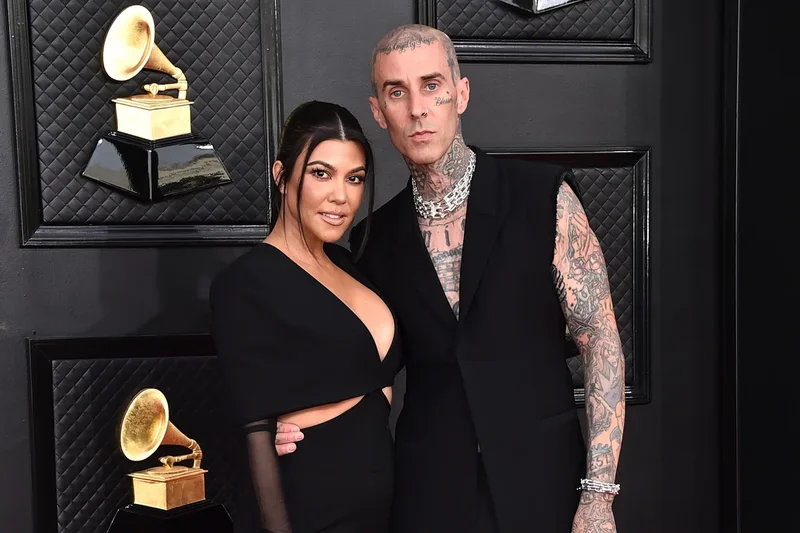
Barker resisted an ending "where this thing still has power over me," opting instead to board the aircraft at the conclusion. The documentary finishes with a slide show of family photographs, featuring his wife Kourtney Kardashian and his children.
"I almost died," Barker says, believing that it "could be helpful to share my life."
An elastic artist
Barker's resume is long, and a two-and-a-half-hour documentary can only cover so much of it. The film hits most of the big notes, quickly establishing Barker as a rebellious kid with a supernatural drumming ability from age 4, when he got his first kit, to now, at 50.
And that's with many projects in-between: From the SoCal punks Feeble, which he joined while working as a trash collector, to his stint in the ska band The Aquabats and multiplatinum, pop-punk legends Blink-182 — the band that skyrocketed Barker into superstardom.
Also covered? His love of skateboarding and car culture, his clothing brands, side-projects Box Car Racer and +44, turntable duo TRV$DJAM, various experiments and collaborations in hip-hop (Bun B, Lil Wayne ) and beyond.
But it all began with drumming, and hilariously enough, Animal from “The Muppets” — his first drumming hero — until he discovered cross-genre greats like jazz legends Buddy Rich, Dennis Chambers and Elvin Jones as well as Mötley Crüe’s Tommy Lee.
“Where drumming got really serious for me was after my mom passed, so it was therapy,” he says, reflecting on his childhood. “It’s like my life. It’s like oxygen to me.”
It's also a kind of sport. Barker has long been a dedicated, athletic percussionist, and he likens it to a boxer's meditative state. “It’s like when you see a fighter and he just goes for broke the first round. There’s sometimes where I just feel like that,” he says. “Something just takes over my body.”
Many events in life threatened that euphoria, but none quite as physically as the plane crash. “I was in a burn center for six months on morphine and I had 30 surgeries,” he recounts. “Seventy percent of my body was burned.” At one point, he didn't only fear if he would be able to drum again — even walking was a question mark.
Lessons from tragedy
Even before the crash, Barker's life — as marked with musical triumphs as it has been — offered lessons in resiliency.
“Whether it was my mom passing away or my plane crash, I learned — and through watching friends of mine and just living life — I’ve seen traumatic experiences either destroy someone or define them,” he says. “Every loss I had, or every everything I took to the chin, it made me stronger. At the time, I can’t realize it, right? I can't like really wrap my head around it. But ... that’s why I went so hard and I was so determined to play music and so determined to succeed. Plan B was only making Plan A work. You know? There was no Plan B.”
The same tenacity can be applied to his sobriety and dedication to flying again — a journey emboldened by his family. “I fly all the time now and I feel turbulence and I can’t even tell you what’s going on in my head. And I just look over and my wife’s perfectly OK,” he says. “My son loves airplanes and plays with airplanes and it’s so innocent. It’s so beautiful.”
“They’ve been my greatest joy,” he says of his children, who grow up on screen across the film's near-decade of filming.
As someone who has lost a lot and thought about what it would be like to lose even more, when it comes to the topic of legacy, Barker has a simple dream. “I think I’d want to be remembered for my music and my drumming and being a great father, husband, and son and brother,” he says.
As for the doc? “Maybe my story helps somebody,” he pauses. “I don’t love how everything happened. I don’t like the losses that happened. But I like how hard I had to work. I like that I wasn’t born with a silver spoon in my mouth. I liked that I had to navigate and find my way. And the journey was awesome.”