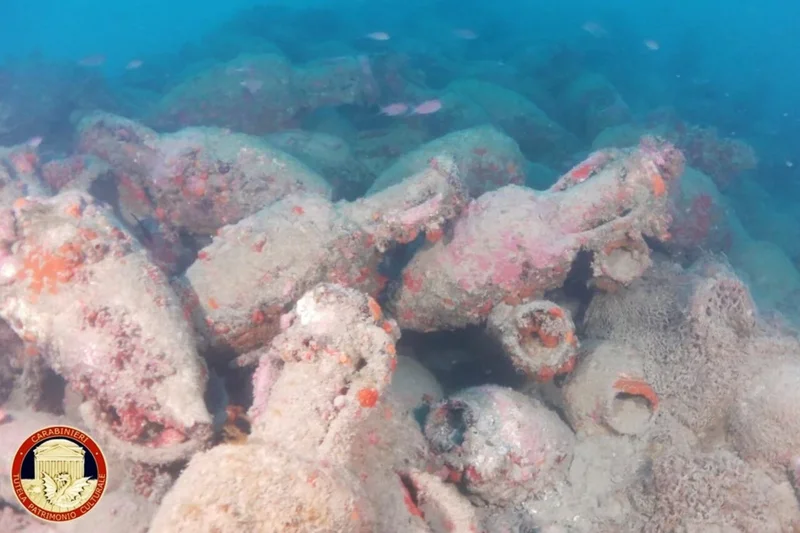
Sometime between the second and first centuries BCE, a Roman ship carrying hundreds of wine-holding vases sank to the bottom of the sea near the coast of modern-day Sicily. And thatâs where it lay for the next two thousand yearsâuntil two divers ran into the shipwreck by accident.
In a statement (translated via Google) last Saturday, the Italian Ministry of Culture reported the discovery of a Roman-era shipwreck roughly 3 miles (4.8 kilometers) off the coast of Mazara del Vallo in Sicily, Italy. Divers Giacomo De Mola and Bisulli Igor encountered the ship at a depth of 151 feet (46 meters). Further investigations by government authorities found that the ship carried hundreds of amphorae, two-handled pots archaeologists believe were used to carry different liquids and grains.
Scoperto al largo di Mazara del Vallo un relitto romano del II-I sec a.C., con centinaia di anfore.
«Una delle più importanti scoperte archeologiche subacquee degli ultimi anni», dichiara il Min Giuli, congratulandosi con @Carabinieri Nucleo TPC e SopMare della Regione Sicilia pic.twitter.com/H1JbfX8MzF— Ministero della Cultura (@MiC_Italia) August 8, 2026
“This is one of the most important underwater archaeological discoveries of recent years,â Alessandro Giuli, Italyâs minister of culture, said in the statement.
A deep dive
In a video on the discovery, diver Giacomo De Mola recalled the encounter, saying that initially, the murky view made him think that he was just swimming past a large rock (translated via Google Translate). Thatâs when he noticed that the ârocksâ werenât what they seemed at all. Then, the pair reported its discovery to officials, who determined that the shipwreck consisted of an amphorae mound roughly 70 feet (21 meters) long, 20 feet (6 meters) wide, and 6.5 feet (2 meters) tall. There were also two large lead anchors and a lead pipe.
âIt is hard to describe the feeling of being among the first humans in nearly twenty centuries to see that place again,â De Mola wrote in his post. âThe sea never ceases to surprise us. This time, we found more than just a shipwreck. We found a piece of our history.â
Records from the past
According to De Mola, Sicilian authorities have created a 3D survey of the wreck, and extended scientific investigations of the site are slated to continue in the coming days. The amphorae appear mostly to be the Dressel 1A type, typically associated with the late Roman period. This is also consistent with archaeologists’ preliminary dating of the site, which points to the wreck being from between the 2nd and 1st centuries BCE.
As the site has just resurfaced, Italian experts are still beginning to get a good grasp of the full archaeological record at the site. Currently, authorities have detailed the cargo of amphorae but have yet to determine the exact circumstances under which the wreck ended up where it did. In any case, the hypothesized timing of the shipwreck âspeaks to us of the people, the routes, and the exchanges that made the Mediterranean a crossroads of civilizations,â Giuli said in the statement.
âResearch will continue to uncover its history and deliver it to the community,â he added.