Banker urges building up seaports
Land Bridge project requires second look
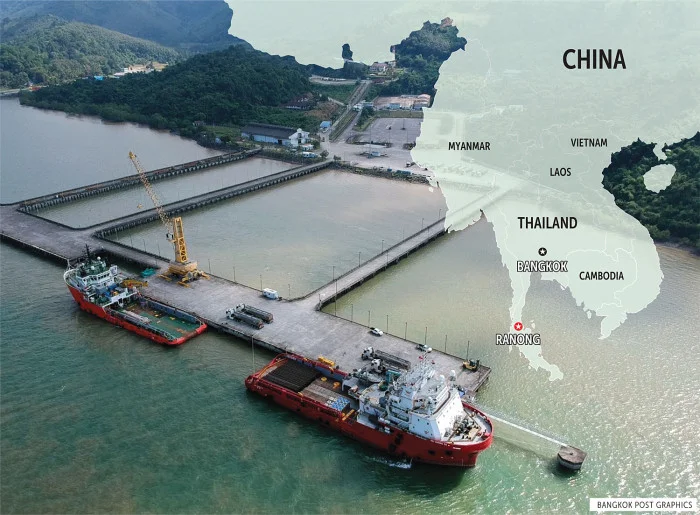
A revised transport network that connects China to western Thailand via a new deep-sea port in Ranong could serve as a more viable alternative to the Land Bridge project, which is considered less feasible, says a banker.
Prime Minister Anutin Charnvirakul recently announced the government would review the Land Bridge project to ensure it represents good value for investment, and may initially focus on connecting the "missing links" between ports on the Andaman coast and the Gulf of Thailand, as well as other parts of the country to those ports.
Kobsak Pootrakool, senior executive vice-president at Bangkok Bank (BBL), said if the full-scale Land Bridge project proves difficult to implement, the priority should be developing western seaports and the connecting infrastructure, which has long been advocated.
Speaking following a visit to China with the government over the past weekend, Mr Kobsak said Chongqing could be a key market because cargo from the area could be transported through Thailand's western ports for onward shipment to India, the Middle East and Europe, offering a more convenient route than via Shanghai.
Postponing the Land Bridge project and focusing on the completion of port development offers a greater chance of project success, he noted.
Rather than upgrading the existing port in Ranong, which is difficult to access due to its river location, Mr Kobsak suggested constructing a new deep-sea port at a more strategically suitable site.
Chinese business interests in Thailand continue to grow. Over the past three years, most foreign direct investment in the country is from China, driven by the "China Plus One" strategy and geopolitical factors.
When establishing operations in Thailand, these companies mainly require working capital, trade finance and local banking services, while domestic financing is expected to become more important in later phases, he said.
BBL aims to strengthen local supply chains. Several Thai companies have already begun producing vehicle bodies and components for Chinese electric vehicle (EV) manufacturers.
Thailand must capitalise on this trend as China expands its strengths in information technology, EVs, solar energy and eventually artificial intelligence, while Japanese technology becomes less dominant, said Mr Kobsak.
Thailand is becoming China's regional hub for Southeast Asia, with many Chinese cities using the country as a distribution centre, he noted.
Although Chinese manufacturers may not initially rely on Thai banks for financing, later investment phases and supply chain expansion are expected to create new opportunities for local lenders, according to BBL.
This investment trend could help drive Thailand's economic growth to 3-5% over 3-4 years as infrastructure projects are completed, said Mr Kobsak.
In addition, he said Thailand's traditional industries must modernise to remain competitive with China.
Factories operating with decades-old technology will struggle to compete, making this an opportune time for businesses to invest in new technologies and production facilities, said Mr Kobsak.
Kobsak Pootrakool (file photo: Bhumjaithai Party)