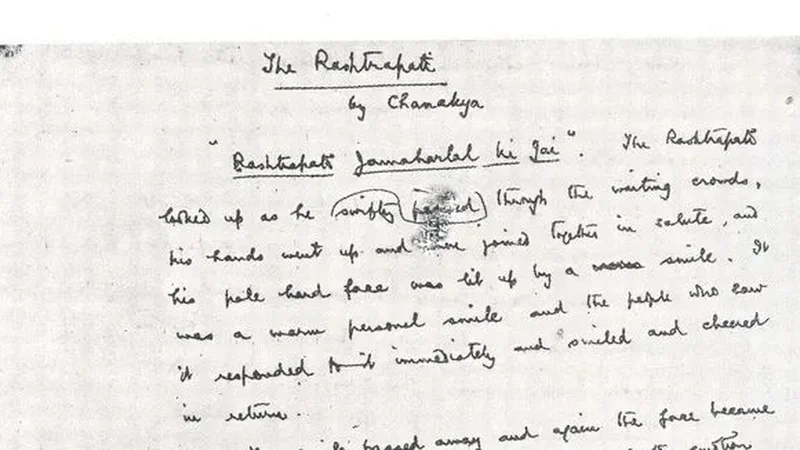
In 1937, as the country stood poised between colonial subjugation and the uncertain promise of freedom, an essay appeared in The Modern Review, titled ‘The Rashtrapati’ and was signed, cryptically, “Chanakya.” Its author, as we know now, was Jawaharlal Nehru, but the reader at that time, was unaware of this. The piece remains one of the strangest acts of political self-examination in modern history: a leader at the height of his popularity writing anonymously about the dangers that his own popularity posed to the country.
Nehru was, by then, much more than a politician. To millions, he symbolised India’s aspirations and was the embodiment of its longing for freedom. The adulation for him overflowed and, as the writer of the essay recognised, it was also unsettling. “Therein lies danger for Jawaharlal and for India,” he wrote. “For it is not through Caesarism that India will attain freedom, and though she may prosper a little under a benevolent and efficient despotism, she will remain stunted and the day of the emancipation of her people will be delayed.”
Nehru wrote in the shadow of Mussolini’s Italy and Hitler’s Germany, but the anxiety around despotism transcended his own age. The gravest threat to democracy as he understood it, is not always tyranny imposed from above. Sometimes it emerges from below, from the yearning of ordinary people to surrender the burdens of citizenship to a figure who appears larger than life.
Leave devotion out of politics
Politics is a fertile field for mythmaking. Nations tell stories about themselves; stories that crystallise around individuals — Washington crossing the Delaware, Mao’s famous crossing of the Yangtze in 1966 and the like. A society pours its hopes and fears into what is perceived as a messianic figure. But democracy rarely survives the elevation of leaders into objects of worship.
Nehru understood this. The phrase that leaps out from ‘The Rashtrapati’ is not “despotism” but “stunted.” It was not that India might become authoritarian. It was that India might cease to grow. A people habituated to looking for salvation in a single individual would lose habits that sustain republican life: scepticism, argument, participation and responsibility. Freedom was never simply the transfer of power from British hands to Indian hands. It was the emancipation of the citizen’s mind.
A dozen years later, on the eve of the Republic’s birth, B. R. Ambedkar returned to the same theme, though in a much more severe language. Addressing the Constituent Assembly on November 25, 1949, he offered what remains one of the most profound warnings in Indian political thought. “Bhakti in religion may be a road to the salvation of the soul. But in politics, Bhakti or hero-worship is a sure road to degradation and to eventual dictatorship.”
A profound understanding of Indian civilisation inspired these words. Devotion occupies a sacred place in our spiritual traditions. But politics, Ambedkar insisted, belongs to another realm. Scrutiny supplants devotion, and accountability rejects surrender.
More than dictatorship in its classical form, Ambedkar feared the slow erosion of democratic culture. Constitutions can be drafted and elections will be held. But republics depend, ultimately, on habits of the mind. They depend upon citizens who are willing to ask difficult questions, to distrust concentrations of power, and to distinguish between loyalty to a nation and loyalty to a leader.
This age-old anxiety defines our century. Recently, Ezra Klein, reflecting on Christopher Nolan’s adaptation of The Odyssey and the age of Elon Musk and Donald Trump, suggested that we are witnessing a clash between two visions of human greatness. One prizes restraint, reciprocity and the difficult art of belonging to a community larger than oneself. The other celebrates disruption, conquest, and the charismatic individual who breaks rules and bends institutions to his will.
Making a messiah
The attraction of the modern strongman, whether political or technological, lies in the promise of transcendence. The entrepreneur who will colonise Mars; the outsider who promises to sweep away corruption and inefficiency. In an age of social media, these narratives acquire an almost epic quality. Politics becomes theatre and citizens become spectators.
Homer would have appreciated this irony. Odysseus, after all, is not merely a conqueror. He is flawed, cunning, restless and often consumed by his own legend. The greatness of The Odyssey lies not in its celebration of heroic power but in its recognition of heroic limits. The epic ends not with conquest but with homecoming. Its lesson is that no individual, however gifted, can exist apart from the obligations of community.
That is the lesson Nehru and Ambedkar were trying to teach India in their own way. The Republic is an argument against the idea of the indispensable man. It argues that institutions matter more than personalities and that power must remain accountable to something larger than itself. Democracies require visionaries, but they also require sceptics.
The tragedy of personality cults is that they encourage us to outsource our judgment and to mistake admiration for patriotism. They tempt us into believing that history is made by singular heroes rather than by the often invisible labour of millions of ordinary men and women. The true measure of a republic is not whether it can produce extraordinary leaders. It is whether it can renew itself without becoming dependent on them.
Nirupama Rao is a former diplomat.
Published - August 11, 2026 12:58 am IST