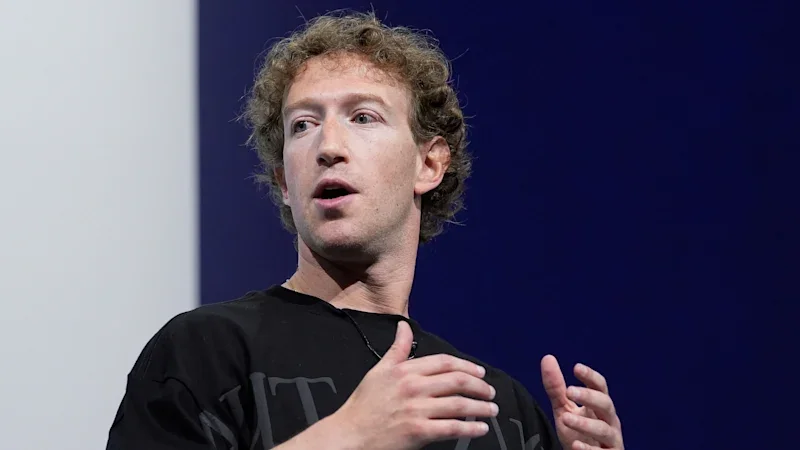
Meta Platforms introduced a new, downloadable AI model that can run on a personal computer, adding fuel to a US debate over whether the increasingly powerful technology should be freely available or kept under tighter control.
Users will be able to download and customise the new Muse Glimmer, a distilled version of the company’s Muse Spark 1.2 model designed with a focus on efficiency to minimise system requirements, Meta said.
At 30 billion parameters, the Muse Glimmer is “small enough” to need only one graphics card to power its work, which will primarily involve agent-like AI tasks such as schedule management and file organisation, according to Meta.
The release, along with a 6500-word essay penned by Meta chief executive officer Mark Zuckerberg, challenge a vision of AI championed by startups like OpenAI and Anthropic, which largely favour keeping the technology under tight control. Google offers its Gemma family of open-weight models that can be run on local devices, while low-cost open models from Chinese companies including DeepSeek, Moonshot and Alibaba Group have intensified pressure on US rivals who charge for access.
The weights, or values that help the AI system make decisions, for Muse Glimmer will be available via the Hugging Face collaboration platform. Meta intends to make the weights for a version of the more powerful Muse Spark available as well. There is no fee for download, though users would bear their own computing costs.
Shares of Meta were up about 1 per cent in New York trading on Monday.
“Rather than centralising superintelligence, we should distribute it widely and give every person the ability to direct it,” Zuckerberg wrote in the essay.
“This has the potential to begin a new era of personal empowerment where individuals can use this powerful new capability to reach their full potential.”
Zuckerberg didn’t name specific companies but criticised rivals that are “focused on building AI for companies, governments, or other institutions.” OpenAI and Anthropic have raised concerns about the safety of open models after a series of reported breaches that saw AI models escape testing environments. Zuckerberg said Meta is creating “personal superintelligence for everyone.”
Zuckerberg’s missive puts Meta at centre stage in the intensifying debate in Washington and Silicon Valley over how to respond to a wave of open-weight AI models from Chinese startups like Moonshot AI’s Kimi K3 that pose a new challenge to the proprietary products from leading American labs.
Some policymakers have considered imposing restrictions on open-weight models from China, and the prospect of government curbs has drawn objections from tech industry leaders, including Nvidia chief executive officer Jensen Huang. They insist that open-weight models are good for the long-term development of AI and help bolster its security, and in his essay, Zuckerberg concurred.
“I do not believe restricting access to foreign open-source models is an effective solution,” the Meta chief wrote. “Our goal should be for American open-source models to be the best globally.” Zuckerberg has spent years promoting the idea of open-weight technology, and the company previously released several open-weight AI models known as Llama, which received mixed reviews.
Trump administration officials have held back on any steps to rein in open systems, and last week told top US tech companies that open-weight models wouldn’t be subject to government testing for now under a new AI safety framework that was completed earlier this month. Under the program, companies would have 30 days to voluntarily submit cutting-edge models for safety reviews before their release.
In his essay, Zuckerberg cautioned against relying on what he called a “rigid process and review timeline,” arguing instead for closer collaboration between the government and the private sector that speeds the release of American models to preserve the US advantage in AI.
“This has the potential to begin a new era of personal empowerment where individuals can use this powerful new capability to reach their full potential.”Mark Zuckerberg
US technology firms are pouring money into AI development, with companies including Meta, Amazon.com, Alphabet and Microsoft committing more than $US2 trillion for expansion. The huge sums being spent have triggered investor concerns that the lavish spending will ever pay off.
Meta began charging for developer access for its Muse Spark 1.1 model for the first time last month.
Meta is also developing plans for a cloud infrastructure business that will sell access to AI computing power and models, along the lines of Amazon Web Services, though the lack of detail on the plan from Zuckerberg has frustrated investors who worry about the company achieving a return on investment.
The company said on Monday that it intends to set up a $US1 billion fund to invest in US communities where it owns and operates data centres. Major infrastructure projects proposed by companies like Meta and Google have been met with resistance in many locations across the US as detractors protest against data centres’ use of land, energy and water.
Bloomberg
Get news and reviews on technology, gadgets and gaming in our Technology newsletter every Friday. Sign up here.