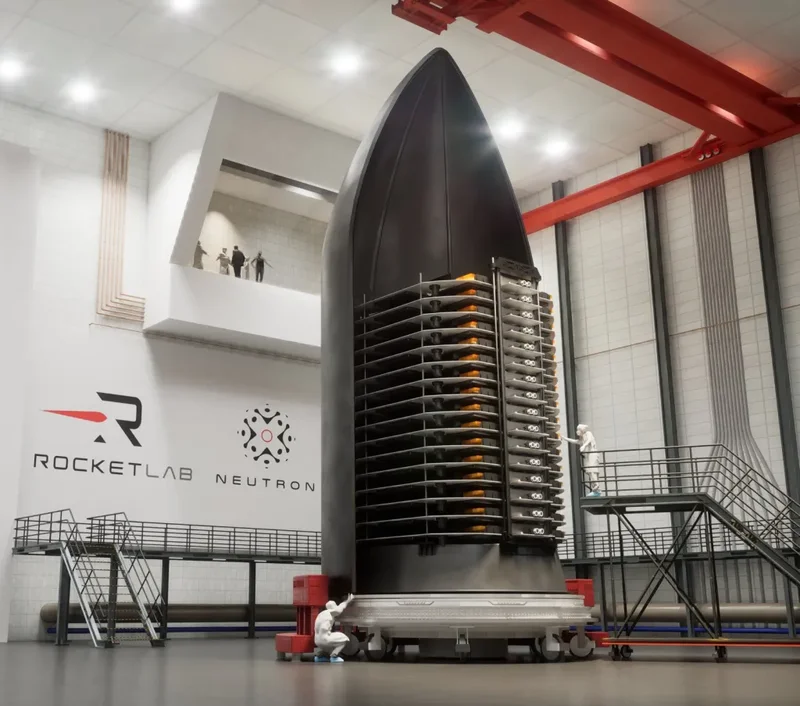
TAMPA, Fla. — Kepler Communications plans to deploy next-generation optical relay satellites on Rocket Lab’s upcoming Neutron rocket in one of several launches the Canadian operator has slated for 2028.
The operator announced Aug. 10 it had booked its first dedicated launch mission for an undisclosed number of satellites as it prepares to ramp up optical connectivity, on-orbit compute and hosted payload capacity. Previous Kepler satellites have shared rides on rockets such as SpaceX’s Falcon 9.
“Securing our first dedicated launch reflects the next stage of growth,” Kepler chief revenue officer Beau Jarvis said in a statement.
“As we continue expanding our constellation to keep pace with growing customer demand, multiple launches in 2028 will increase capacity, strengthen resilience, and enable new services for customers around the world.”
Kepler deployed 10 satellites around 300 kilograms each for Tranche 1 of the network earlier this year, as part of the company’s shift away from providing connectivity for remote Internet of Things (IoT) devices with much smaller radio frequency spacecraft around 12 kilograms.
According to the company, the low Earth orbit (LEO) relay network has helped deliver 10-fold year-over-year revenue growth, while also serving as the foundation for hosted payloads.
Disclosed hosted payload partners include German wildfire-detection company OroraTech, which has four thermal imaging payloads aboard Tranche 1 satellites.
Whereas Kepler’s current optical relay service advertises data rates of up to 2.5 gigabits per second, the second tranche is designed to support rates of up to 100 Gbps, while remaining compatible with the earlier generation.
Tranche 2 is also slated to include 10 satellites Kepler is developing for the first element of the European Space Agency’s HydRON program, which aims to demonstrate a multi-orbit, terabit-per-second transport system for extending the reach of terrestrial fiber networks.
Rocket Lab’s medium-lift Neutron rocket is designed to carry up to 13,000 kilograms to LEO in its reusable configeration, compared with up to 300 kilograms for its Electron small launch workhorse.
The company plans to debut Neutron late this year after a first-stage propellant tank ruptured during testing in January.
Multiple contracts have been announced for Neutron to date, including a confidential customer that booked five Neutron and three Electron launches in May for missions between 2026 and 2029, in what was then Rocket Lab’s largest launch contract.
In July, Rocket Lab announced a $266 million U.S. Space Force contract for up to 18 suborbital missions, which the company said marked its largest launch award to date.