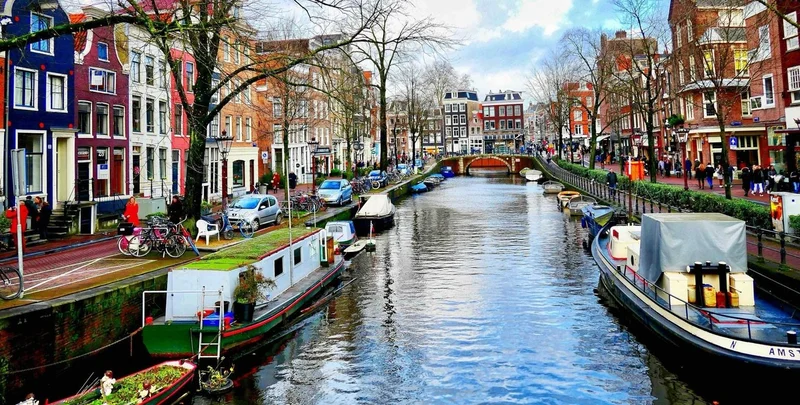
Our children both live and work in Amsterdam, and so we have spent a fair amount of time there over the past five years or so. It is a truly fabulous place â the polity thrives without the nastiness and dysfunction we see almost everywhere else.
The responsibilities of both governing and being a good citizen are taken seriously â we always arrive and leave feeling warmly towards the country, weather notwithstanding.
This extends to much of the rest of the continent. Europe has spent the better part of 70 years constructing what many would regard as the most successful social experiment in modern history. It built societies that are mostly peaceful, prosperous, liberal and remarkably humane, notwithstanding occasional spikiness.
Universal healthcare became an expectation rather than an aspiration. Higher education expanded. Workers acquired protections that their grandparents could scarcely have imagined. Cities became cleaner, safer and easier to live in. Even today, when democratic institutions appear to be under pressure across much of the developed world, Europe (especially Northern Europe) continues to dominate almost every international ranking of governance, transparency, civil liberties and quality of life.
If one were asked to design an advanced society from scratch, there is a fair chance it would end up looking rather European, at least to those of us who lean towards secular pluralism and a humane-faced sort of capitalism. (Of course, it is also true that the money used to build these societies was often extracted through colonisation, but here we are).
But something has begun to shift. It is not dramatic enough to dominate headlines and certainly not sudden enough to resemble a crisis. It is rather a gradual erosion of economic vitality that has become increasingly difficult to ignore. Growth has slowed. Germany, long regarded as the continentâs industrial engine, has begun to splutter. Europe has largely missed the tech revolution, produced relatively few global technology champions and now finds itself trailing the United States and China in artificial intelligence, venture capital and the commercialisation of new technologies.
None of these developments exists in isolation. Together they raise an uncomfortable possibility. Europe may have succeeded so completely in building the society it wanted that it has become progressively less capable of generating the wealth required to sustain it.
A demographic problem
The arithmetic begins (and possibly ends) with demographics.
Eurostat recently reported that the European Unionâs fertility rate has fallen to 1.34 children per woman, the lowest level ever recorded. Replacement requires roughly 2.1. Deaths have exceeded births across the EU for more than a decade, and although immigration continues to prevent an outright decline in population, the underlying trend is unmistakable. The European Commission projects that the EUâs population will peak before the end of this decade and then begin a long decline, while the proportion of elderly citizens rises inexorably. Within the lifetime of todayâs graduates, Europe will have dramatically fewer workers supporting dramatically more retirees.
Demography is often described as destiny (attribution for this quote is contested, but it has near-cliché status now). It might overstate the case. It is better understood as arithmetic. Once birth rates remain below replacement for long enough, the sums become stubbornly difficult to escape or reverse.
Babies, immigration or robots
Jacob Shapiro, a geopolitical analyst who writes for Mauldin Economics, a publication to which I have long subscribed, recently reduced the problem to a formulation that is both amusing and rather difficult to refute.
Countries facing shrinking workforces have only a limited menu of options. They can persuade people to have more children. They can welcome more immigrants (and risk the cultural discord we now see everywhere). Or they can replace missing workers with machines. Shapiroâs shorthand was âbabies, immigration or robotsâ. It sounds almost flippant until one looks closer.
Encouraging larger families has proved extraordinarily difficult. Governments from France to Hungary have experimented with generous tax incentives, subsidised childcare, housing support and extended parental leave. These policies may soften the decline, but no advanced economy has discovered a reliable formula for restoring fertility to replacement levels.
Modern societies become wealthier, women become better educated, careers lengthen, urban housing becomes more expensive, and people simply have fewer children. Governments can influence those decisions at the margin. They cannot reverse them.
Immigration offers a more immediate economic solution. A skilled engineer arriving from India contributes to the labour force tomorrow. A newborn European will not do so for another 20 years. Yet the politics of immigration have become progressively more combustible across the continent as cultures collide. Parties sceptical of migration continue to gain support from Sweden to Germany, from the Netherlands to France.
That leaves the robots.
AI possibilities
This is where the story acquires irony. Europe arguably has more to gain from artificial intelligence and automation than any other developed region. A shrinking workforce should make labour-saving technology economically irresistible. Every robot installed in a factory, every AI system that augments a radiologist or automates routine legal work or replaces a management consultant â all would partially compensate for workers who simply do not exist under the mathematical certainties of demographic collapse.
Yet Europe has approached this technological revolution with characteristic caution. Before Silicon Valley had finished building large language models, Brussels had begun constructing a regulatory framework to govern them. The impulse is understandable. Europeans are rightly concerned about privacy, surveillance, discrimination and the concentration of corporate power.
Those concerns are neither imaginary nor irrational. But there remains a striking contrast between the worldâs major economic blocs. America and China ask what new technologies can achieve while Europe is often more concerned about what they might break.
Different priorities
That is a much slower route to innovation, and the caution may itself be coloured by demographics.
An ageing electorate naturally develops different priorities from a younger one. Older citizens are more likely to own property, depend upon pensions, rely upon healthcare systems and prefer stability over disruption. They have accumulated assets worth protecting. There is nothing irrational about these preferences. But when an ever-larger share of voters values predictability above experimentation, politics begins to favour preservation over creative destruction. Regulation proliferates, and risk becomes something to be managed rather than embraced. This hasnât happened in China (also ageing), because the electorate doesnât really have a say.
Draghiâs warning
EU policymaker Mario Draghiâs 2024 report on European competitiveness, commissioned by the European Commission itself, amounted to one of the bleakest official assessments of the continentâs economic prospects in decades. Europe, he argued, had steadily fallen behind the United States in productivity, investment and technological leadership.
Research remains excellent. Scientific talent remains abundant. What Europe struggles to produce are the giant companies that redefine industries and generate the extraordinary wealth from which future prosperity is financed. The paper set out a series of prescriptions to return the EU to the race for the future.
His warning in a later retort to a journalist was memorable for its brevity.
âDo this, or itâs a slow agony.â
Germany illustrates the problem. For decades it represented the industrial ideal â disciplined manufacturing, engineering excellence, vocational education and export prowess. That model prospered in an era of inexpensive Russian energy, expanding Chinese demand and comparatively predictable geopolitics.
Almost every one of those assumptions has now weakened simultaneously. Chinese firms have evolved from customers into competitors. Energy has become structurally more expensive. The transition to software-defined vehicles has diminished some of Germanyâs traditional engineering advantages. At precisely the same moment, Germanyâs own workforce has begun to shrink.
Politics and the ballot box
None of this implies that Europe has chosen wrongly. American dynamism comes at the price of greater inequality, weaker social safety nets and political volatility. Chinaâs extraordinary industrial rise has been accompanied by a very different understanding of individual liberty. Europe has consciously pursued another path, one that places greater emphasis on human dignity, environmental protection, consumer rights and the rule of law. These are achievements to be admired rather than dismissed. But the admiration does not extend to wealth creation and all that it brings.
So, back to babies, immigrants and robots. The uncomfortable truth is that these are not competing strategies. Europe will almost certainly require all three, but for the pesky reality of the ballot box.
There is still time to act. Europe is still wealthy, scientifically sophisticated and home to some of the worldâs finest educational and industrial institutions. Its decline is neither inevitable nor irreversible. But it is no longer sufficient simply to celebrate the virtues that made Europe successful during the second half of the 20th century. The conditions that supported that success have changed.
Whether politicians and (more importantly) voters will see this and act is far less certain. DM
Steven Boykey Sidley is a professor of practice (ex-JBS, University of Johannesburg), a partner at Bridge Capital and a columnist-at-large at Daily Maverick, where he writes the weekly Crossed Wires column. His new book, Itâs Mine: How the Crypto Industry is Redefining Ownership, is published by Maverick451 in South Africa and Legend Times Group in the UK/EU, available now.