Care Between the Lines is a summer series, which will introduce you to volunteers in health care who fill gaps and provide compassion in a system that can be isolating and scary.
Leny Rose Simbre sat in a doctor’s office in Toronto, accompanying a friend from the Filipino community to hear the result of a daunting medical exam. As the physician explained something about precancerous cells, her companion froze and was unable to speak. She had no money, insurance or family in Canada to turn to for support.
If it wasn’t for Ms. Simbre, she would have been utterly alone for the May appointment.
“She sometimes could not understand what the doctor was saying. Of course, you’d be overwhelmed and your mind would be all over the place when you’re in shock from hearing that you’re sick,” Ms. Simbre said in Tagalog. “I stepped in and tried to understand what the doctor said and read the documents given to her.”
Language barriers, unfamiliarity with the system and, sometimes, their immigration status can daunt newcomers when they receivehealth care in Canada – a process that can be profoundly different from what they were used to in their home countries, and sometimes more expensive.
To alleviate these problems, many immigrant volunteers go beyond the confines of formal organizations and programs, bridging fellow newcomers to the Canadian health care system and other supports. Many of them are aunts, uncles, sisters and brothers in diaspora communities where kinship extends beyond blood relations. They translate, manage documents and connect people with resources. Often, their presence is all that’s needed, especially for those who are alone in Canada.
Ms. Simbre, 46, has been assisting immigrants from the Philippinessince 2012 with health care, labour and legal issues – both through formal networks such as Migrante Ontario and Kababayan Multicultural Centre, and informally through word of mouth. She came to Canada in 2007 as a live-in caregiver. She now serves on the board at Kababayan and works as a research assistant at the York Centre for Asian Research.
At the appointment in May, Ms. Simbre was the one to speakwith the doctor instead of the patient – her stunned Ate, a Tagalog honorific for older woman or sister. She remembered how her Ate zoned out, looking at nothing in particular; she understood English but could not fully process what she heard. She turned to Ms. Simbre, asking in Tagalog, “Len, am I understanding this right?”
Ms. Simbre translated and confirmed the doctor’s findings. They found abnormal cells in the results of her Ate’s colposcopy – an exam to screen for any irregularities in the cervix, vagina and vulva. It could develop into cervical cancer if left untreated, the doctor said.
In a fluid mix of Tagalog and English, dubbed Taglish, Ms. Simbre told The Globe: “I remember always telling her, ‘Ate, we’re here for you. You’re not alone.’ Sometimes I would say, ‘Let’s do this step by step, Ate. Let’s hear what the doctor says, and then we’ll figure out the next step.’”
Two weeks later, her Ate underwent a quick procedure to remove the precancerous cells. Ms. Simbre came with her to the hospital, waiting 30 minutes until the minor surgery was over. She stayed with her as she rested and accompanied her home. She said in Taglish, “At least she knows that someone is with her.”

As a single mother with no relatives in Canada apart from her son, Ms. Simbre says her family is her community. She found her calling in aiding Filipinos who, like her, are far away from their homeland.
Through Ms. Simbre’s years of service in migrant and settlement organizations, she has become known in her community. She seems to always be on the move, her calendar filled with people she takes to the clinic, to the consulate, or wherever they need to be.
“I’m the one people always come to,” she said in Tagalog. Through word of mouth, Filipinos who need help find her. Her Ate found her the same way.
Informal support coming from their ethnic community – typically from friends and relatives – often serves as a bridge between newcomers and formal organizations that provide resources, said Miu Chung Yan, a professor in the School of Social Work at the University of British Columbia.
Recent immigrants often have no idea about settlement and ethnicity-specific organizations or what they can provide, Dr. Yan said. Neighbourhood ates, kuyas (the honorific for an older man or brother), aunts and uncles put them in the know, guiding them as they build their lives in Canada.
Ms. Simbre looked for other ways to help her Ate.She took advantage of her network of like-minded immigrant volunteers, and for her 46th birthday started a fundraiser on social media. In a Facebook post, she wrote, “Instead of gifts, I am asking for solidarity.”
The fundraiser aimed to pay for the medical bills of her Ate and another Filipino worker she calls Kuya, who suffered a stroke. She raised $1,700 in two weeks. The money helped ease their financial burden, if even just a little bit, Ms. Simbre said.
For temporary residents, eligibility for publicly funded health insurance depends on their province and the type of permit they hold. Many seek out private health insurance. In 2022, 29 per cent of health care spending overall came from out-of-pocket costs and voluntary insurance, a report from the Canadian Institute for Health Information found.
When the people she helps require assistance beyond her own capacity, Ms. Simbre refers them to Migrante and Kababayan. She hopes their resources can help her Kuya realize hiswish to scrape together enough funds for a ticket back to the Philippines, so he can be with his family as he recovers from the stroke.
While Ms. Simbre uses her connections to help her people, other immigrant volunteers offer their education and professional health training.
Khush Fatima, 21, recently graduated from a biology for health sciences program at the University of Toronto Mississauga. She volunteers as a medical assistant at the walk-in clinic in her neighbourhood.
Ms. Fatima, who arrived from Pakistan when she was nine years old, also often receives requests from Pakistani family friends to check their electrocardiograms, blood tests and other routine assessment results for irregularities.
Her community knows that she and her mom, who is a physiotherapist, have health-related backgrounds, so people often come to them with medical concerns.

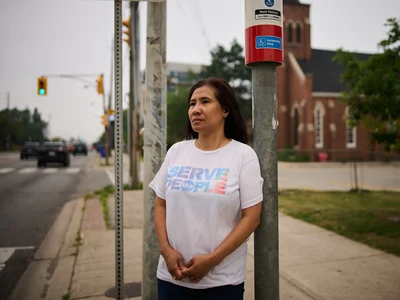
After years of service in local migrant and settlement organizations, Ms. Simbre has become well-known and highly regarded in her community.
Her mom’s friend’s mother, who suffered a heart attack, sent them her ECG and results of other standardized tests. The doctors confirmed everything looked good and there was no need for surgery, Ms. Fatima said, but the family was skeptical. She and her mom looked at the documents, which reassured them that nothing was amiss. They reminded the family that the doctors knew what they were doing.
The family was relieved “even though we didn’t really add too much to what they already knew,” Ms. Fatima said.
Language barriers can become a hindrance when building trust between newcomers and health professionals, she added.
“There is a fear that they would misunderstand what the doctors are saying because they often tend to use big medical jargon or scary words ... as opposed to if they were getting their treatment done back home, where everyone speaks the same language,” she said.
Ms. Fatima said it’s amusing that family friends trust their knowledge even though they are not technically medical professionals. Typically, all people seem to need is reassurance from somebody in their community with whom they have a higher “comfort level,” she said. A certain kind of understanding shared between people who not only speak the same language but also connect with the same culture.
Immigrants leave behind the community dynamics and family support that make dealing with health scares easier, Ms. Simbre explained. “In the Philippines, when somebody is hospitalized, almost the entire family is there. There’s someone looking after you. Someone brings you food. Someone talks to the doctor. Even the neighbour sometimes knows you’re in the hospital,” she said in Taglish.
Having a community to advocate for the sick is particularly important because of hiya – a Filipino concept loosely translated to shame – in her culture, Ms. Simbre said. “We don’t want to ask too many questions because we don’t want to be seen as demanding or difficult,” she said.
Volunteers “cannot always solve the person’s problem. We are not doctors. We are not the ones making the medical decisions,” she acknowledged. “But we can make sure that a person feels seen, heard and cared for.”
Dr. Yan pointed to connection as the reason why the likes of Ms. Simbre and Ms. Fatima freely give their time to their communities.
“People like to connect with real human beings,” he said.
With society “becoming more and more fragmented,” Canadians can learn something from tight-knit immigrant communities, Dr. Yan said. As loneliness and isolation become common phenomena, particularly in urban areas, people can benefit from the sense of “physical togetherness” and from doing a good deed without expecting anything in return, he said.
Her family is her community, Ms. Simbre said. As a single mother who has no other relatives to support her in Canada except for her son, she said, “I know it’s hard to be alone.”
She found her purpose and calling in serving Filipinos like her, who are far away from home. “We need to stand with people in their most vulnerable moments so they don’t feel alone,” she said.
Care between the lines
Volunteer drivers go the distance to bridge rural Saskatchewan's health care transportation gaps
Women’s Auxiliary Volunteers at SickKids bring warmth to patients and their families