July 23, 2026 — 11:30am
Save
You have reached your maximum number of saved items.
Remove items from your saved list to add more.
AAA
In a little over a month, spring will spring and many a person’s fancy will turn to the sounds of hooves thumping on turf.
Three years ago, I opined that it was contrived nonsense that The Everest wasn’t by then a group 1 race. On pure numbers, under the rules as written, no cogent argument could be maintained against its elevation.
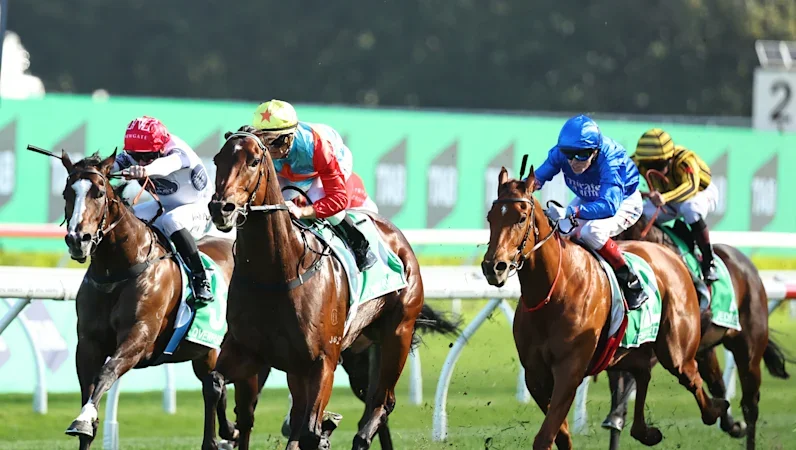
Ka Ying Rising cleaned up in the 2025 edition of The Everest.Getty Images
I also proffered that Racing Australia was manifestly derelict in not elevating the race years earlier, and questions needed to be asked. The Everest is now a group 1 race, and separately, questions were asked. Just not by anyone in Australia.
Last December, the Asian Racing Federation exhausted its patience. Its Asian Pattern Committee seized control of decisions on the status of every black type race in Australia. Every group 1, 2, 3 and Listed race.
Its reasoning was pointed, in that Australia hasn’t operated a properly functioning quality control system for its elite races in a decade. The national pattern committee last met in 2018. Since then, crickets.
Classifying Australia’s best races, the currency on which a multibillion-dollar breeding industry trades, is now determined by a committee whose members are drawn from the racing authorities of Hong Kong, Japan, New Zealand, South Africa and the UAE. Odd, much?
Everest day has quickly become a highlight of the Australian racing calendar.Dion Georgopoulos
The ARF dangled the threat of demoting Australia from the highest standard of the global directory of stakes races – alongside Britain, Ireland, France, Japan and the USA.
How did we arrive at this nadir?
Interstate jealousy, chiefly. Racing Australia’s constituent bodies wasted years trying to agree on national black-type guidelines.
Racing NSW, understandably impatient, started “upgrading” its own races such as the Golden Gift and The Warra from October 2024.
James McDonald and Chris Waller lift the Golden Eagle trophy after Autumn Glow’s 2025 success.Getty Images
They were upgrades the rest of the world refused to recognise, thus never filtering into international sales catalogues. There was approximately 18 races, run under gradings that existed mostly in the minds of their promoters. It was an untenable impasse.
The APC has delivered its first tranche of classification decisions. Now, 30 Australian races have been upgraded or admitted to stakes status, many of them only battle-worn punters will have even heard of. None were downgraded. Seventy-five per cent of those races are run in NSW.
The $10 million Golden Eagle vaults from carrying no black type status to the highest echelon, becoming Australia’s 77th top-tier race for the upcoming season. In context, there were roughly 64 group 1s in Australia a quarter-century ago.
The Victoria Derby, The Metropolitan and Perth’s Railway Stakes, each examined for possible demotion, survive intact. Just imagine if the Victoria Derby was downgraded.
‘Here’s the rub: group 1 status is meant to denote “The best of the best”.’
To be clear, the argument I prosecuted for The Everest in 2023 was that the ARF’s Ground Rules are objective. If a race’s ratings clear the prescribed benchmark across its recent renewals, elevation should be axiomatic.
The APC’s rules ordinarily require a race to enter the pattern at group 3 and ascend; but exceptional circumstances provisions exist, used previously for The Everest and Melbourne’s All-Star Mile, permitting direct positioning at the summit. The Golden Eagle’s ratings justify the use of the exception.
Rules honestly applied are the point here, and on that measure there can’t be a complaint.
But here’s the rub: group 1 status is meant to denote “The best of the best”.
Mark Zahra and Observer win the 2025 Victoria Derby at Flemington.Getty Images
Scarcity isn’t a by-product of the classification, as opposed to it being the essential point of the exercise. Australia will now conduct 77 group 1 races per season.
Great Britain and Ireland stage about 50 combined. Japan runs roughly two dozen. Hong Kong, whose representatives sit on the committee now grading our races, conducts a dozen. Even the United States, with a human population 12 times Australia’s, hosts about 110 group 1s annually.
Australia races more horses, at more meetings, on more racecourses than almost anywhere.
A bigger racing population can sustain a bigger elite, but the trend is concerning. No Australian race has been downgraded since August 2012.
If Treasurer Jim Chalmers ever plunged his fingers into horse racing once he’s done with the rest of the economy, he’d call that inflationary.
Inflation works on race classifications the same as it does on money, where every unwarranted note printed devalues the genuine article. If everything becomes elite, nothing is. What’d happen if the FIFA World Cup were an annual thing; or if Rory McIlroy were asked to defend his Green Jacket once a semester, even when Augusta’s flowers aren’t blooming?
It’s the owners of horses that win authentic group 1 races, and the breeders who sell their progeny on the strength of those two words appearing on a catalogue page, who quietly wear the cost.
The next problem is geographic. Twenty-two of 30 elevated races are in NSW. What Racing NSW and its senior management have done for the business of thoroughbred racing over the last 20 years, traced back to prosecuting the race fields case to the High Court 20 years ago, is magnificent and extraordinary.
Kerrin McEvoy and Redzel claimed the first edition of The Everest in 2017.Getty Images
But prizemoney has become a weapon.
Money buys fields, and fields generate ratings, and ratings satisfy ground rules.
On the bare numbers, the Sydney races arguably deserve their new status. Racing elsewhere, though, is not thriving the same way; in some places it’s withering.
Now chase that logic to its terminus. If black type simply tracks prizemoney, the pattern migrates permanently to wherever the money is on offer: Sydney first, Melbourne second and daylight third.
The signature races of South Australia, Western Australia and Queensland drift towards oblivion while Randwick’s five-year-old inventions leapfrog everything.
A national pattern concentrated in two cities isn’t a national pattern. It’s a duopoly, with regional exhibition matches tacked on.
In fairness, the APC is no rubber stamp. In September 2025, it rejected a Racing Australia application to upgrade more than 40 races, precisely because not a single downgrade was offered in exchange.
This month, several races were admitted at levels below what Australia requested.
Is all of this good for racing? The evidence is incomplete. The APC meets in September to determine the remainder of the calendar, including, presumably, the downgrades.
If the Sydney Cup, the Adelaide Cup and their kind are assessed without sentiment and demoted where the numbers require, Australia will possess a credible, functioning, two-directional pattern. That will be painful but necessary.
If instead September passes and the ladder still points skywards, then what happened this month wasn’t quality control, as distinct from being a coronation of the status quo, with the dilution of Australian black type handed to an international imprimatur.
In 2023, I wrote that The Everest being padlocked in the freezer was wrong. The new question is harder.
Not whether one race deserves elevation, but whether a grade shared by 77 races can still claim to identify the best of the best. Racing’s administrators, wherever they now sit, ought to remember it.
Save
You have reached your maximum number of saved items.
Remove items from your saved list to add more.
Darren Kane is a sports columnist for The Sydney Morning Herald.Connect via X or email.