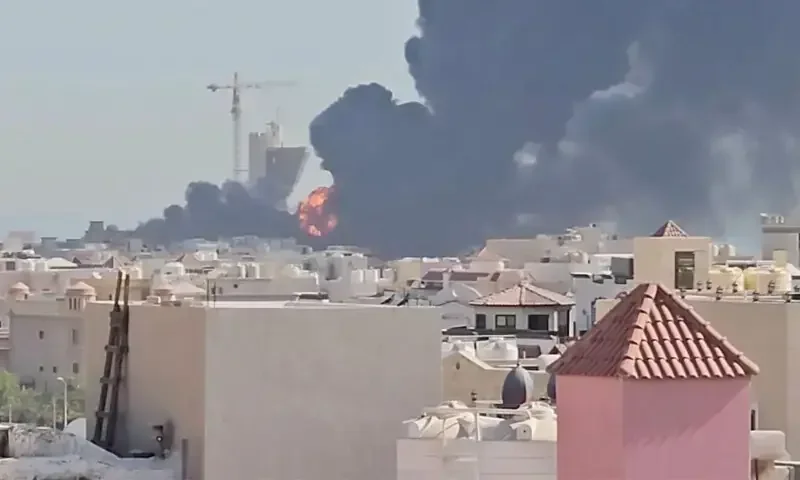
WHILE the exchange of fire across the Gulf — and the wider Middle East — continues between the US and Iran, efforts are also underway to de-escalate matters and revive the ceasefire. An important development in this regard was the series of meetings between Iranian Interior Minister Eskander Momeni and Pakistan’s top civil and military officials on Tuesday. As expected, the regional situation was amongst the main agenda items, and Mr Momeni indicated that talks will continue. That Tehran sent a senior official to Pakistan shows that despite the hostilities, it is still interested in an off-ramp. Meanwhile, speaking in Manila yesterday, US Secretary of State Marco Rubio used a tough tone for Iran, but did not rule out the possibility of a diplomatic settlement to the conflict. Revival of the peace process is an incredibly difficult undertaking. Iranian President Masoud Pezeshkian has said his country is in a “full-scale war” with the US, and the growing escalation over the last two weeks shows that the conflict is headed in a very dangerous direction. Yet the recent developments in Islamabad, and the fact that the US has not yet slammed the door shut on negotiations, show that there is still a chance — however slim — of restarting the dialogue process. At the same time, trust levels between Washington and Tehran are very low, and it will take exceptional diplomatic skill to bring both belligerents back to the table. As hard as the task to revive the peace process may be, the alternative is a regional war which will be far more destructive than the last round. Already the theatre has expanded, with Iran attacking US bases beyond the Gulf, and Yemen’s Houthis enforcing a blockade of Saudi ships in the Red Sea. To prevent an even more alarming escalation, both sides need to silence their guns and give the negotiators a chance to create the framework for a doable peace. The US must stop attacking Iran and issuing fresh threats, while Iran must refrain from targeting the Gulf states. The escalation may seem controlled at the moment, but in such situations, things can easily get out of hand, and spiral into something much bigger. And just as states such as Pakistan are working behind the scenes to de-escalate, some forces are trying their best to ensure hostilities continue. For example, US Vice President J.D. Vance recently said in a podcast that some in Israel want “to keep the war going on indefinitely”. The American president should realise that continuing on the warpath with Iran will lead to a regional conflagration, and the only way to end this unnecessary conflict is for the US and Iran to work with Pakistan and other negotiators to find an honourable exit. Published in Dawn, July 23rd, 2026
De-escalation efforts