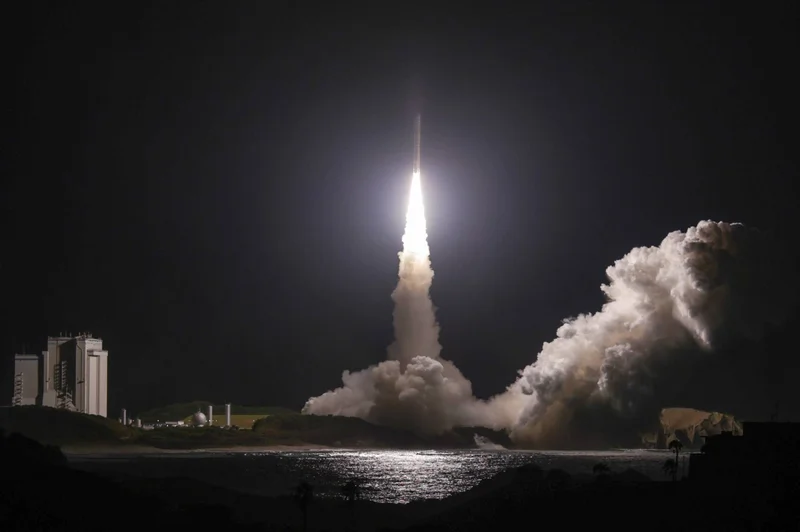
The Japan Aerospace Exploration Agency, or JAXA, successfully launched an H3 rocket carrying the Michibiki No. 7 positioning satellite from its Tanegashima Space Center in Kagoshima Prefecture at 4:23 a.m. Tuesday.
The satellite reached its planned orbit about 30 minutes later.
The No. 9 rocket was the first H3 unit carrying a practical-use satellite since a launch failure last December. Tuesday’s success means that seven out of the nine H3 units have been successfully launched.
“We made improvements with a determination not to fail again and were able to conduct a launch with enhanced reliability. As a result, we’ve achieved a good outcome,” Makoto Arita, JAXA’s H3 project manager, told a news conference after the launch.
The Michibiki is Japan’s version of GPS, complementing the U.S. GPS satellite network and enabling positioning with a precision of up to several centimeters. The Michibiki No. 1 satellite was launched in 2010.
The government aims to establish a system of seven Michibiki satellites that will allow constant positioning without the need to be complemented by foreign positioning satellites. The system will be expanded to 11 satellites eventually.
However, following the loss of the Michibiki No. 5 satellite due to the H3 launch failure last December, six satellites will be operational for now, including the No. 7 unit launched this time.
The Michibiki No. 7 satellite is about 19 meters wide when its solar panels are deployed. In addition to positioning services, it can distribute emergency information to compatible devices during disasters.
The H3 is a two-stage liquid-propellant rocket developed by JAXA and Mitsubishi Heavy Industries Ltd.
After the failure of the No. 8 unit last December, JAXA identified the cause as a problem with a parts-joining process for the satellite-mounting section.
After resolving the problem, JAXA successfully launched the No. 6 rocket in June this year. The reliability of the No. 9 rocket was enhanced by adopting a method for joining parts with proven track records.