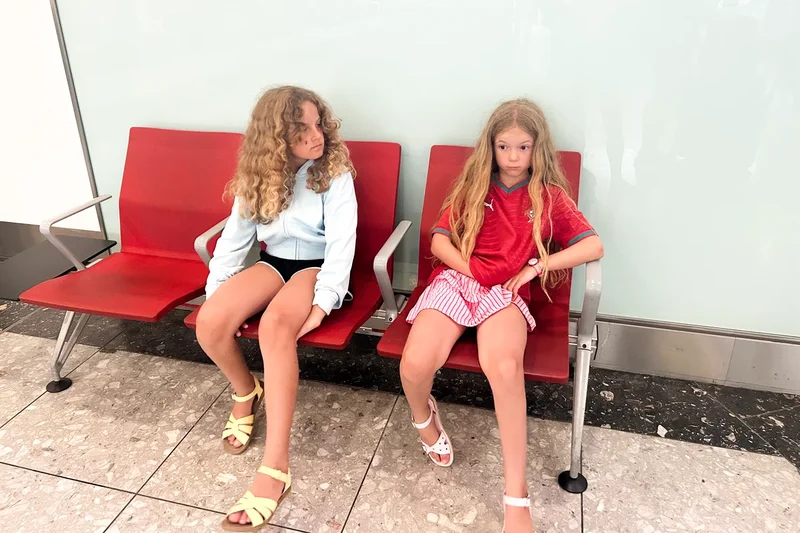
Like millions of other working parents dealing with the six-week school holiday this summer, there is one phrase I hear a lot: “Mum, I am bored.”
School holiday boredom typically peaks around the third week of the break, according to studies, and new research commissioned by Playmobil shows that 28 per cent of them will turn to screens when bored compared to only 12 per cent who invent a pretend game. The same research showed that only one in 10 children consider going outside as a first choice when they are bored.
In my family, boredom creeps in about 15 minutes after they wake up and realise there is no major event has been planned for that day. It can set in literally anywhere – they’ve even grumbled at the airport right after a fast-paced beach holiday.
My immediate response is to want to fix it as I recoil with mum guilt at the fact their life is not jam-packed with bilingual developmental holiday camps, creative coding, robotics, and tennis lessons.
But the reality is that I’m more jellyfish than helicopter parent – and the summer holidays are the ideal time to go with the flow, and, well, hope for the best. That means that in between them being shifted around friends’ houses for playdates, they have periods of time when there is a lull with nothing to do.
But instead of micromanaging it, I’m teaching my children the creative power of boredom. I’ve stocked up on arts and crafts materials – and my secret weapon is a glue gun.
My daughters Lola, 10, and Liberty, eight, have made intricate paper rooms with shelving and tables, even using frilly material as lace detail on tablecloths.
Liberty has successfully managed to make her own squishie butter squeezy toy – the plastic version is a viral trend online – but hers is free, made out of paper and the inside of a teddy bear.
Lola is a bookworm who is reading the popularWarrior Cats – there are over 100 books in the series by Erin Hunter – but after a few hours, her boredom comes creeping back in.
“Mum, I don’t know what to do – can I watch my iPad for a bit?” Whenever I hear this inevitable request, I tell them to get a grip and push through the boredom – saying all the typical parenting phrases like, “It will be the making of you.” But I mean it, because I buy into the notion that boredom is an essential component of healthy child development, and former education secretary Bridget Phillipson agrees with me.
“There is nothing wrong with kids being bored,” she said on Newsround, talking about the social media ban for under-16s. “That is also an important part of growing up. If you're bored, go and find something to do.” She’s not the only one who advocates it.
Tennis star, Novak Djokovic, believes boredom is one of the most important experiences for a child. During a conversation on the podcast On Purpose with Jay Shetty in 2025, he spoke about how he dealt with it with his son Stefan, 11, when they were at his parents’ house in the countryside.
“We were playing ping pong, kayaking in the lake. We played some football and kept quite active the first few hours of the day,” reported Djokovic.
“And then I was doing something else. He comes up to me and goes, ‘Daddy, I’m bored.’ Then I had to sit him down and said, ‘Son, it’s okay to be bored sometimes. You had a great, active morning. And second of all, if you are bored, it does not mean you have to take up a book or screen immediately. You need to learn to be with your thoughts’.”
He added: “I really want my kids to want to learn to be bored because that’s the time you are the most creative. That’s when you can manage your own thoughts – the ones you’ve been suppressing with the phone.”
However, viewing boredom as wholesome is not the only way to see it. Dr James Danckert, professor in the School of Psychology at the University of Waterloo in Ontario, Canada, is an expert on the psychology of boredom who is interested in the neuroscience of attention and mental model updating.
“I don’t think we need to encourage more boredom in our children’s lives,” he says. “I think we need to encourage better coping skills with boredom and more autonomy”.
“The brain needs engagement... and good engagement eliminates boredom. We just need to sit down with children and say, “Okay, what plan do you think would work for the next time when you find yourself bored?’ Let them know that sometimes the top three things on the list won’t work - and sometimes they will. It’s okay for things to fail with boredom.”
In his view, parents desperately want their children to experience more boredom, in the hope they will learn to get over the feelings of restlessness and agitation that are associated with boredom. But it’s impossible, says Danckert, because it’s part and parcel of the experience.
“Boredom is an important signal that tells us that whatever we are doing right now is not working and we need to find something better to do – something that feels more purposeful and meaningful to you,” he adds.
A key factor of boredom is that the person experiencing it doesn’t feel like they are in control of the goals in their life – and the knee-jerk reaction in parents is to suggest a host of things they could do. “But what we are doing is taking away their autonomy,” he says.
Boredom is an important signal that tells us that whatever we are doing right now is not working and we need to find something better to do
“Kids aren’t stupid – they understand what those options are. What they are saying when they are bored is ‘I don’t want these things at this time’. So rather than asking or suggesting they need to get better at boredom and so they should have more boredom in play, we should help them respond better to boredom.”
There are lots of reasons why people get bored, he says, but the primary issues include monotony, the constraint of having to do something rather than wanting to do it, and any lack of meaning to the activity. Children may not be able to articulate those things but they will be the main drivers for it.
“All we should be doing is to encourage them to develop the tools to best deal with boredom, which is hard as they are young and developing, and the bells and whistles of the tablet are enticing.”
Child psychologist, Amanda Gummer, and founder of The Good Play Guide, agrees that boredom can feel uncomfortable for parents because a bored child may become restless or demanding. “There is also considerable pressure to make every part of childhood productive, stimulating or entertaining, so parents can feel they are failing if their child has nothing planned.”
But children need some unstructured time, she says. “When adults resist the urge to provide an immediate activity, children have an opportunity to use their initiative, invent games, explore ideas and persist when inspiration does not come straight away. These are useful skills for play, learning and later life.”
Boredom is not automatically beneficial, however, and prolonged boredom may indicate that a child lacks suitable opportunities or support. Boredom eating starts when you're aged four, according to a 2023 study that found that children eat 79 per cent more when they’re not entertained. When my children start eating all the crisps, I know I need to get them out to the park.
But for many experts, boredom is a vital developmental tool that fosters creativity, problem-solving, and independence. Dr Sandi Mann, author of The Science of Boredom and Senior Psychology Lecturer at the University of Central Lancashire, believes parents should be less afraid of boredom because of its creative potential.
Dr Mann argues that boredom is essential for brain development mainly because when we are bored, we are searching for something to relieve the feeling.
“If that search isn’t met with any satisfaction and we are not provided with anything to stop the boredom, then our brains will solve the problem usually using creative means... which is a very valuable skill,” she says.
“If we, on the other hand, don’t let them be bored, and give them a device to scroll their boredom away, they are not learning problem-solving.”
We seem to be more bored than ever before. The dying art is the ability to cope with that boredom because parents are scared to let kids be bored
While you’d think, with the world at our fingertips, people wouldn’t know what boredom was anymore, she says that this is not the case.
“We seem to be more bored than ever before,” says Dr Mann. “The dying art is the ability to cope with that boredom because parents are scared to let kids be bored. They feel they should be providing stimulation and that if they are bored they’ll do something negative with their boredom like vandalism and become feral.”
Dr Mann suggests giving children materials to solve their own boredom rather than solving it for them – which is a tactic I’ve taken.
So, with another four weeks to go until the new school year, I’m off to buy activator and glue for them to make slime and more glue gun pellets. But first we have to get through a five-hour car journey to Blackpool to see their grandma, where I’ll hear “Are we nearly there, Mum?” non-stop.
I think the buck stops here – it’s iPads all the way.