- Published
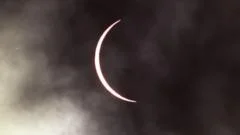
As the countdown begins to a partial solar eclipse, people have been sharing memories of the total eclipse in 1999 in parts of the South West and Channel Islands.
On 11 August 1999 a few minutes of the day turned to night as the Moon blocked out the sun's light.
It was the last total solar eclipse of the 20th Century, with only Cornwall and the Channel Islands the only parts of the British Isles to witness totality, the full blacking out of the sun by the Moon.
Barbara Logan, who watched the eclipse in Shortlanesend, near Truro, said the experience was a "weird sensation".
In Devon and Cornwall, the partial solar eclipse will start at about 18:18, peak at 19:15 and finish at about 20:09.
In Guernsey and Jersey the timings will be about 18:21, 19:17 and 20:10.
Recalling the 1999 eclipse in Cornwall, Logan said: "One minute it was light then it began to get dark and I could hear all the birds singing and getting ready to go to roost.
"We were all gathered down in the square with our glasses ready.
"It was a weird feeling, you didn't know if it was night-time or daytime."
Nigel Brown, from Horsham, who was visiting Truro for the day, said the eclipse in 1999 had felt peculiar.
"Once the eclipse started it was a wonderful but really eerie experience," he said.
"I couldn't believe how day turned into dusk and the birds stopped making a noise.
"I was on my own and I didn't feel frightened, but you were aware something really big was happening."
Anne Le Cheminant said hundreds of people lined the seafront in St Peter Port, Guernsey, to watch the total eclipse.
"I'm still quite emotional about it, it was just such a gigantic, awesome event," she said.
"It was eerie, it was very strange, you can imagine the ancients had a supernatural feel about it.
"The light wasn't quite the same as evening lights, it was very grey.
"All the birds flew around and went back to their nests.
"As the Moon cleared the sun, you could feel the collective awe of everyone watching it."
'Temperature dropped sharply'
Former BBC News correspondent Simon Hall reported from Alderney during the 1999 eclipse.
The third-largest Channel Island had some of the best views of the eclipse in the British Isles, despite some cloud cover.
More than 250 astronomers had gathered with islanders to watch the event.
Hall said: "Eclipse day in Alderney was a tease.
"From the start there was cloud and uncertainty about what we would see."
He said the first half of the event was obscured by cloud which had helped to reduce the sun's dazzle.
"At 11:00 the temperature dropped sharply when totality was approaching," he said.
"The odds had been 50/50 but at 11:16, the moment of totality, the cloud cleared."
The UK's next total solar eclipse will not happen until 2090, according to Royal Museums Greenwich, external.
Follow BBC Cornwall on X, external, Facebook, external and Instagram, external. Follow BBC Devon on X, external, Facebook, external and Instagram, external. Send your story ideas to spotlight@bbc.co.uk, external. Follow BBC Guernsey on X, external and Facebook, external. Follow BBC Jersey on X, external and Facebook, external. Send your story ideas to channel.islands@bbc.co.uk, external.