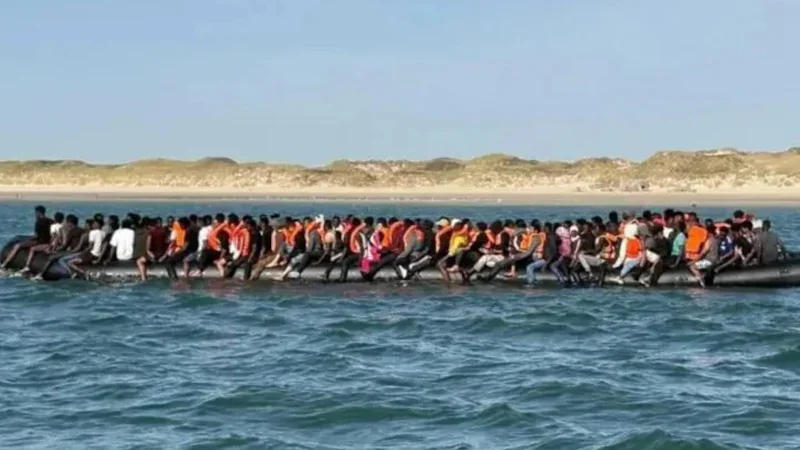
France’s lifeboat service has warned there is “no limit” to the number of migrants people-smugglers will put on a boat to Britain.
The French national sea rescue service (SNSM) warned it was seeing “more and more” large boats ferrying hundreds of migrants across the Channel.
On Monday morning (UK time) a record 230 asylum seekers arrived in Britain after travelling on a single 15-metre-long vessel from near Berck-sur-Mer, Normandy.
The vessel, which was intercepted by Border Force, HM Coastguard and the Royal National Lifeboat Institution (RNLI), surpassed the previous record of 165 migrants who reached the UK in a single boat in July.
Jean-Marc Lamblin, the director of the SNSM’s Berck-sur-Mer branch, said: “Over the past three months we’ve been seeing more and more 15-metre boats passing through.”
He added that when the 150-migrants-per-boat figure was recently surpassed, “we didn’t think there could be any more, but there really is no limit now”.
Many of the “mega-dinghies” used for Channel crossings are manufactured in China, then shipped via commercial routes through countries such as Turkey and Bulgaria to European staging posts, chiefly Germany.
International smuggling networks store and distribute them at the staging posts before they reach the French beaches from where they are launched. Home Office officials have previously identified Chinese websites as a key source of boats and parts, and have been working with Beijing to clamp down on them.
A source at the National Crime Agency said China was “likely to be one of the countries but not the only country” from which smuggling gangs obtained their equipment.
It was not clear whether the mega-dinghy used in Monday’s crossing came from China.
UK government sources said smuggling gangs were turning to such large vessels out of desperation to make the crossings financially viable.
Last week people-smugglers packed 173 people onto a boat attempting to cross the Channel but they were returned to France after its engine caught fire.
Joint operations between the British and French police on the ground have meant more planned launches are thwarted early, while co-operation with countries including Germany and China has helped restrict their supply of boats and engines.
French police are deploying new tactics to counter the growing use of mega-dinghies, including targeting and dispersing large gatherings of migrants near the coast, which are often a sign that a launch is imminent.
As a result, the gangs were finding it increasingly difficult to launch enough small boats to make ends meet, officials said, meaning they were having to turn to cramming large numbers of migrants onto single-vessel voyages instead.
A government source told The Telegraph: “Sustained pressure from law enforcement means the gangs are finding it harder to launch boats, and are therefore being forced to place more people onto them.
“While this boat is larger, the number of crossings is down significantly, and we just had the lowest figures for a July since 2020.”
Officials said overall numbers of migrants arriving were down by 43 per cent compared with the previous year. This was despite the fact that August is one of the busiest periods of the year for “red days”, when sea conditions are most suitable for crossing.
The average number of migrants per small boat has increased from seven in 2018 to 63 in the year to March, and 70 so far this month.
But they warned that the smugglers’ use of larger boats had made both the crossings and the rescue operations at sea more perilous.
The SNSM said about 30 people had ended up in the sea during the rush to climb on the mega-dinghy at about 5pm on Sunday. Some became cut off by the tide and needed to be rescued.
French lifeboat workers noted that the large dinghy was first seen with about 50 migrants on board, then cruised close to a beach, picking up more people. The crowded dinghy was described as “buckling under the swell” as it headed towards Britain.
Dr Mihnea Cuibus, senior researcher at the Migration Observatory at the University of Oxford, said: “There has been a longstanding trend of smugglers fitting increasingly more migrants onto larger and more crowded boats.
“It is likely that this is at least partly driven by increased enforcement in and around the French coast.
“Authorities have been trying to make it harder for smugglers to obtain boats, disrupting supply chains and confiscating equipment alongside European partners and thus creating incentives to fit as many people as possible into available boats.”
The average number of migrants per small boat has increased from seven in 2018 to 63 in the year to March, and 70 so far this month.
Nigel Farage, the leader of Reform UK, said the record-breaking crossing proved the “illegal invasion is a national security emergency”.
In a post on X he said: “At 2.30am this morning, a boat carrying 230 people was taken into Dover. This is a record number in a single vessel. It’s yet more proof that this illegal invasion is a national security emergency.”
Chris Philp, the shadow home secretary, said the French authorities should have stopped the dinghy. He said: “This is now beyond a joke. The French authorities could easily have stopped a vessel this size from embarking in shallow waters.
“I recently saw for myself French gendarmes standing by and doing nothing while illegal immigrants boarded in knee-deep water. Shabana Mahmood is handing over £660 million of our money while this happens. It’s a disgrace.”
A spokesman for Europol, the EU’s law enforcement agency, said: “The European Centre Against Migrant Smuggling is aware of this development.
“We are in constant exchange with the appropriate authorities in both France and the United Kingdom on this phenomenon and also have a dedicated operational taskforce running that concentrates on smuggling of migrants with boats (no matter if relatively small boats or, as of recently, larger boats) across the Channel.”
A Home Office spokesman said: “This latest incident demonstrates the reckless and dangerous tactics employed by the criminal gangs facilitating these crossings, who continue to put lives at risk by cramming ever greater numbers of people onto unseaworthy vessels.
“We are making progress, with the number of small boat crossings down this year and the lowest number recorded for the month of July since 2020.
“But we must go further, which is why we have signed a payment-by-results deal with the French to put 40 per cent more boots on the ground on French beaches.”
The Telegraph, London