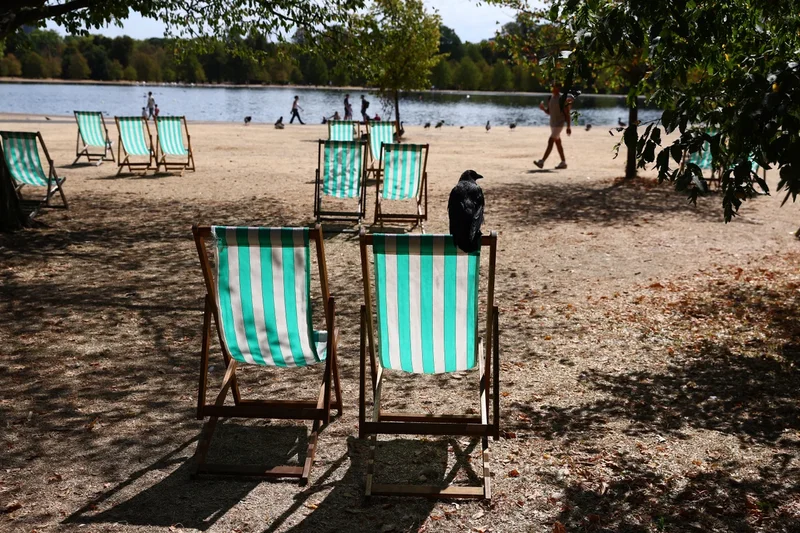
Amber heat health alerts are to come into force as the UK braces for the fifth heatwave of the year, with almost three-quarters of England in drought.
On Tuesday, highs of 29C in Cardiff, 28C in Manchester and 25C in London are forecast before temperatures soar to the mid-30s in some areas on Thursday, according to the Met Office.
Some 45 million people have been plunged into drought conditions as dry and hot weather continues to blight large swathes of England and Wales.
The National Drought Group determined that 71.3 per cent of England is now experiencing a flash drought, warning on Monday that conditions will get worse without "significant and sustained rainfall".
Temperatures are expected to reach highs of 30C on Tuesday, before climbing through the week and reaching peaks of 36C in East Anglia and the South East by Thursday.
England and Wales recorded their driest July in records dating back to 1836, with 19 counties of England seeing no rain for the entire month, provisional statistics have shown.
Amber heat health alerts come into force across England and Wales
Heat health alerts are to come into force as the UK braces for the fifth heatwave of the year, with almost three-quarters of England in drought.
On Tuesday, highs of 29C in Cardiff, 28C in Manchester and 25C in London are forecast before temperatures soar to the mid-30s in some areas on Thursday, according to the Met Office.
From 9am on Tuesday, heat health alerts issued by the UK Health Security Agency (UKHSA) are in place across England until Friday evening.
Officials have urged people to take simple steps to stay safe, such as drinking plenty of water, checking on vulnerable friends and family, and avoiding the sun at the hottest part of the day.
Amber heat health alerts have been issued for most of England including the Midlands, South East, North West and South West, while a yellow alert will be in force for the North East.
Shoppers warned of supermarket price rises ‘within months’ due to extreme heat
Historic gardens, parks and cemeteries under threat from climate change – report
The UK’s treasured historic green spaces are under increasing threat from climate extremes, a report warns.
The National Lottery Heritage Fund and Historic England warn that historic parks, gardens and cemeteries across the country are vulnerable to damage from harsher, more widespread drought, intense rainfall, more severe storms and pests which can thrive in warmer conditions.
These impacts, driven by climate change – which is mostly caused by burning fossil fuels for power plants, cars, heating and industry – are affecting all aspects of these heritage landscapes, from trees and plant collections to paths, terraces and lakes.
The report says historic parks and gardens, including Chiswick House and Gardens, Kew and the Royal Parks, in London, and Princes Street Gardens in Edinburgh, employ more than 32,000 people and contribute £2.9 billion to the UK economy each year from international visitors alone.
But they are already being hit by increasingly extreme weather caused by climate change, with paths and drainage systems not fit for current conditions, trees lost to drought and high winds, and potential loss of entire groups of plants to diseases affecting box, ash, sweet chestnut and oak.
Invest in climate defence rather than heed Trump on military spend – Polanski
The UK should be investing money in defending the country against the climate crisis rather than listening to Donald Trump on security spending, Zack Polanski has said.
The Green Party leader on Saturday reiterated his view that the climate crisis is “the biggest threat to our national security since the Second World War”.
Appearing at Iain Dale All Talk at the Edinburgh Fringe, he was asked by an audience member whether he and his party agree with increasing defence spending to 3% of GDP when there are “so many competing environmental needs.”
Mr Polanski said that if defence spending includes money for climate adaptation such as dealing with floods and wildfires then we “clearly need to up our spending”.
He suggested that was more important than listening to US President Donald Trump, who has called for Nato allies to shoulder more of the burden of European defence.
Mr Polanski said: “If we’re talking about spending 3.5 per cent of our GDP on military spending to please Donald Trump, then I think there’s an absolute incoherency in that.
“We’re already, I think, one of the fifth biggest spenders on military capacity, and actually, I think we need to look at defence as a much more holistic issue.
“I said this week, and I really believe, that the climate crisis is the biggest threat to our national security since the Second World War.
“It’s not some distant threat – it’s right here, right now. We’ve had wildfires not far away from here, where we’re talking in Edinburgh, and we know that what’s happening right now is not the new normal.
“This is the beginning of what will be the least extreme temperatures and least extreme weather in our lifetimes.
“It is going to get worse and worse and worse. And in many ways, it’s a grim message.
“We can’t stop some of that breakdown, what we can do, though, and it’s important that people hear this, is we can stop total breakdown, and that feels beyond important to do, and that’s where we should be investing right now, not on listening to what Donald Trump says or creating arbitrary numbers of GDP.”
Watch: Shocking scale of New Forest blaze seen in Hampshire fire service drone footage
Recap: Almost three-quarters of England in drought as conditions worsen in dry August
Almost three-quarters of England is in “flash drought” as a dry start to August follows the country’s driest July on record, the Environment Agency (EA) has said.
The East Midlands, Lincolnshire and Northamptonshire, Kent and East Sussex, and Solent and the South Downs have become the latest areas to move into drought.
The announcement came after a meeting of officials, water companies and farming leaders under the National Drought Group, which warned that all regions of the country are experiencing pressure on their water resources, with impacts on agriculture, public water supplies and the environment.
Last week, the EA announced that half of England had plunged into flash drought – one which develops very quickly because of a combination of very low rainfall and high temperatures – and the latest announcement means 71.3 per cent of the country is in drought.
The North East and Yorkshire have moved to “prolonged dry weather” status, the stage before drought, and nowhere in England is in “normal” status, the EA said.
The latest drought warnings came as parts of the UK braced for the fifth heatwave of the summer, with temperatures expected to climb into the mid 30Cs later in the week, peaking at 36C on Thursday.
'Water resilience cannot be treated as a seasonal issue'
Fran Barnes, chief executive of the Horticultural Trades Association (HTA), said: “With almost three-quarters of England in ‘flash drought’ and all of Wales now officially in drought, numerous water restrictions and Temporary Use Bans (TUBS) across the UK, and data showing that last month was officially the driest July on record, the pressure on our water resources couldn’t be clearer.
“The solution to the UK’s water challenges lies not just in the amount of rainfall, but in how effectively we capture, store, and manage it. Today we reiterated the need for the UK to take action and implement a long-term water resilience strategy that addresses the realities of a changing climate.
“The current conditions are having a huge impact on our 1,400 members – garden retailers, growers, landscapers, designers, suppliers and manufacturers – despite our sector investing heavily in becoming more water efficient. Growers increasingly capture and recycle rainwater, retailers and landscapers promote drought-tolerant planting and more effective watering, including water butts and efficient irrigation systems suitable for gardeners, not just professional growers. We set out these needs again today at the National Drought Group meeting.
“Our climate may be changing, but our message remains clear: water resilience cannot be treated as a seasonal issue.