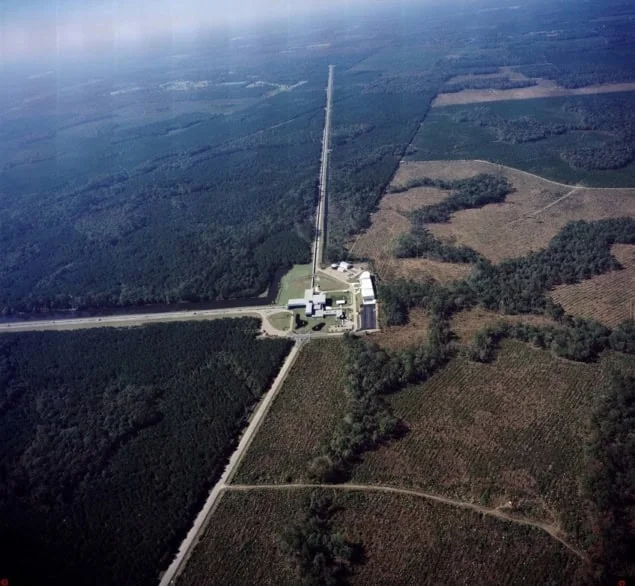
Black hole collisions, merging neutron stars, exploding supernovae – these massive cosmic events are all observed by interferometer-based gravitational-wave observatories such as LIGO. Detection of the ripples in space-time caused by these phenomena is dependent on the careful control of the mirrors used in these observatories.
Led by Jonathan Richardson at University of California, Riverside, a research team has demonstrated a new wavefront actuator that can correct deformations in the surface of the mirrors by applying carefully mapped heating patterns. In a new development, reported in Classical and Quantum Gravity, Richardson’s team has used thermal imaging cameras to pinpoint where the corrections are needed. This approach should massively reduce the main limitation on the sensitivity of gravitational-wave observations.
Limiting LIGO
Since their first detection in 2015, the world of gravitational-wave observation has thrived. Now, with two major updates planned for pioneer interferometer observatory LIGO (LIGO A+ and LIGO A#) and plans for a more powerful generation of new sites, the field has reached a major turning point. Richardson describes this transition as moving from “an initial discovery era – a time when the closest, loudest events were just barely resolvable above the detectors’ noise floors – to an era of precision science”.
Richardson notes that, even now, observations such as that of a binary black hole merger with a record signal-to-noise ratio of 80 are allowing researchers to test our most fundamental theories of the nature of gravity and black holes. Heightened sensitivity will allow the observation of waves that have travelled far greater distances, over longer time periods, and are weaker as a result. These new developments will allow astrophysicists to peer further out into our universe and further back in cosmic time than ever before.
This major increase in sensitivity requires new levels of power, with LIGO A# reaching an unprecedented 1.5 MW of circulating laser arm power. The mirrors used in these detectors absorb some of the power of the incident lasers as thermal energy, resulting in heat-induced distortions that have a detrimental effect on the sensitivity of the detector. It is these deformations that place a limiting factor on the capabilities of gravitational-wave observatories.
A surprisingly simple solution
Richardson’s team has already taken huge steps towards reducing this effect with the development of new adaptive optics. In principle, these devices can apply a variable blanket of heat across the surface of the mirror that cancels out the thermal deformation from the laser heating at the nanoscale. Unfortunately, the application of this method is limited by researchers’ ability to precisely map these aberrations. This lack of sensing capability posed a roadblock on the path to high-powered gravitational-wave observation.
Richardson’s group discovered a solution to this problem when testing this new technology on a full-scale 40 kg LIGO mirror. They realised that they could accurately reconstruct the optical distortions across the entire 34 cm-diameter mirror by combining direct measurements of the surface temperature with a well programmed model of heat flow in the material.
In a surprising turn of events, the thermal imaging cameras needed to survey the full aperture of the mirror are widely commercially available and can be calibrated using LIGO’s Hartmann wavefront sensors that are already in place. Without the need for a lengthy process of technology development, as is usually required to solve LIGO instrumentation problems, Richardson is “all the more hopeful that we will reach megawatt-scale interferometry in the coming years”.
The future of gravitational-wave detection
The planned improvements to LIGO will drastically increase the observational power of this leading facility, but designs for a new generation of observatories could present even greater opportunities.
Cosmic Explorer is the US-led contribution to a new class of interferometers. Its arms will reach an enormous 40 km each, with ten times the sensitivity of LIGO. Richardson’s team will be responsible for implementing their cutting-edge research in laser wavefront sensing and correction as part of Cosmic Explorer’s base design. As a testing ground for these developments, LIGO will pave the way for an exciting new era of gravitational-wave detection.
Super-loud gravitational waves offer a new way to study black hole event horizons
With these levels of sensitivity, Cosmic Explorer aims to observe gravitational waves from hundreds of thousands to millions of black hole and neutron star mergers per year. Gravitational-wave detection will then reach close to the edge of our observable universe, looking back approximately 14 billion years across cosmic time.
Using existing, widely available technology, Richardson’s research group is pushing the limits of gravitational-wave detection and spurring on the development of a new, more powerful class of observatory.