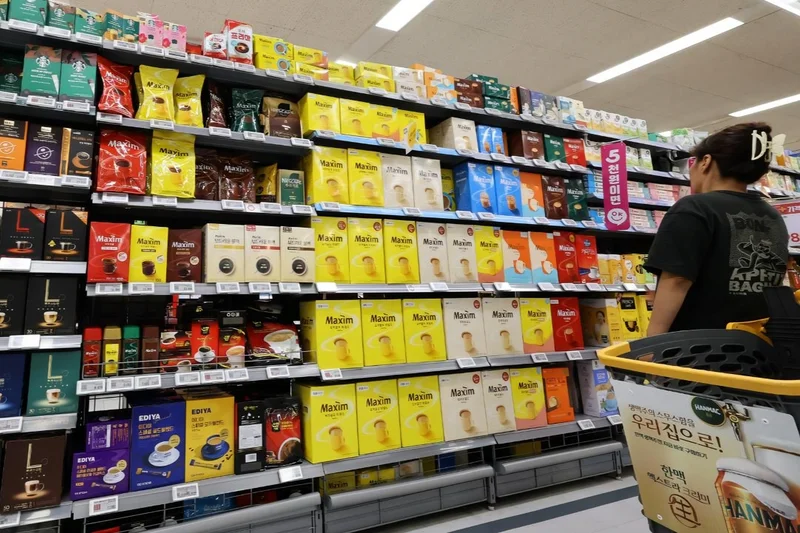
Diversifying demand for coffee drinks has broadened the consumer market in Korea and increased the country’s exports, according to the government, Tuesday.
The Ministry of Agriculture, Food and Rural Affairs said the country’s coffee consumption has expanded from instant coffee mixes to a wider variety of roasted coffee beans and specialty drinks made with them. Demand for budget coffee has also surged, indicating a “market polarization” between premium specialty coffees and more affordable options, the ministry said.
Citing data from the Ministry of Food and Drug Safety, the agriculture ministry said roasted coffee businesses in 2024 posted the highest sales across the country’s coffee industry, with over 1.3 trillion won ($917 million). The figure showed an average annual growth of 15.8 percent since 2018. Ready-to-drink coffee and instant coffee followed the market scale in the same year with 1.1 trillion won and 404 billion won, respectively.
Sales and exports of coffee mix products, however, began to see a decline in 2018. This shows the domestic coffee industry that previously pivoted on coffee mix consumption has shifted its weight on roasted coffee.
Global brands coming to Korea has contributed to the growth of Korea's coffee market. The government said foreign brands increasingly expanded to Korea before deciding to expand further to other East Asian markets. The authority said this indicates Korea has become a “key test bed” for global coffee firms to test their marketability.
Korea imported more than 200,000 tons of coffee beans worth $1.4 billion in 2024, up 5.8 percent from the previous year. Despite its reliance on imported coffee beans, the country’s coffee exports have continued to grow, according to the ministry. Coffee exports totaled $230 million in 2024, up 4.6 percent from a year earlier. Instant coffee products accounted for 98 percent of total exports, while exports of roasted coffee beans surged 46.8 percent year-on-year in May 2025.
Israel replaced China in importing most Korean coffee products in 2023 and retains the trade volume. Israel accounted for 18.1 percent of Korean exports, while China made up 15.4 percent, followed by Australia, the Philippines and Chile.
“Driven by diversified consumer preferences, the domestic coffee industry features a highly dynamic ecosystem, with both premium and value-for-money markets growing simultaneously," said Jung Kyung-suk, director general of the Food Industry Policy Bureau at the ministry.
In 2023, the number of coffee processing businesses fell for the first time, as it decreased by 8 percent to 1,660. However, the number of coffee shops dealing directly with consumers rose by 5.7 percent year-on-year to reach 106,452. The share of coffee shops within the entire food service industry also expanded from 9.3 percent in 2018 to 13.4 percent in 2023, meaning one in every seven food service establishments is a coffee shop.
The overall domestic coffee market in 2024 was valued at 3.7 trillion won, up 35.6 percent from 2018, showing an average annual growth of 5.2 percent.