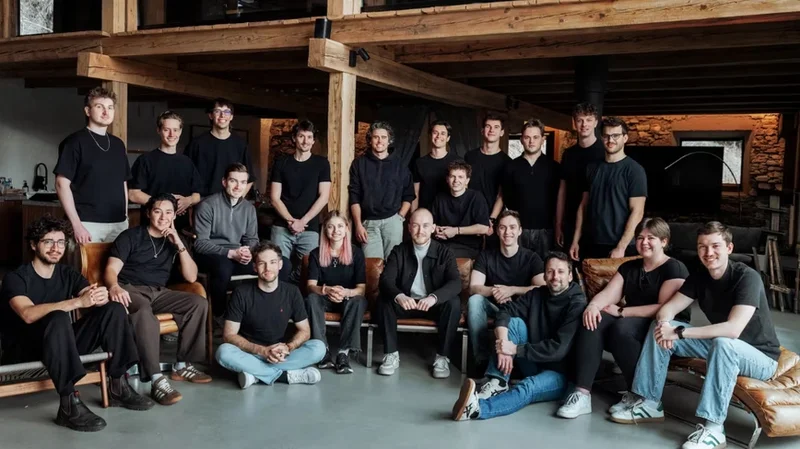
Vienna startup most of the tech world has not heard of just posted numbers that would turn heads anywhere. fonio.ai, a European platform for AI-powered customer calls, says it has surpassed $10m in annual recurring revenue in under twelve months.
Since February, when the company switched from a prepaid model to subscriptions, it says it has grown revenue by more than 30% a month, a compounding run that has carried it from a standing start into eight-figure territory.
What fonio.ai sells is automated conversation; its AI agents answer the phone, handle WhatsApp and will soon manage email and chat too, holding natural-sounding conversations for businesses that field high volumes of customer contact around the clock.
The scale is already substantial as the company says it serves more than 7,000 customers and runs several million calls through its platform every month, the kind of volume that turns a clever demo into a genuine operational tool.
In June, fonio.ai closed a $17M seed round led by Harry Stebbings’ 20VC at a $140m valuation, reportedly one of the largest seed rounds Austria has ever seen, only months after an earlier raise.
“We are building a global market leader, and we are building it out of Vienna,” says co-founder and chief executive Daniel Keinrath, who started the company in late 2024 with Matthias Gruber.
The pitch rests on owning more of the stack than rivals do. fonio.ai produces its own voices, which it says sound hyper-realistic and rank among the best available in many languages, rather than leaning entirely on the human-realistic voice tools that have become widely available to everyone.
It is also leaning into personalisation. Its agents are designed to learn from the calls they handle, and the platform can recognise returning callers to greet them by name or recall their details, a feature it says is GDPR-compliant and has to be switched on deliberately.
Customer-service lines are expensive to staff and notoriously hard to keep running around the clock, so an agent that answers instantly, in a caller’s own language and at any hour, targets one of the clearest cost centres a company has.
The company is not shy about where it thinks this goes. fonio.ai is targeting annual recurring revenue of €20m to €30m by the end of the year, which would more than double the milestone it is now celebrating.
Moreover, the company made its first hire only in June 2025 and already counts around 80 staff, with 17 joining last month alone, 52 roles open, and a target of 130 to 150 people by year-end across ten markets.
It has grown by acquisition as well as recruitment, having bought its Linz-based rival fluently last September, a sign that it intends to consolidate its home region rather than merely defend it.
The competition, though, is exactly the catch. Well-funded American rivals such as HappyRobot, fresh off a $150m round, are chasing the same enterprise buyers, and the model labs keep folding ever-better voices into their own products.
There are the usual caveats to a company-announced milestone, too. ARR is self-reported and unaudited, blistering monthly growth is far easier from a small base than a large one, and the hard questions of gross margin, churn and profitability sit outside a celebratory headline.
fonio.ai co-founder and chief executive Daniel Keinrath talked with us and gave some insights on the matter.
$10m ARR in twelve months is exceptional. How much of that is net-new customers versus expansion within existing accounts, and what is your net revenue retention?
Daniel Keinrath: We don’t want to share our exact revenue composition, but we can share that our current NRR is a little under 100%. The goal is to reach 110% until EOY.
Churn tends to be the quiet killer for AI companies that are growing fast. What are your logo and revenue churn rates, and how did the prepaid-to-subscription switch change them?
Daniel Keinrath: We can’t share our exact churn, but I can share that it helps a lot that we don’t have a free trial. We work with a hard paywall. Therefore the buy-in of our customers is quite high and we have a very solid churn-rate for an AI startup.
Your agents “learn from the conversations they hold.” What exactly are they learning, how do you stop them from learning the wrong things, and how can a customer audit that?
Daniel Keinrath: Our customers automatically get a list of proposals that should be added to the knowledge base. They can review it and accept / decline / improve the suggestions. In 95% of the cases our customers just accept the improvements of the knowledge base.
You talk about building a global market leader out of Vienna. Can a European voice-AI company really win globally, or will the US market eventually pull your centre of gravity across the Atlantic?
Daniel Keinrath: I think we currently have one of the best shots to win our market segment globally. We are based in Europe, but work with a US mindset and US intensity. Also, our 17m seed round would have also been in the top 1-2% of US seed rounds.
For fonio.ai, the challenge now is the one Daniel Keinrath named himself: turning a spectacular twelve months into a durable, global business.
Get the TNW newsletter
Get the most important tech news in your inbox each week.